

For centuries, Medea’s story has been twisted: cast as a villain or a victim, her truth buried beneath myths of revenge and foreignness. But beneath the myth, she’s a powerful archetype—one who challenges us to confront our own traumas, shadows, and the boundaries we fear to cross.
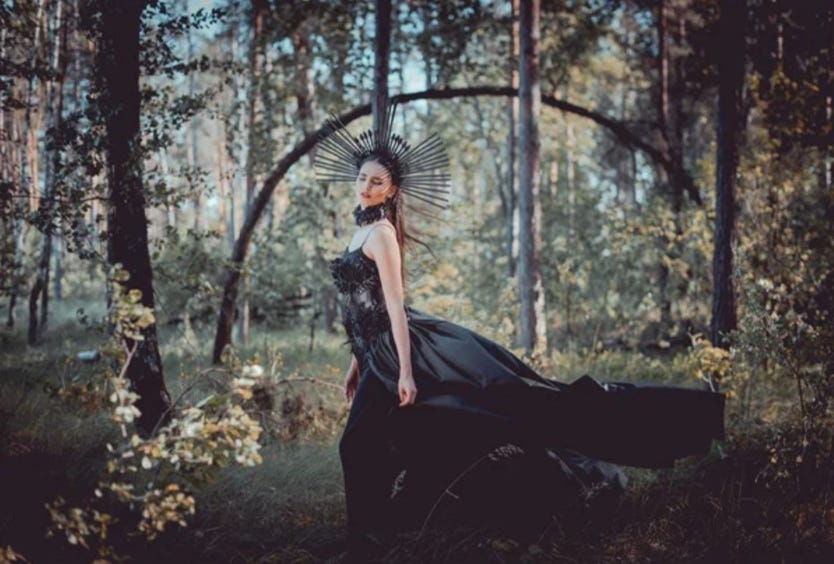
Deep into our own shadows, Medea calls us. To embrace the poison that heals. Find power after victimization. Stand sovereign and speak truth.
Christen and I explore the mythological and historical significance of Medea, her representation in ancient stories, and her relevance for modern shadow work and healing.
She’s the witch who transforms poison into medicine—reminding us that healing often comes from the deepest shadows.
Medea, that mythical sorceress whose magic built a king and then destroyed him. For over 2,000 years she has captivated our attention. Reviled by some for her unspeakable actions, understood by others as a woman robbed of any personal agency. Medea operated in the shadows, often crafting her spells in secret, and she can also be seen as being in the grips of the shadow self. Her longing for her prince, and perhaps power, possessed her above all.
Far from her pilloried mainstream image, Medea offers us the key of healing from our own tragedies, while guiding us towards personal triumphs. Christen and I go deep into Medea in this brand new recorded conversation.
There is so much to the mythological figure Medea, from her historical significance and the personal connections individuals have with her spirit. Beginning with the prologue from Entering Hekate’s Garden, which was written by Medea, we unlock her mysteries through an examination of how she is understand through story and art. Often misunderstood and vilified, Medea is portrayed as an archetype of the witch, embodying themes of female power, betrayal, and choice. The conversation highlights her duality as both a healer and a destructive force, influenced by her status as a foreigner. Through our experiences and reflections on empowerment, self-reflection, and the complexities of love, we encourage a deeper understanding of Medea beyond popular culture.
Medea: Regina Venificarum (Queen of Poisons)
Medea is the eternal witch. Her archetype is one of the woman feared by men so much that they transformed her into a creature to be vilified. This is not the truth of Medea.
As Hekate has risen, so has this eternal witch-daughter of hers. She meets us at the crossroads where she tells us the truth of her story. She tells us that time’s up for all those who have robbed us of our power, and forced their pain upon us. Medea is a powerful ally, a witch ancestor who guides her descendants along their earthly journey. Not for the timid or weak, Medea’s medicine is strong and fierce.
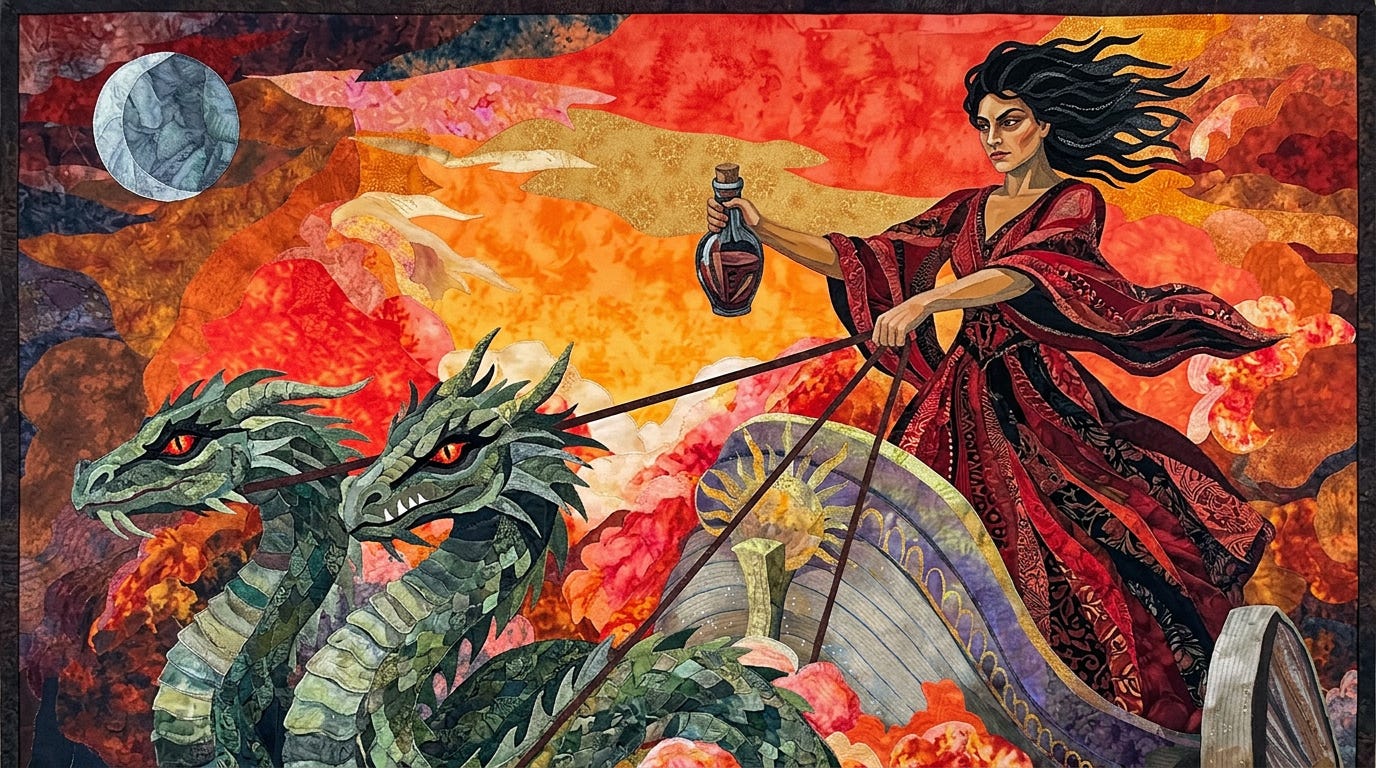
Inspired by a quilt by Marilyn Bedford. Medea, riding off in her dragon chariot. There are times when we need to do likewise.
Medea represents the principle of passion, the fiery emotional depths within us.
Medea has become a central force in my teaching. When I wrote Entering Hekate’s Garden, she insisted on speaking in the introduction. Here’s an excerpt:
“Our ways were not welcome by those who feared our power. In their hands we suffered greatly. Through their words, we were reviled. It is now time for you to remember the truth and cast aside their lies.
We are rising.
The men created their own gods, forever reminding Mother that she, too, must bear her burdens. These gods, made in the image of men, feared Mother. They sought to rob us of our rightful inheritance, that of the green world. Through their so-called civilization they defiled the natural ways.” - from the introduction to Entering Hekate’s Garden.
Historical Medea: The Briefest of Summaries
There is no way that I can do a thorough job of summarizing Medea’s story as it was told by the ancient Greek and Roman authors who were so fascinated with her. Most likely, her example of the dangerous woman was around long before Euripides scratched out his play. You ready? Here we go…
Medea was a princess/witch trained by her Aunt Kirke (Circe in Latin, I prefer the Greek just like I do for Hekate) who lived on an island where her dad was king. Her grandfather was Helios, the sun itself. She was a Priestess of Hekate, making her also a Daughter of the Moon (and the Under World). Jason (the Argonaut) showed up needing her help to get something he really, really wanted (a throne…which required a golden fleece). Medea killed her own brother to make it happen for that seductive warrior prince. Off they went to claim the throne, get married and live happily ever after.
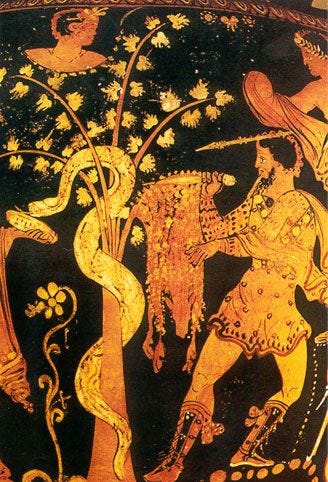
Jason getting his golden fleece.
Into The Cauldron
It didn’t work out that way. Does it ever? Medea used her powerful healing abilities to “rebirth” Jason’s dad in her cauldron (restore his health). She was persuaded to do the same for his uncle which ultimately led to the death of the king (Jason’s dad). That’s enough of a story right there to provide loads of symbolism and ways to work with Medea, but…wait…it’s only getting started.
Jason and Medea flee the scene. Through a whole bunch of complex events, Jason ends up wanting to ditch Medea (power hungry jerk that he is) for another woman. Medea, not being welcomed back on her home island (due to killing her brother) or in Greece (she is a foreigner), feels backed into a corner. The King of Athens happens to be in town. He offers to give her refuge if she can cure his sterility.
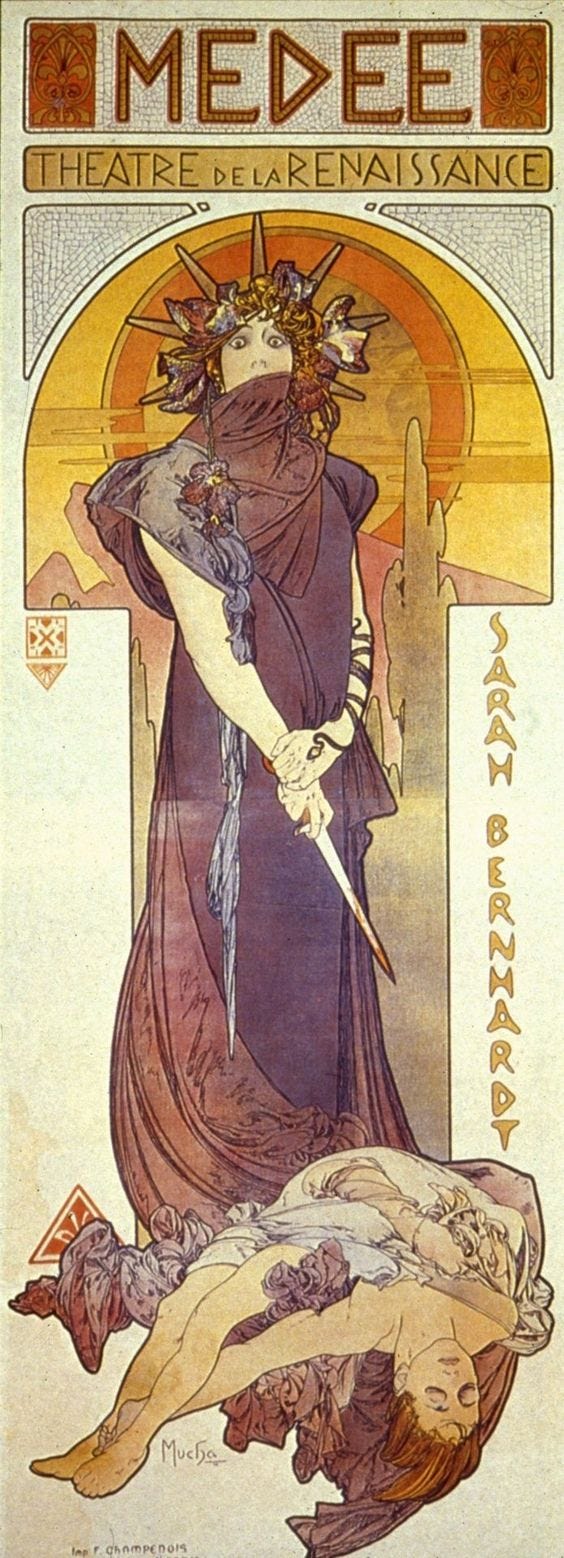
Medea by Alphonse Mucha (1898).
She Who Has Been Poisoned, Poisons Others
However, no one puts Medea in a corner. She goes on a murderous rampage, killing Jason’s trophy bride (and her dad also dies just for good measure), her sons and wrecking havoc. NOTE: she gave the replacement wife a poisonous crown and dress. She escapes the mess in one of her grandfather’s chariots pulled by either dragons or snakes depending on the translation. Oh, all of this was orchestrated by Hera who was pissed off at Jason’s uncle. Medea, in some versions, fled to Athens, married the king, and once again tried the poison thing (this time on the king’s son) which backfired. Whew! Now I shall take a nice, deep breath and then talk about ways we can work with Medea in our 21st century witchery.
Like with almost all the Greek myths and stories, there are different versions of Medea’s tale.
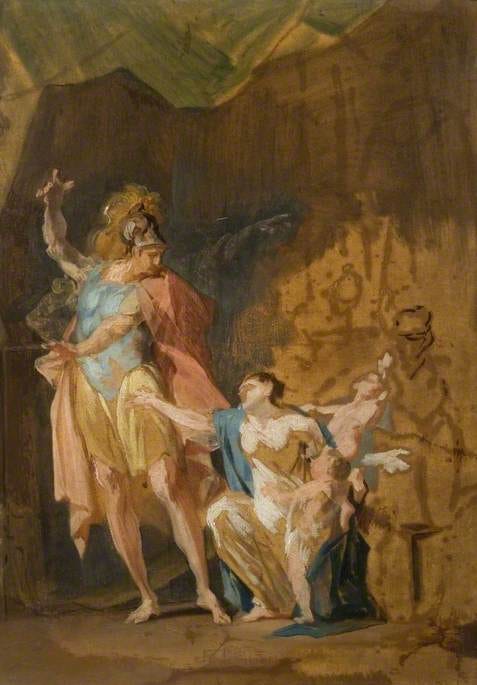
Giovanni Antonio Pellegrini - Jason Rejecting Medea (1711).
Medea: The Eternal Energy of Female Witch Power
Medea represents an energetic current: that of female witch power. My emphasis on the dangerous woman vibe is most definitely not a slur against those who don’t identify as female. Medea’s story can be both an inspiration and warning to everyone who uses the label “witch” (and even those who don’t). Medea is the mysterious and dangerous “other” that is both alluring and frightening. Moreover, she is the symbol of outlaw witches who refuse to play by the rules. Sadly, Medea succumbs to her wounds, resulting in her wicked ways. But, it’s entirely understandable. The question Medea poses is “what would you be willing to believe, to conceal, to do, to save your own skin, or simply to stay close to power? Who would you be willing to sacrifice?” (Margaret Atwood)
Speaking of her enduring lesson, Medea remains a very relevant figure in popular culture and academic study. You can find links below. She has been hailed as a feminist icon and a victim of the patriarchy. Is her story one of empowerment or victimhood? I think the answer is “both,” showing how complex a character Medea is. The powerful evil sovereign/victim witch queen theme is found in countless stories across time and cultures. Today, this archetype is most wonderfully, wickedly demonstrated by the character of Cersei in Game of Thrones.
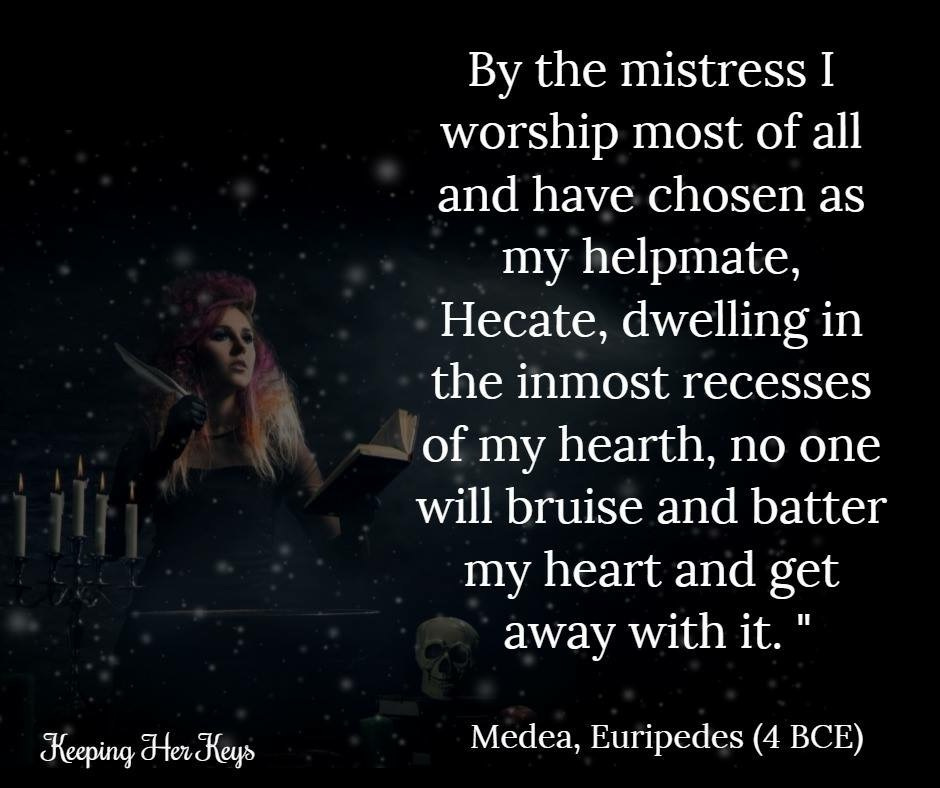
Themes With Medea
Not surprisingly, Medea as the Eternal Witch offers many themes for us to incorporate in our own witchery. Medea was a skilled herbal crafter, well trained by her Aunt Kirke, and she was a surrogate daughter to Hekate. One powerful witch, indeed. Like all witches, her magic was neither good nor bad. She used it for healing many times, including her rejuvenation spells.
Proceed with Caution
Medea is a very powerful witch, as is the eternal dangerous witch energy current that she represents. Medea and I have been tight for as long as I can remember. She’s not a force that will gently rub your back and say kind words. Medea will kick your ass, turn you upside down and, ultimately, help you become the witch you were born to be. However, go gently and respectfully towards her.
The Shadow Self
Like Medea, our shadow side shouldn’t be dismissed but understood with compassion. Through this approach, including acceptance of the past, we can move towards healing. If you are drawn to shadow work, petition Medea to help you integrate yours. The journey to wholeness is one of leaning into the mysteries of our shadow.
Healing
Medea was a herbalist first and foremost. While she is remembered for her specialty, poisons, she also did a lot of healing. Turn to Medea’s energy to empower your own skills as a herbalist, medical intuitive and healer. Her energy can be sought when learning new techniques or for following your intuition.
Rebirth
That cauldron of hers was a highly effective tool no matter how she used it. Claim your own rebirth through the witches’ cauldron. Take a ritual bath using non-toxic members of Hekate’s Garden, such as lavender. Envision being immersed in Medea’s Cauldron where she rebirths you into your true self, freeing you from your pain. Hekate awaits on the other side.
Passion
Feeling a bit “meh”? Tap into that eternal passionate energy of which Medea symbolizes so well. Put that red dress on and be dangerous (but in a safe way). Develop a passion spell seeking Medea’s help, but ask her for only what you can handle.
Honoring Witch Ancestors
Setting up a Witch Ancestor altar and developing a ritual honoring the ones who appeal most to you is a fantastic way to tap into the witch energy currents. I include mythic (like Medea) and actual (like Doreen Valiente) in my workings. Who am I to say what and who is real? They are very, very present in my life. That’s real enough for me.
Connecting With Medea
I often sing my incantations just like she did. I like to think that she hovers nearby, half-smiling at my lame rhyming skills.
Bless botanicals, especially poisons, in her name. Offer them to her and infuse them with her energy as appropriate. Aconite is her favorite (wolf’s bane, monkshood).
She can be associated with all of the plants in Hekate’s Garden, including popular ones today such as lavender, mugwort and sage. Less common but awesome examples are Dittany of Crete and saffron.
Connect with animal spirits that she is associated with, including the sacrificial ram, but also owls and snakes. Dragons are her companion. Call upon them to drag you out of the Under World and stand in your own power. Crows as a contemporary symbol of witches are also suitable.
She can be petitioned and honored at initiation rites.
Epithets/Roles/Characteristics: Initiator, Herbalist, Wise One, Priestess of Hekate, Witch, Princess, etc.
Elements: south (fire), west (water).
Worlds/Selves: Under World/Emotions/Lower Self; Middle World/Actions/Middle Self; Upper World/Intellect/Higher Self. She covers all three, in the same way that Hekate does.
Colors: red, yellow, black
Moon and Sun (she also has an asteroid)
Symbols: crown, leaf, cauldron
Days: Sunday, Monday and perhaps Saturday since aconite is associated with Saturn (also with Hekate).
Witch style: anyone who weaves poison into a crown and dress is a style icon to be honored and called upon accordingly.
Listen to this on the Keeping Her Keys Podcast on all major platforms.
In “Entering Hekate’s Garden,” Medea plays a central role as the Queen of Poisons. You can find this book in different formats, along with Keeping Her Keys, from major online booksellers. I also discuss Medea in “Entering Hekate’s Cauldron.”
Learn more at The Covina Institute.
Beautiful and inspiring read and watch. Thank you both 💜 Will grab my books and read/learn as much as possible about Medea and how to approach her. Have enough roaming inside of me that I have to face and resolve, so I can become whole again.
Love & light Karin ✨️💜✨️
Cyndi you are a very beautiful blonde.