

Hekate of the Dark Moon, Renowned Triple Queen.
I stand at the threshold where three worlds converge,
Bearing offerings made with devotion and love.
Hekate Chthonia, transform what I release into power,
Hekate Enodia, illuminate my path with your twin torches,
Hekate Noeros, awaken divine wisdom within my soul.
I am renewed, I am refocused, I am radiant.
Accept these gifts as tokens of my sincere devotion,
Guide me through the shadows and into the light.
Hail Hekate Triformis, Goddess of All Realms.
Hail the Sacred Deipnon and the mysteries you reveal.
Link below to join the class at 11 AM ET on June 13, 2026.
Hekate is an ancient goddess whose worship dates back over 2,000 years to the Mediterranean world. She is a liminal deity—a goddess of thresholds, crossroads, and the spaces between worlds. Known by many names and epithets, Hekate has been honored as torchbearer, key-keeper, guide of souls, protector of the vulnerable, and queen of witches. Her domain encompasses the Upper World of divine consciousness, the Middle World of earthly existence, and the Lower World of the ancestors and mysteries.
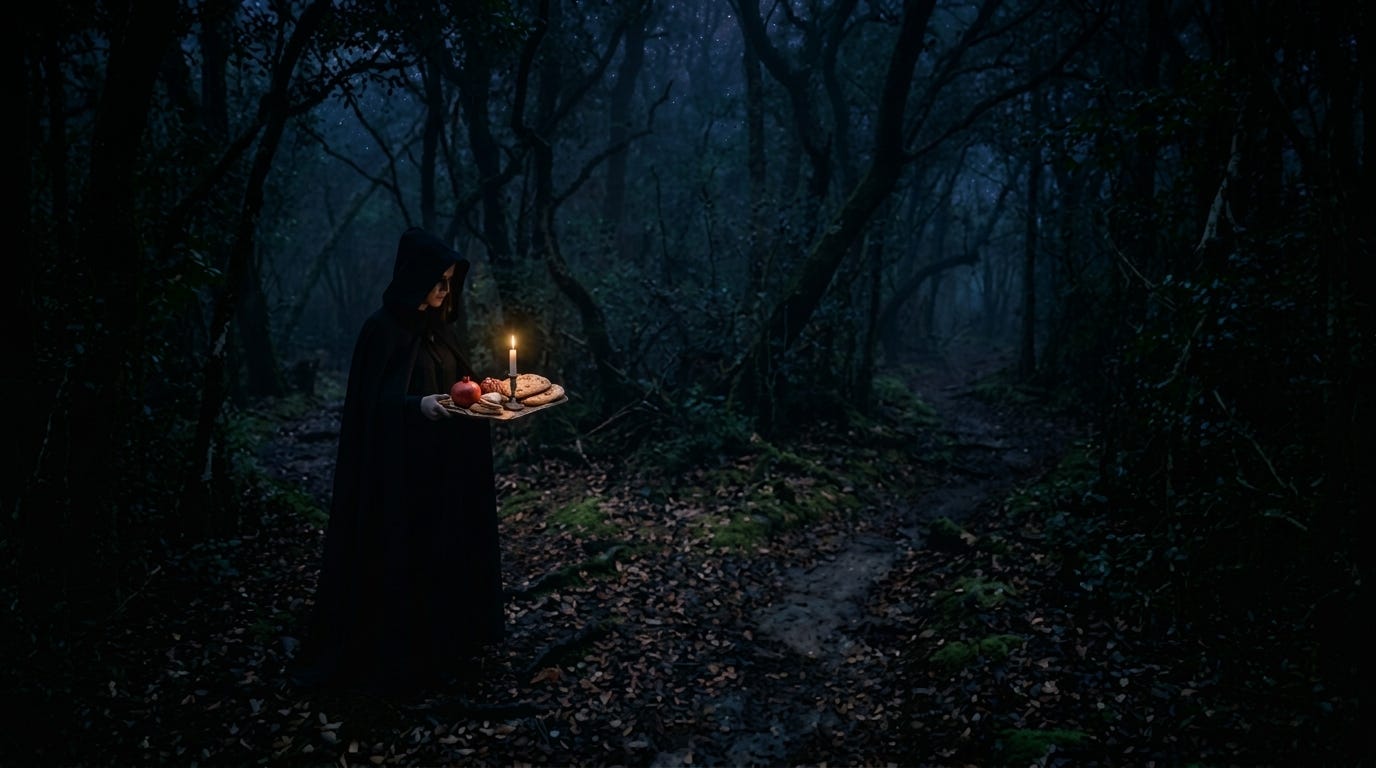
Unlike many deities who were honored in grand temples, Hekate was uniquely propitiated at crossroads—those liminal spaces where paths converge and choices must be made. This reflects her essential nature as one who dwells in the in-between, who guides us through transitions, and who illuminates the darkness with her twin torches.
To the ancient Greeks and Romans, Hekate was a powerful force—both protective and potentially dangerous if not properly honored. She was associated with magic, herbalism, necromancy, and the mysteries of life, death, and rebirth. Her sacred animals include dogs, serpents, and horses. Her sacred plants include garlic, yew, cypress, and many others. She is often depicted as a triple-formed goddess, though this is just one of her many aspects.
Today, modern practitioners honor Hekate as a goddess of personal sovereignty, transformation, and witchcraft. She calls to those who walk the crooked path—those who embrace shadow work, seek hidden wisdom, and are willing to face their fears in pursuit of truth and power. She is a fierce protector of the marginalized and vulnerable, and she demands authenticity and courage from her devotees.
What Does It Mean to Honor Hekate?
Honoring Hekate is a deeply personal practice that goes far beyond ritual gestures. At its core, honoring Hekate means honoring yourself—your truth, your sovereignty, your journey. The Anima Mundi (World Soul) that fuels your essence is of Hekate. When you live authentically, when you reclaim your power, when you walk your path with courage and integrity, you honor her.
Honoring Hekate can take many forms:
Devotional Practice: Regular rituals, prayers, meditations, and offerings that express your relationship with the goddess
Service: Supporting the vulnerable in your community—the unhoused, at-risk animals (especially dogs), children, women, and those rejected by mainstream society
Personal Sovereignty: Doing the inner work to reclaim your power, set healthy boundaries, and live your truth
Study and Learning: Deepening your understanding of Hekate through historical research, personal gnosis, and experiential practice
Shadow Work: Facing your fears, healing your wounds, and integrating all aspects of yourself
Witchcraft: Practicing magic, herbalism, divination, and other occult arts under her guidance
The practice of honoring Hekate on the Dark Moon—the astronomical new moon when the moon is not visible in the sky—is one of the most ancient and enduring traditions associated with this goddess. This monthly observance, known in ancient times as the Deipnon (meaning “supper”), provides a regular rhythm for connecting with Hekate, purifying yourself and your space, and renewing your commitment to your path.
Whether you create an elaborate feast inspired by ancient practices or simply light a candle and speak words of devotion, what matters most is the sincerity of your offering. Hekate sees into the heart of things. She values authenticity over perfection, courage over comfort, and genuine devotion over empty gestures.
Ancient Origins of Honoring Hekate on the Dark Moon
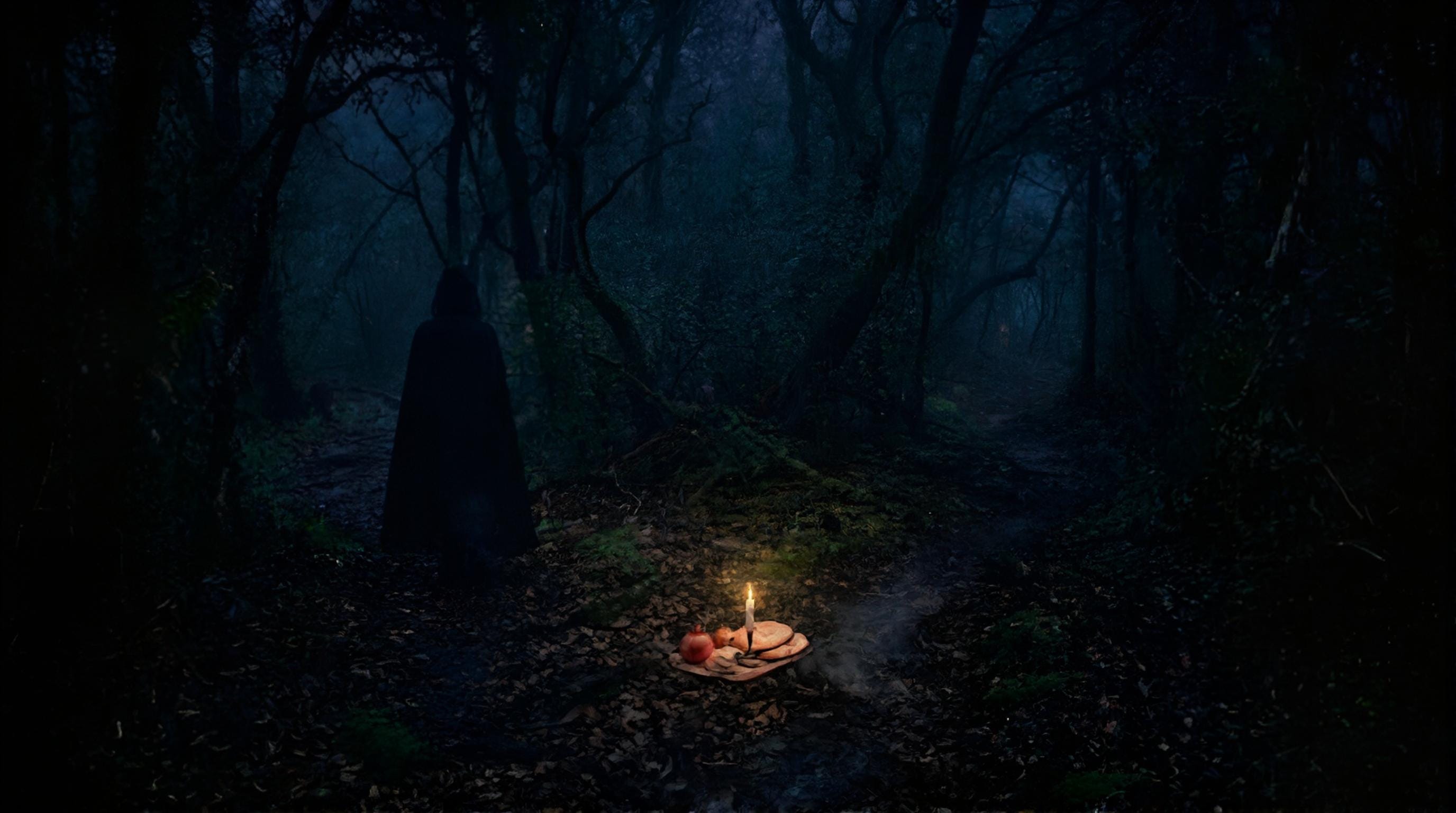
In areas of the ancient Mediterranean, food was left at crossroads for Hekate on the Dark Moon to honor her and petition her for protection and guidance. This ritual dates back over 2,000 years and was called Hekate’s Deipnon. The term Deipnon translates to “supper,” but there was much more to this ritual than just making food offerings.
The ritual began with the purification of the home and its occupants, with a sacrificial animal (usually a black puppy) playing a central role in the process. Although animal sacrifice was common in ancient times, using black puppies was unique to Hekatean rites. As upsetting as this sounds today, it was culturally normative back then. Through this “scape puppy,” the toxic energies of the home and its occupants, which they called miasma, were transferred to the dog and then released through the sacrifice. A kinder version of the sacrifice can be accomplished through cleansing with eggs. Although it is unknown whether those engaging in ancient Hekate’s suppers used this method, some scholars believe they may have.
When the purification was complete, the house was well cleaned and swept, and all residue from the sacrifice and the sweeping (known as oxuthumia) was removed and set aside for later disposal.
After the home was cleansed, an elaborate meal was prepared. It typically included eggs, fish, cheese, bread, garlic, vegetables, fruit, cakes, and probably nuts. If you are called to recreate an ancient Hekate’s supper as accurately as possible, the eggs should be raw, the fish should be mullet and sprat, the cheese should be freshly made, and the cake should be a sort of cheesecake upon which, according to some references, a candle burns. The ancient Greeks didn’t have wax candles, however, so they used pine resin. The bread component of the feast probably resembled flatbreads or a type of savory pancakes, known as tiganites, that were common in ancient Greece. Fruits that were common 2,000 years ago include grapes and dates.
The completed meal and the ritual waste would then be taken to a crossroads. The whole point of the ritual was to gain Hekate’s favor and to protect against unsavory spirits and negative energies. Given that it would have been known to those undertaking this ritual that the feast would likely be consumed by outcasts, we can be inspired to make offerings to the vulnerable in our own society through charitable acts and donations. Supporting at-risk dogs, the unhoused, children, women, and those rejected by the mainstream are all in keeping with the spirit of this ancient meal. While our cultural norms may be different, the theme of propitiating Hekate through both personal veneration and service to others is a tradition we can continue.
Preparing to Honor Hekate on the Dark Moon
Whether you are planning to create a Hekate’s supper inspired by this ancient ritual or scheduling a few moments of quiet veneration, make honoring Hekate on the Dark Moon a priority. Your veneration can be as simple as making an offering to the goddess while petitioning her for guidance and protection. Use this invocation or create one yourself:
Great Hekate. Mysterious Moon. Stars above. Earth surrounds. Water below. Guide me along my way. Protect my journey, And bless my path. These offerings are reflections of my devotion.
Many witches, including myself, have “Hekate trees,” either on their own property or nearby, where they journey each month on the Dark Moon to honor the goddess. However you choose to honor Hekate at this time, I do recommend some preparation. Begin by creating a plan to guide you throughout your rite. Here are some items to consider as you plan:
Timing: Plan your ritual for a time when you will have no distractions. The Dark Moon is the astronomical new moon—the precise moment when the moon is not visible in the sky. There is a distinction between the Dark Moon and what the ancients called Noumenia, which means “new moon.” Noumenia was the spiritual start of a new lunar month—the earliest waxing crescent phase of the moon when it first becomes visible again. To the ancients, the day began at sundown rather than sunrise, contrary to the system we’re used to. We are now able to calculate the precise timing of each astronomical new moon, even if the moon is not physically visible. If the astronomical new moon occurs after sundown, perform your rituals before the next sundown.
Location: Whether you are embarking on a pilgrimage to a real crossroads or visiting a symbolic crossroads on your own property or honoring the goddess at a crossroads altar on the floor in your room, select a location that works best for you and make sure that it is a safe space. There are bears and wildcats where I live, as well as other troublesome night creatures, like the restless dead and porcupines. I make a lot of noise when I venture out during the Dark Moon, and I erect energetic shields around my location to protect myself from unwelcome intruders. A counterclockwise circular movement with my left arm, repeated in groups of three, while reciting “I am protected from all harm, and I do no harm,” is a habitual practice for when I am out in the wild. Salt sprinkled in a counterclockwise circle on the ground is good for this kind of protection.
Moon sign: The astrological sign in which the new moon will occur can help you determine the type of energy to highlight during your ritual. Give special attention to the sign as it relates to your personal astrology. I put the qualities of each sign of the zodiac in conjunction with the new moon in Chapter 5 of Entering Hekate’s Cauldron.
Focus: Consider whether there is a particular aspect of Hekate that you want to express.
Intention: Write a short statement establishing your focus for the ritual.
Daily practice: Use your practice to enhance your plans and to attune to the focus of your ritual.
Offerings: These can be either personal or traditional, as long as they are meaningfully linked to your focus.
Altar: Create an altar connected to your focus that includes crossroads energy, using physical symbols, botanicals, soil retrieved from an actual intersection, images, and any items that evoke the energy of crossroads for you—for instance, two crossed keys.
Cauldron: Attune your cauldron to the focus of your ritual; perhaps even have a special one in which to place your offerings.
Sacred flame: Have a candle, a backyard fire, or a fire in your fireplace—anything suitable to ignite as a sacred flame at the beginning of the ritual process.
Cleansing: Perform purification rituals appropriate to your practice, and plan a good general cleaning of your home. Khernips is an excellent purification ritual, as is the lustral egg ritual I describe in Chapter 5 of Entering Hekate’s Cauldron.
Animara: This term, which derives from the word “soul,” refers to rituals, meditations, written words, and other practices that awaken us to the mysteries and take us beyond our physical selves.
Make sure to record any dreams, synchronicities, encounters, visions, and other messages you may receive while you are planning your ritual and also during and after it.
PAID SUBSCRIBERS - Live Witches Hour: Honoring Hekate on the Dark Moon (Saturday, June 13)
Session Introduction
Khernips Purification Ritual
Ritual: Triformis of the Crossroads
Invocation: Honoring Hekate on the Dark Moon
Meditation: Honoring Hekate on the Dark Moon Journey
Oracle Reading: Hekate’s Wisdom Dark Moon Reading
Talk: Dark Moon Pilgrimage, Crossroads Energy, and Purification Practices
