

Hekate, your fire is the vital fuel of the universe,
The key of the mysteries, the sovereign eye of the divine.
The central spark that is the primordial source.
Pyros Anthos, you are the molten geometry of unification;
May I dwell forever within the noetic petals of your radiant bloom.
Hieros Pyr, Sacred Flame undulating through all creation,
I call upon your active current to awaken the ember within.
Lampadios, Bearer of the Torch,
I honor the focused light that pierces absolute darkness.
Hekate Pyriboulos, Burning Wisdom Bringer,
I heed the watchful gaze of your guidance in the shadows.
Hekate Pyripnoa, Cosmic Breath of Fire,
I respire your power and channel it through my own voice.
I honor the shifting cycles of creation and destruction,
Where transcendence is forged in the crucible of your flame,
Where illumination burns away the soot of illusion,
And the living torrent shapes the architecture of my soul.
Hekate, be with me in the fullness of your fire,
As I walk the crooked path of flame and spirit.
Those torches. They light the way through darkness. Yet, they can also burn us if we ignore her signs, are out of alignment with ourselves, and ignore the fact that SHE is the absolute sacred fire (Hieros Pyr).
Welcome to the realm of Hekatean fire - the domain where all transformation is born. This is the fierce, active radiance where consciousness expands, where truth is revealed, and where the mysteries burn away all that is false. Here in Hekate’s burning heart, we encounter Hekate in her most illuminating aspects, and we discover that the greatest mystery is the ember burning within us. I liken this fire to the central blooming spark contained within the strophalos, often symbolized as her twin blazing torches, her divine radiance, and the eternal light in the darkness.
A recent mishap reminded me of the power of Hekate’s fire. Unfortunately, someone - not me - was burned by a candle. This witch identified the misfortune as a sign from Hekate about a personal conflict she’d been ignoring. Fire safety is important, witches. Put out those candles, keep them safe, but also pay attention to them. Hekate speaks through our candles. While a flicker or a pattern of wax can transmit her wisdom, we need to be open to receiving the transmission. When we ignore her communications, she may turn up the heat. I’ve been burned myself a few times. There’s medicine in the flames. When we seek connection to Hekate, we are awakening that fire. It’s within us, but it’s also a primordial force far greater than we know.
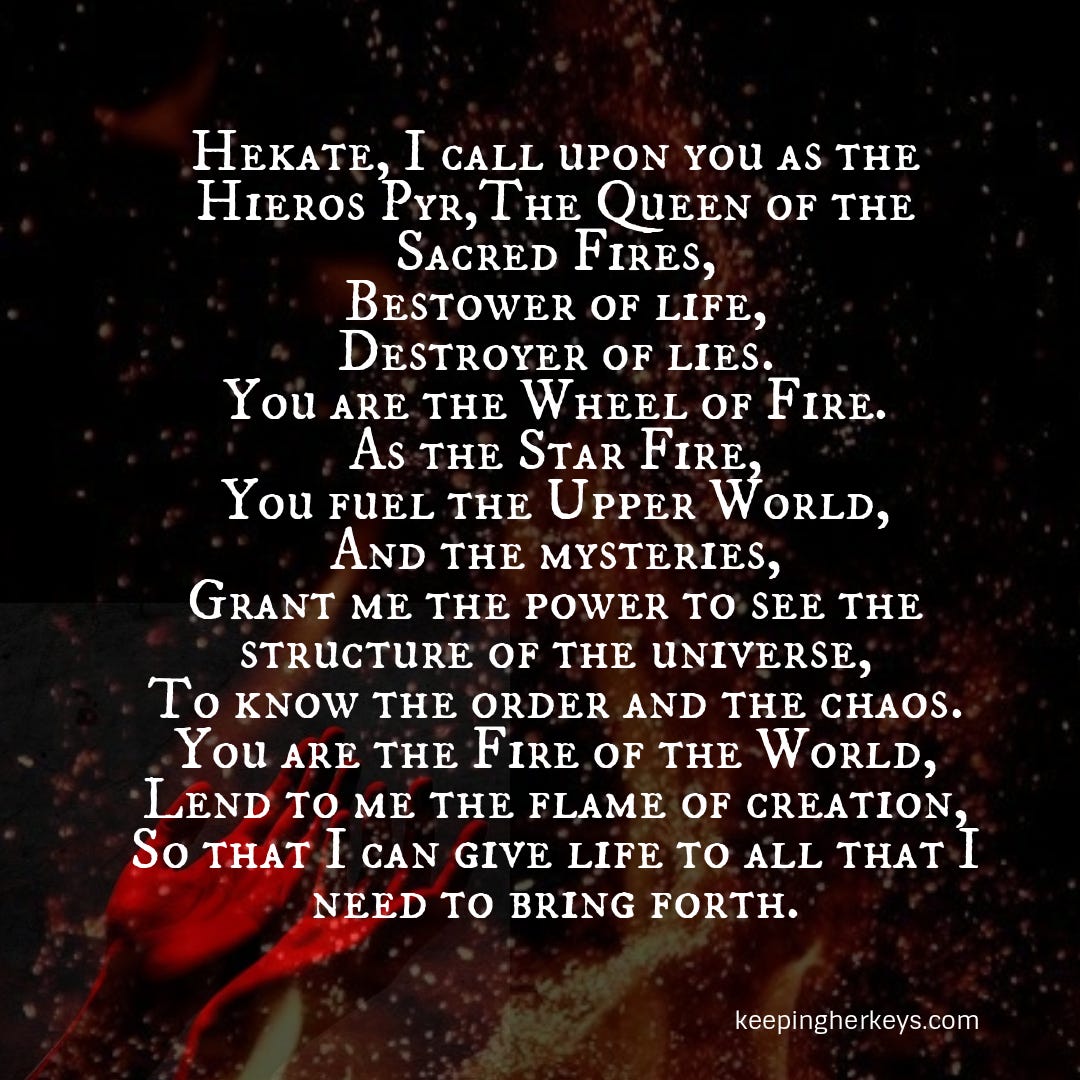
This verse was inspired by this passage from the mystical text known as The Chaldean Oracles, where Hekate’s fires extend far beyond those iconic torches:
“… from there, a lightning-bolt, sweeping along, obscures the flower of fire as it leaps into the hollows of the worlds. For from there, all things begin to extend wonderful rays down below. (The Chaldean Oracles, Fragment 34)
We call upon this power. It is unharnessed, uncontrollable and utterly divine. Our simple candles, through words and intention, and sometimes Hekate’s intervention, become the portal of this raw essence.
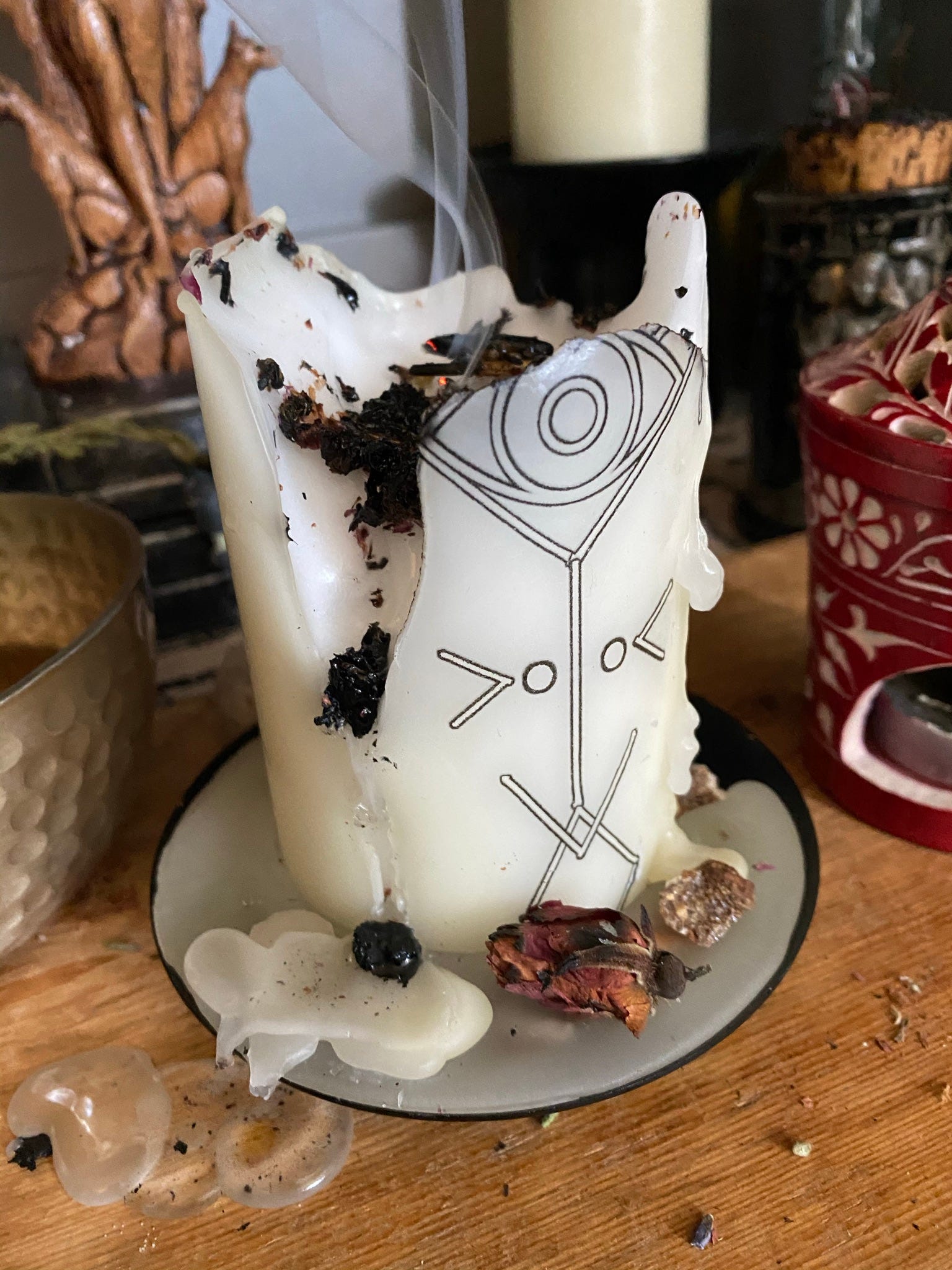
This candle exploded during a Soul Retrieval Ritual in the coven that was particularly powerful. You can find the Soul Retrieval Ritual in Entering Hekate’s Cave: The Journey Through Darkness to Wholeness by Cyndi Brannen. For the live experience coming up on Imbolc, become a student in The Via Hekate.
The plaid I’m wearing in the video at the beginning of this article actually did catch on fire once. I am not advocating for being irresponsible with candles and fire. I am saying that sometimes the fire has its own mission. In my experience, it is a sort of “medicine in the poison,” like I wrote about in Entering Hekate’s Garden.
This freaked me out. Naturally, we should be freaked out when candles get aggressive. Yet, afterwards, I explored what that incidence was beyond a hyperactive candle. I was at a crossroads. There was something I was avoiding. To me, that was a transmission of Hekate. There’s no other explanation.
Hekate and The Torch: The Light in Darkness
“In ancient rituals, spells, and tales, Hekate is seen as lighting the way with Her blazing torches. Perhaps the most commonly known is The Homeric Hymn to Demeter where Hekate’s torches light Persephone’s way to and from the Under World. Images of Hekate holding Her torches can be found in ancient representations of Her, including magical coins. My personal perception of Hekate tends to see Her as holding one lamp, rather than any number of torches. It doesn’t matter what type of fire She uses to light our way. There are several ancient references to Hekate as Lampadios (lamp-bearer), including the example I quoted earlier.” - from Keeping Her Keys: An Introduction to Hekate’s Modern Witchcraft (second edition).
The torch is Hekate’s signature symbol, it is her fiery flower intersected with the personal journey. The torch represents her role as guide, as the one who goes before us into unknown territory, lighting the way.
Lamp-bearer, shining and aglow, Selene, Star-coursing, heavenly, torchbearer, fire-breather ... (IV, 2557). [Note: In the PGM, Hekate is syncretized with other goddesses including Selene.]
In the ancient world, torches were essential for navigating at night, particularly in cities without street lighting. To carry a torch was to claim agency in the darkness, to refuse to be paralyzed by fear of the unknown. Hekate, as torch-bearer, embodies this courage—she does not banish the darkness but rather illuminates it, showing us that we can move through shadow without being consumed by it. Linked with the moon as they share the power to illuminate darkness, both torch and moon are linked to the feminine mysteries, while carrying the potent assertiveness of the masculine.
The torch also represents the fire of consciousness itself; the light of awareness that allows us to see clearly, to distinguish truth from illusion, to navigate complex situations with wisdom. When we call upon Hekate as Lampadios or Pyrphoros, we’re asking her to illuminate our path, to help us see what we need to see, to guide us through transitions and thresholds.
Many of Hekate’s epithets emphasize her torch-bearing nature: Dadophoros (Torch-Bearer), Lampadios (Torch-Bearer), Pyrphoros (Fire-Bearer). These names remind us that Hekate doesn’t just possess fire - she carries it, she moves with it, she uses it to guide and protect. The torch is active, dynamic, purposeful - just as our work with Hekate’s fiery aspects should be.
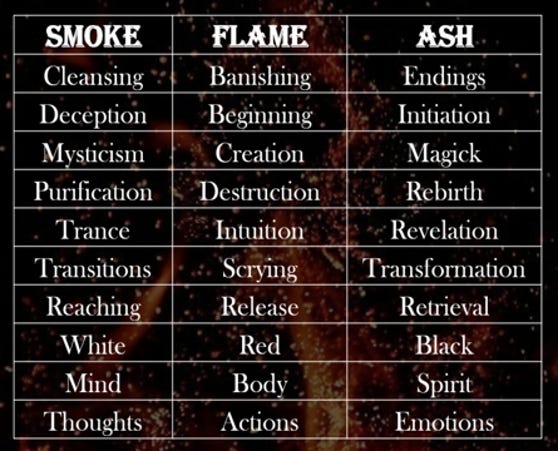
Fire, while the active flame is what I’ve discussed here, has the forms of smoke and ash as well. Here are some themes for working with these configurations of Hekate’s sacred flame in all it’s forms.
Hekate and Fire: Cycles and Transformation
Hekate’s connection to fire is profound and complex. While she carries torches to illuminate the darkness, she is also associated with the transformative fire that purifies, the sacred flame that connects mortals to the divine, and the consuming fire that destroys what must be released.
Fire represents transformation in its most fundamental form. Unlike water, which dissolves and carries away, fire transforms through consumption; it breaks down matter into its essential components, releasing energy and leaving only ash. This is the nature of spiritual transformation as well: we must allow what no longer serves to be consumed, to be broken down, to be released as energy that can fuel our growth.
The candles we light for spellwork, the botanicals burnt for offerings, the fires tended in ritual; all of these are expressions of Hekate’s fiery nature. But fire also governs the internal processes of transformation: the burning away of limiting beliefs, the purification of intention, the forging of will into focused power.
The fire also represents the cycles of creation and destruction that are necessary for growth. Just as a forest fire clears away dead wood and allows new growth to emerge, spiritual fire clears away what is stagnant or toxic, creating space for new possibilities. Hekate, as a goddess of transformation, guides us through these necessary destructions, helping us understand that what burns away was meant to go, and that what remains is stronger for having been tested by fire.
Ancient Roots, Flames and Cycles of Hekate’s Fiery Nature
Hekate’s connection to fire is ancient and multifaceted. I believe the ancients knew the power of her flame, perhaps they, too, had been literally burned by it. While she is often associated with the darkness and the underworld, her role as torch-bearer is equally fundamental to her nature. The torch is perhaps her most recognizable symbol, appearing in ancient art, literature, and ritual practice throughout the Greco-Roman world. In ancient depictions, Hekate is frequently shown holding torches—sometimes one, sometimes two, illuminating the darkness and guiding travelers through dangerous passages. These torches represent her role as Lampadios (Torch-Bearer), the one who illuminates what is hidden, who guides souls through transitions, who reveals truth in the darkness.
Hekate’s fiery nature is also deeply connected to transformation and purification. Fire is the element that changes everything it touches; it transforms solid matter into ash, releases energy as light and heat, and purifies through its consuming power. In ancient purification rituals, fire was used alongside water to cleanse people and spaces of miasma (spiritual pollution). The khernips ritual itself involves the union of fire and water, creating a purifying agent through the marriage of opposites.
Throughout ancient Greek religion, fire was understood as the element that connected mortals to the divine. Sacrificial offerings were burned so their smoke could rise to the gods. The sacred flame in temples was kept perpetually burning as a sign of divine presence. Fire was the medium through which prayers ascended and through which divine will descended.
Hekate in the Greek Magical Papyri: Fire and Transformation
The Greek Magical Papyri (PGM) contain numerous references to Hekate’s fiery nature. She is invoked with epithets that emphasize her connection to fire, light, and transformation. The practitioners who wrote these spells understood Hekate as a goddess who could work through fire to reveal hidden knowledge, to transform consciousness, and to purify and empower. In our previous explorations of Hekate’s depths, focusing on her lunar aspects, we studied the Hymn to the Waning Moon (PGM IV. 2241-2358). Scholars believe that, in many instances, her “holy beams” and such carry a three-fold meaning: 1. divine eminence, 2. symbolized in the moon, and 3. her fire. The similarity between the moon and her torches in the ancient world made practical sense in a world devoid of electricity - both illuminated the darkness. The Hymn to the Waning Moon conveys this multilayered meaning in several passages. In addition, near the end it provides a litany of fire epithets:
Mare, Kore, dragoness (Drakaina), lamp (Lampadios) lightning (Photoplex), flash (Phaenno), star (Astrodia), lion, she-wolf
I know your good and great majestic names,
Which illuminate the heavens.
The Earth drinks dew and is pregnant;
The universe increases and declines.
Reveal and remove those things which stand in the way of my destiny so that my way shall be clear.
Many of the epithets in the table at the end of this guidebook come from the PGM. These are not gentle, passive titles; they are fierce, powerful, transformative names that reflect Hekate’s true nature as a goddess of sacred fire. Names like Pyrphoros (Torch-Bearer), Pyripnoa (Fire-Breather), and Hieros Pyr (Holy Fire) remind us that Hekate’s power includes the flame, the heat, the transformative force that burns away what no longer serves.
The PGM spells often call upon Hekate’s ability to work with fire for divination—particularly through fire scrying, where practitioners would gaze into flames to receive visions and messages. This reflects the understanding that fire is not just destructive but revelatory, that flames can show us what is hidden, that the dance of fire contains wisdom for those who know how to read it.
As you learned in your study of Hekate’s history, the connection between her fiery aspects and the practice of witchcraft runs deep. Fire is the element of will, of transformation, of the power to change reality through focused intention. When we craft spells today, we’re working with this same fiery current—using the heat of our desire, the light of our vision, the transformative power of our will to shape outcomes and create change.
Hekate in The Chaldean Oracles: The Fiery Flower of Creation (Pyros Anthos)
I’ve already mentioned The Chaldean Oracles, a collection of mystical texts from the 2nd century CE, present one of the most profound and cosmologically significant portrayals of Hekate in ancient literature. Here, She is not merely a goddess of crossroads or underworld passages, but a cosmic force - the mediating principle between the transcendent divine and the material world, the sacred fire that flows through all levels of existence. Without Hekate’s mediating presence, the divine fire could not descend into matter; without Her, spirit and flesh could never meet.
Pyros Anthos: The Fiery Flower
Most significantly for our work with Her fiery aspects, The Chaldean Oracles call Hekate the celebrated “flower of fire” (pyros anthos, πυρὸς ἄνθος) in multiple fragments. This epithet captures Her essential nature: She is the bloom of divine fire, the flowering forth of sacred flame into form. Like a rose that emerges from seed, unfolds its petals, and releases its fragrance, Hekate is the unfolding of the Father’s creative fire into the multiplicity of existence. She is both the process and the product of divine manifestation; the fire that creates and the creation that burns with fire. In the modern strophalos, it is the six rayed figure at the center, both flower and star.
For Implacable Thunders leap from him and the lightning-receiving womb of the shining ray of Hecate, who is generated from the Father. From him leap the girdling flower of fire and the powerful breath (situated) beyond the fiery poles. (Fragment 35)
The image of the “fiery flower” is particularly potent because it unites opposites: fire (masculine, active, ascending) with flower (feminine, receptive, blooming). Hekate as fiery flower embodies the sacred marriage of these principles as the active force of creation and the receptive vessel that gives it form. She is the flame that rises and the blossom that opens. This paradox is central to understanding Her role in the Chaldean cosmology: She is simultaneously the fire that descends from the heights and the force that draws creation upward toward its divine source. Support for the power of the Pyros Anthos is found in Aeschylus’s famous play Prometheus Bound, when Prometheus steals fire from the gods to give to humanity, the exact phrase used in the original Greek text is “anthos pyros” (ἄνθος πυρός) - the “blossom of fire.” Thus, the power of the “fiery flower,” is truly the fit of life.
For practitioners of Modern Hekatean Witchcraft, the Chaldean understanding of Hekate offers profound insight into Her fiery nature. When we work with Her as Hieros Pyr (Holy Fire), we are not just working with an elemental force - we are connecting with the very principle of divine creativity, the sacred fire that brings all things into being. When we invoke Her as Pyriphoitai (Fire-Sending), we are calling upon the cosmic force that mediates between spirit and matter, that makes manifestation possible, that flowers forth from the divine source into the multiplicity of creation. That can illuminate us, ignite our own spark, and, yes, burn us.
From Cosmic Flame to Soul Spark: The Evolution of Her Fiery Spirit
Exploring the ultimate mystery of Hekate as the animating force of the universe (Anima Mundi), I traced the linguistic and conceptual trail that leads from the deep cosmic architecture of the Chaldean Oracles straight into the practical sorcery of the Greek Magical Papyri (PGM). In the fragments of Chaldean philosophy, this is not a chaotic wildfire, but a highly organized, geometric state of divine being. The Pyros Anthos represents the precise boundary membrane where the blinding, unmanifest power of pure spirit passes through Hekate’s cosmic heart and refracts outward like blossoming petals. It is the reproductive organ of divinity, scattering conscious, living sparks of light to weave the very fabric of the World Soul (Anima Mundi). Through the Pyros Anthos, we learn that Hekate’s fiery spirit is an organic, unfolding blueprint designed to bring structure, beauty, and life to the formless void. And, yes, it is alive on our altars, it breathes through our candles, it stirs in our souls.
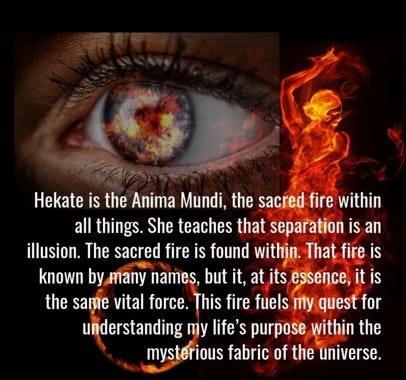
The Light in The Darkness: My Love for Erigeneia
I believe the ancient practitioners glimpsed the fiery flower, and the multivalent nature it emanated. In the sprawling manuscript of the PGM, specifically within the Prayer before the Moon for Any Purpose (PGM IV. 2785–2890); the high-philosophical fire of the Chaldeans assumes a deeply poetic and transitional persona. Amidst titles celebrating Hekate’s command over the night and the stars, the scribe addresses the goddess as Erigeneia (ἠριγένεια), meaning “Early-Born” or “Daughter of the Dawn.” By stepping onto the cosmic horizon as Erigeneia, Hekate bridges the worlds. She is no longer only the dark guardian holding a torch in the silent subterranean caves of the Underworld; she has become the literal horizon line where the underworld fire rises to meet the heavens, transforming darkness into the first flush of an impending spiritual awakening. If you’ve been in one of our High Rituals, you may know that “Erigeneia,” is part of my sacred name, so I wanted to share a bit about the deeper meaning of this epithet.
Personally, I’ve always envisioned Pyros Anthos as a red rose, so I went on the hunt for a link to continue the progression through Erigeneia. In classical literature, the deployment of Erigeneia in a magical text is a brilliant siren call. In the epic formulas of Homer’s Iliad and Odyssey, the word Erigeneia does not exist in isolation—it is structurally and eternally married to its famous poetic twin, Rhododaktylos (ῥοδοδάκτυλος), forming the iconic cadence: “Early-born, rosy-fingered Dawn.” By deliberately embedding Erigeneia into her PGM liturgy, the ancient magicians seamlessly pulled the entire classical dawn complex into Hekate’s sphere. This implicit linguistic trail reveals the ultimate synthesis of her fire: the Chaldean Pyros Anthos that blooms at the center of existence is the very same force that reaches across our sky as Rhododaktylos. Her “rosy fingers” are the active, reaching beams of that conscious, cosmic fire—gently pulling back the velvet veil of the material night to paint our world with the vital, awakening brushstrokes of pure, animating spirit.
Yes, her fire is boundless, and also it lives within us. Perhaps you connect deeply with one aspect, like I do with Erigeneia. However you feel her flames, may she ignite and light your way. And be safe with those candles, witches. But, also heed their transmissions. She is the fire and she speaks through it.
Hekate’s Fire in Books By Me (Cyndi Brannen)
I’ve written about Hekate’s fire power in all of my books. Here’s a selection of passages from them.
Keeping Her Keys: An Introduction to Hekate’s Modern Witchcraft
·The Keeping Her Keys book explores the meaning of Hekate’s dual torches and the power of their flames throughout, including what is still one of my favorite metaphors – “the holy darkness.” While I wrote that a decade ago, it still holds true. She is the light that cannot be extinguished, and we carry it within our souls.
In that book, I position her torches as symbolic of her role of guardian, protecting us as we explore our own shadows and her witchcraft.
The Evocation of Hekate Suitable for Any Rite unlocks the multivalent numinous mysteries of her sacred fire. Consult the separate guidebook on this ritual for how Hekate’s fire is woven into the version we experience in the coven.
There’s an extended section on her association with fire, from her torches to the stars, followed by a fire scrying exercise.
Entering Hekate’s Garden: The Magick, Medicine and Mystery of Plant Spirit Witchcraft
In Entering Hekate’s Garden, I center the Hieros Pyr as the essence that flows through plant spirit witchcraft.
There are formulations of the Hieros Pyr in that book, including an incense and writing about basil as the plant spirit most powerful evocative of her sacred fire, although there are many others included as well. Saffron is another botanical deeply attuned to Hekate’s fires, especially for High Ritual work.
There’s also the “holy water,” in the pomegranate section, that is suitable for many purposes, including khernips, the 3,000 year old ritual that is the sacred convergence of purification. You can learn more about khernips in the separate comprehensive guidebook.
The fire dancing ritual near the end of the book is an excellent way to sway to the rhythm of her fire.
Entering Hekate’s Cave: The Journey Through Darkness to Wholeness
“She is the darkness, and she is the fire,” is the first line of the introductory epigraph in Entering Hekate’s Cave. Unsurprisingly, then, the entire book is built around this as central to healing our shadows.
This book is centered in the triple torchbearers – Hekate, Persephone and Demeter – and the meaning of the torch is central.
The Quotidia (daily) sacred fire ritual is explained in the sacred fire section of the first chapter.
There is an entire chapter dedicated to Hekate Lampadios, which translates as “torch bearer,” and “lamp holder.” In this chapter, I discuss her Chaldean meaning and other historical sources, the principle of sympathetic fire, the individuation journey, and how to create and work with our own “fiery council.
Entering Hekate’s Cauldron: Spells, Spirits, Rites and Rituals
Designed as a Book of Shadows, Entering Hekate’s Cauldron covers Hekate’s fire and torches throughout, including:
The “cauldron of fire,” as the fourth pillar that fuels the other three of land, sea and sky.
A deep dive into the history of her association with them.
A version of the fire dancing ritual that is not rooted in botanical witchery.
A section on candle magick that goes beyond the botanical approach in Entering Hekate’s Garden.
A complete list of Hekate’s epithets, including her fiery ones. You can find an expanded version of her fire aspects at the end of this guidebook.
✨💜✨