

When my book Keeping Her Keys was released, a magazine interview I did featured an illustration depicting a very elderly woman surrounded by jack-o-lanterns. While beautiful in its own right, it didn’t align with my personal experience of Hekate. I didn’t perceive her as a stooped old woman among seasonal decorations. My reaction to the illustration prompted self-examination.
I hold firmly that everyone is entitled to their own experience of Hekate and other goddesses—there’s no singular “correct” way to envision the divine. An essential truth about Hekate: she is the connector, the threshold keeper who unlocks access to other goddesses and spiritual figures as we explore our life’s meaning and spiritual path. Hekate doesn’t possess a limiting ego; she doesn’t seek to control or confine her devotees. Instead, she encourages us to explore the vast deeper world to which she keeps the keys.
In creating this image, I merged the crone with Hekate’s triple nature. The first time I shared it, there was some negative pushback. Although controversial to some, exploring Hekate’s connection to the crone archetype has been a very meaningful experience for me.
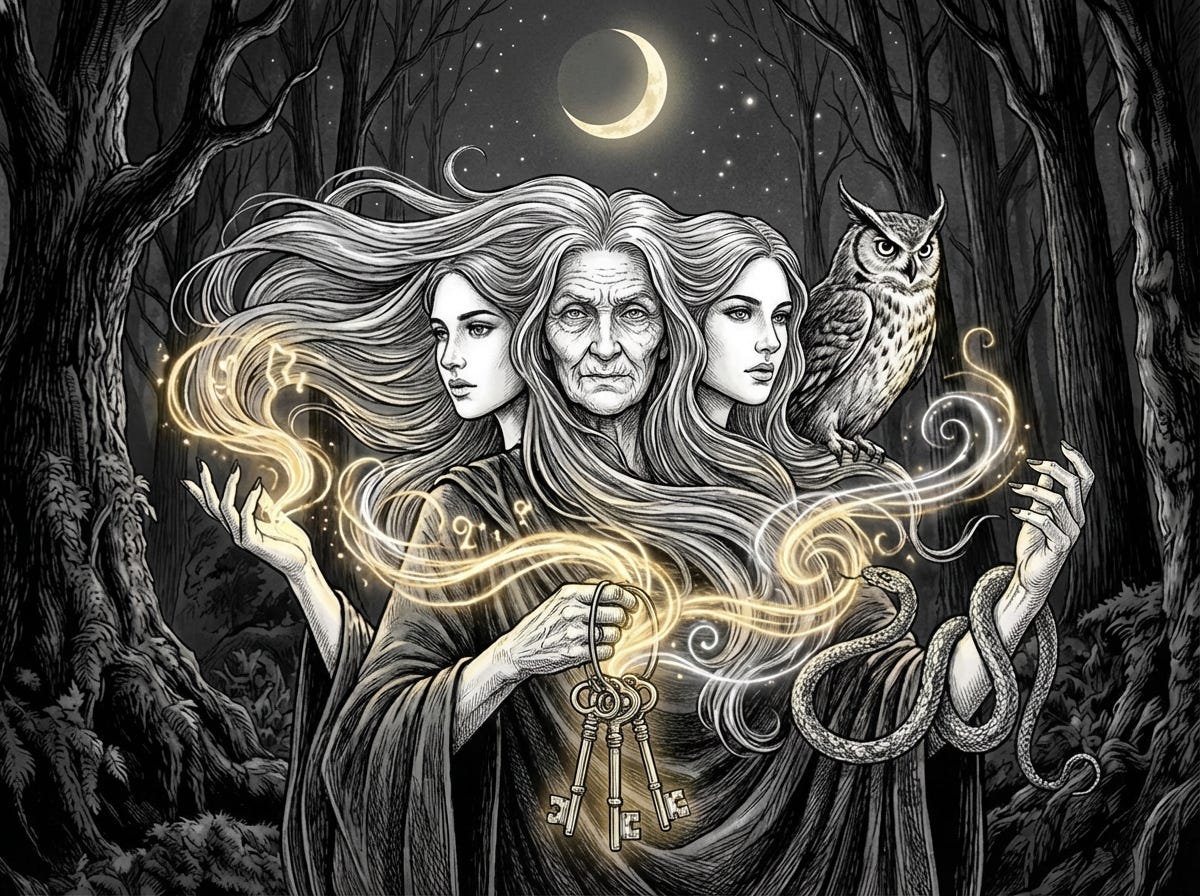
I understand why Hekate can be perceived as a crone. She embodies wild wisdom and inhabits the threshold—the liminal space between worlds. The crone similarly occupies liminal territory. Like Hekate, crones are associated with magic and mystery. Hekate tends to restless spirits, helps us cross into the deeper world (and back), is associated with protecting children, and has been subjected to much denigration. Like Baba Yaga’s initiation of Vasilisa into womanhood, an ancient ritual was led by a prepubescent girl carrying a key. When examining Hekate’s ancient attributes—guiding souls, serving as divine midwife, protecting children, and practicing magic—these qualities resonate strongly with what might be called “crone energy.” While a few lesser-known myths depict her mothering her own children exist, she generally appears in ancient Greek stories as a wise woman associated with the natural world and spirits, dwelling in caves or gardens rather than cities.
Watch: Exploring Hekate and The Crone
This episode of the Keeping Her Keys Podcast is available wherever you get yours.
Hekate’s Ancient Origins
In ancient Greek religion, Hekate occupied the threshold. The Greeks didn’t place her within temples but stationed her at their entrances, though other regions like ancient Caria had Hekate-centered temples where she was honored as a great mother goddess. Hesiod, in his Theogony, which dates back to before classical Greece, describes her as a benevolent goddess who abides with humans, yet has free dominion over all the realms. To the Greeks specifically, she embodied the wise woman role appearing in myths and theatrical works. The monthly offerings to Hekate were delivered to the crossroads, not placed before an elegant altar in a temple. These were apotropaic, for like the crone Hekate’s protection was important, as was avoiding her displeasure.
Crucially, the ancient Greeks didn’t perceive Hekate as an old woman. Their worldview considered it impossible for the divine to assume the appearance of age. The gods and goddesses were portrayed as adults—somewhere between their late teens and forties—but never as elderly or as children. In ancient Caria, where she was revered as a great mother goddess, she would have been depicted as a mature woman rather than elderly—more developed than a maiden figure like Kore, but still within that adult range evident in surviving iconography. The contrast between ancient vases depicting Demeter, Persephone, and Hekate together reveals this understanding of the divine. Their differentiation comes through attire, symbols, and attributes—Hekate with her torches, positioned in the middle, mediating the relationship between Demeter and Persephone.
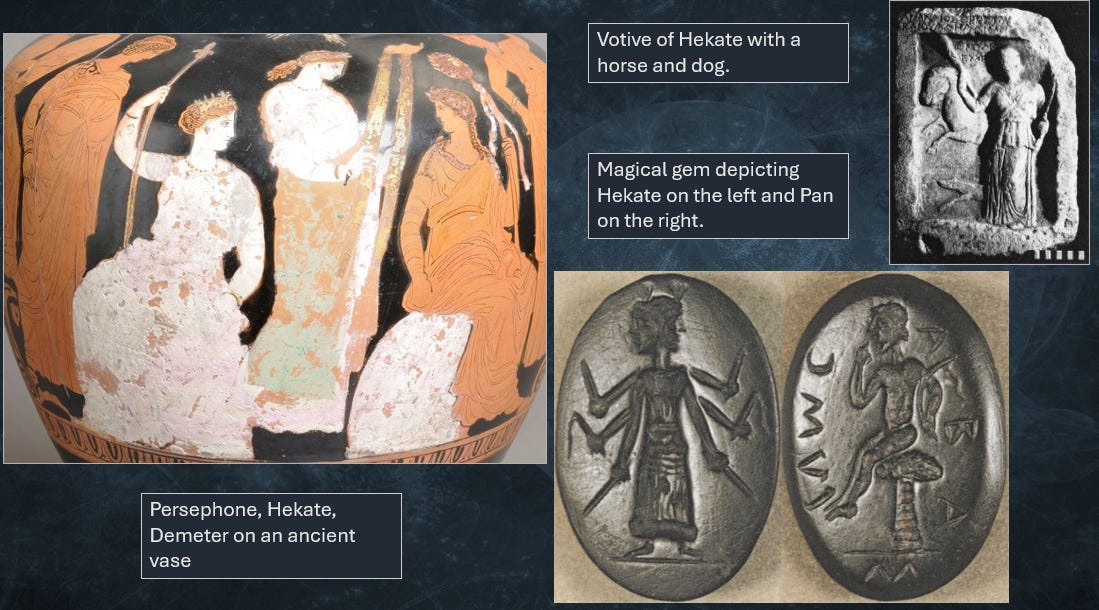
By looking at the history and artefacts, it makes sense that Hekate later on became seen as a crone or having crone-like superpowers. She connects souls to the afterlife, connects spirits to the waking world. Never part of the classical Greek pantheon, she was also an outsider, abiding in the boundaries between places and worlds. Herein is an other similarity with many of the crones of lore and legend. The fact that she didn’t typically have a male consort in myths – apart from her frequent companion of Hermes – reinforces her crone-like nature.
Hekate and Witches
Like the crones, hags and witches with which she became associated over the centuries, Hekate was dangerous because she was solitary. Hekate was connected to the natural world, from dogs – evidenced in Hecuba’s tale – to horses, lions, and serpents. Like the hags of folklore, she was of the natural world. Her association with magic comes from multiple sources, including ancient Greek literature and archeological finds of ancient spells, including magical gemstones, curse tablets, and a sort of ancient book of shadows, commonly known as The Greek Magical Papyri. An additional similarity shared with the crone comes from one of her obscure epithets, Presbeia, which translates as “ancient,” although to the ones who referred to her as such it didn’t refer to her physical appearance but that she was older than time. As with The Cailleach, she is of the natural world, not separated from it. Magic was rooted in this, from herbs to summoning spirits. Over time, as ideas about magic shifted, this connection became viewed as sinister, when it’s origins were anything but.
Hekate shares this derogatory transformation with many goddesses, such as Welsh Cerridwen and The Morrigan from Ireland. All three are associated with magic, thresholds and shapeshifting. Hekate and Cerridwen have often been depicted as elderly women in modern paganism, while The Morrigan, who did transform into a crone in different stories, is rarely so. Our images of goddesses is largely in the eyes of the beholders, yet I ponder why this is so. Culture and personal gnosis colors how we experience the divine, and it’s important to acknowledge this. Indeed, in the ancient Mediterranean, views about goddesses changed over time. When once Hekate’s triple nature – so unique among the Greek deities – perhaps referred to her governance over the three realms, her transformative powers, and her ability to offer protection by seeing in all directions, over time became a source for maligning her. Coupled with her rootedness in the natural world, her three forms depicted with animal characteristics, became evidence of her savageness.
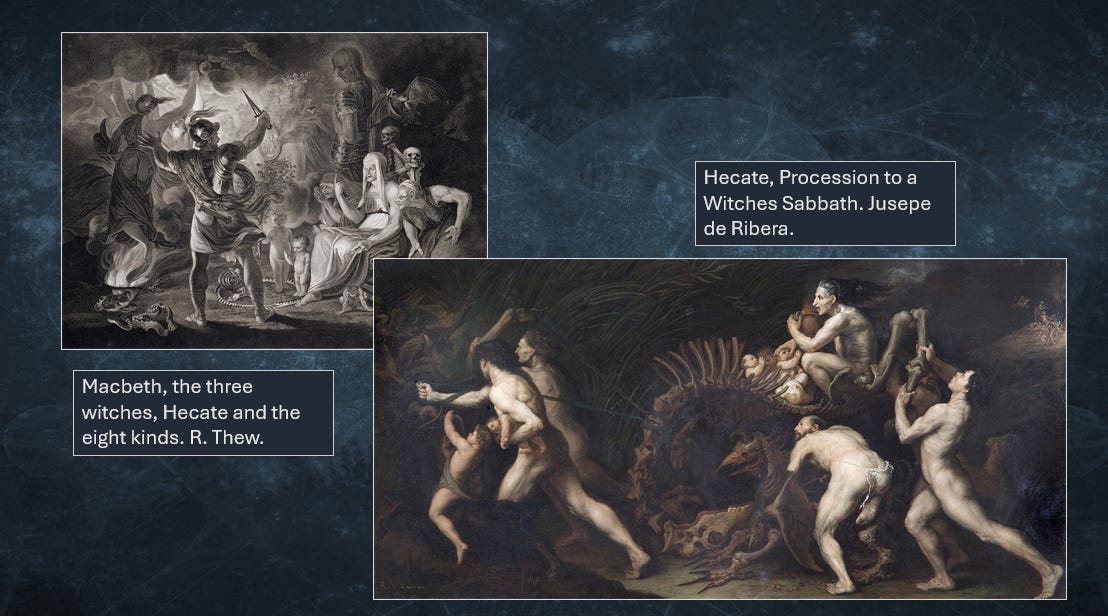
Hekate’s association with magic, which had been a natural connection in previous times, became seen as malevolent over the centuries. Her role in magic, in a broader lens, may have been linked to her being a foreigner adopted by the Greeks rather than a native goddess. Like Baba Yaga living in the woods, Hekate was not part of the civilized world. Greek literature features many women who were connected to Hekate, such as Hecuba. It is perhaps her mentorship of witches that is most revealing, though. In Euripides’ Medea, this sorceress calls up Hekate to help with her spells, a theme that is repeated in other stories, including Circe in The Odyssey. As the centuries past, the Romans retold these tales, with Hekate and her witches becoming more hag-like and troublesome. When Christianity was made the state religion by the Romans starting in the fourth century CE, they entered into an era of state-sanctioned vilification of all things “pagan,” including Hekate and her witches.
Women who wove magic, even the healing kind, became hideous hags. By the middle ages, Hekate, in art and literature, is far removed from her ancient origins as a Great Mother. In the 17th century play, The Witch by Thomas Middleton, she is an old hag that lives in a cave directly, which may have been inspired by the Homeric Hymn to Demeter where she lives in a cave. In this play she is a saucy, spicy troublesome crone. With Macbeth, Shakespeare wrote this version of Hekate into his enduring play, influencing how she was seen even to this day.
Hekate endures throughout the centuries, yet her depiction changes. How do we make sense of 3,000 years of history? We’ve redefined witch and witchcraft so much in the past 50 years, plus there has been so much reclaiming of the divine feminine. I believe Hekate shows herself to us as she wills, whether it’s a hunched back hag or a giant triple goddess. There’s magic in that.
Hekate as Psychopomp: The Soul Guide
Psychopomp is certainly an aspect of like the crone that Hekate shares. The guiding of souls throughout their lives, to and from the afterlife, is a common theme in many crone stories. At times, she shows up, like in Medea, to support the hero, which can be viewed as another type of psychopompery. There’s also her very real connection with spirits. When Hekate comes to us, she offers the keys of transformation, magic, and awakening of our own mystical talents. She may scare the life into us, offering a rattling key to a new journey – here in the crone’s country – that shakes us out of our stuckness. Not to the hero’s journey of conquest and glory, but onto the crooked path of her mysteries. At times, my understanding of Hekate has drawn harsh criticism, such as connecting her to the crone. If there’s one key she’s given me that I will always cherish it is that of unlocking my own truth. There are legitimate similarities between Hekate and the archetype of the crone. These offer the possibility of centering her and ourselves within the vast landscape of the crone’s territory.
Crossroads and Choices
Hekate is always centered in the crossroads. There’s a choice to be made. As we age, we make choices that are more attuned to who we are. In examining Hekate’s established attributes, such as guiding souls and magic, we see the potential in the keys she offers. With burning torches lighting the threshold, she lights the way. Yet Hekate not only offers keys but also ignites our own torches so that our journey can highlight the value of the crooked journey for others. In my experience, Hekate, very much like how she guided Persephone to and from the underworld, companions us as we explore our own depths. Her millennia-old association with the dark moon, which was the night when suppers were left for her at the crossroads, speaks to it’s rising in the crone’s country, reflecting upon us the world beyond mortal existence. Perhaps this is the one insistence of Hekate that I’ve come to know: that we make the most of this life.
I’m taking a break from the podcast and other public-facing activities for the new few months while I work on my new book.
I’ll be teaching a six-month long course diving deeper into my book, Entering Hekate’s Cauldron, starting May 1. Go to keepingherkeys.com for more details.
If you’re interested in the crone, consider joining the Destination Crone course. LEARN MORE HERE.
Meditation follows for paid subscribers.
