

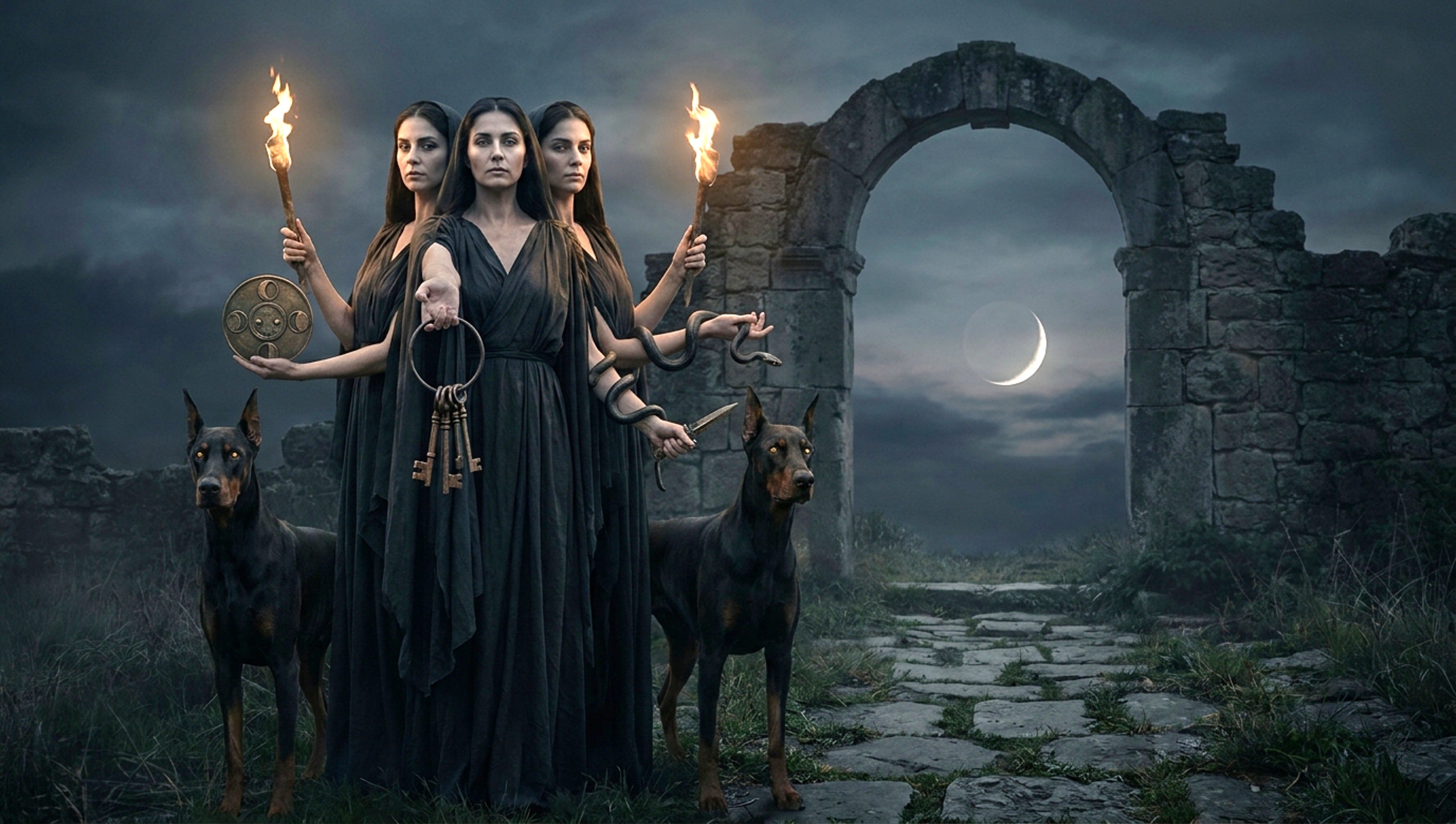
Hekate’s role as Kleidoukhos—Keeper of Keys—is so central to my personal devotion that I named first my blog, then website, and a book after this epithet. I remain, after all these years on her path, keeping her keys. In this article and accompanying video, I take you on a journey from ancient Laconian keys to cosmic mysteries, exploring how keys in the ancient world represented far more than physical access - they were symbols of authority, sovereignty, and sacred trust. I end with my own gnosis about “Keeping Her Keys,” and offer some tips for modern practitioners.
Watch The Talk: Hekate Kleidoukhos
In this talk, I contextualize the rich history of Hekate Kleidoukhos, ranging from ancient sources such as The Orphic Hymns to her role governing thresholds. Note that this talk was recorded as part of a live class on Hekate as Key Bearer, which was the central seminar for a weekend devoted to this aspect, including the second segment on the thirteen modern Keys of Hekate, a guided meditation to receive a key, a collective tarot reading, and a ceremonial ritual. You can become a student in Hekate’s Keys to view those recordings.
The current six month cycle is rooted in my book Entering Hekate’s Cauldron. Weekly live seminars, moon salons, sabbat rituals. Resource guidebooks, sharing circles and a vibrant community of Hekate’s Witches. If you join before July 18, you’ll immediately have access to all eight lessons of Part 1. Use code “OURANIA” at checkout. LEARN MORE.
The Ancient Keys: Material and Metaphor
I’m a visual person, so when I discovered what ancient keys looked like, it helped me understand Hekate as Kleidoukhos—Keeper of Keys in a new way. They were nothing like the skeleton keys we associate today, like the crossed ones in the Keeping Her Keys logo. I could write a lot about why that is the name for my work dedicated to Hekate, but I’ll let you ponder the reasons as you work through this summary about the ancient origins of my personal favorite epithet. Keys in the ancient Mediterranean world, unlike our modern metal keys with their intricate teeth and grooves, were substantial objects, often made of iron, bronze, or wood. Greek and Roman keys ranged from small finger-length implements to massive ceremonial keys that required two hands to carry. The most common type was the “Laconian key”—a long shaft with teeth at one end that lifted pins inside a lock, and a curved handle at the other end that could be worn on the arm like a bracelet or hung from a belt.
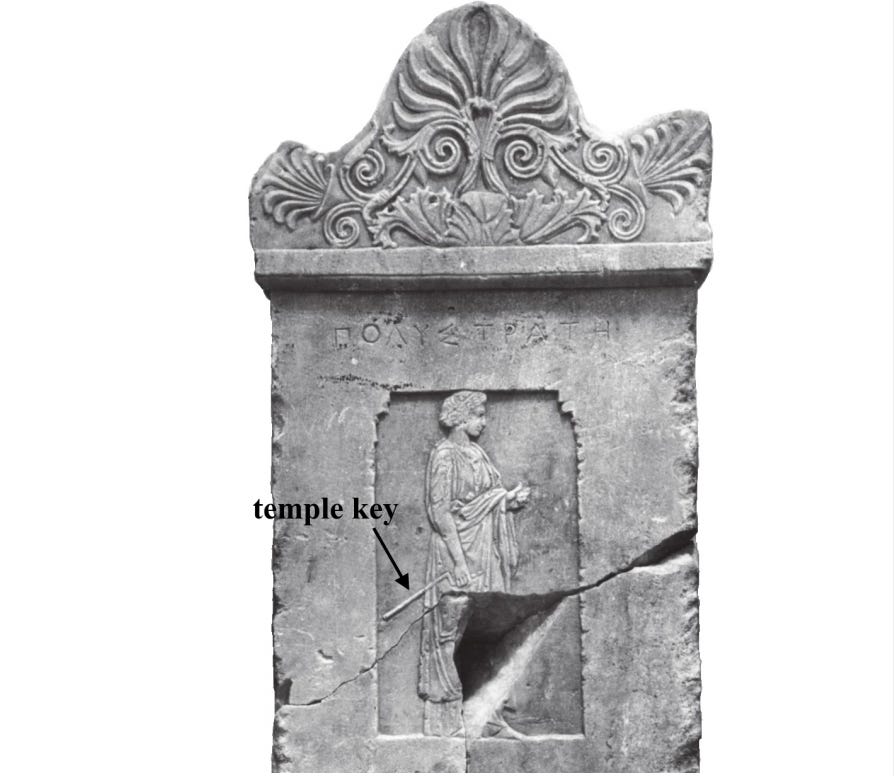
From “Key-bearers of Greek Temples: The Temple Key as a Symbol of Priestly Authority.” Reference at the end of article.
These keys were much more than functional objects; they were symbols of authority, responsibility, and access to power. In a world where most people owned very little, the person who held the keys controlled resources, protected treasures, and determined who could enter sacred or private spaces. Keys represented the power to grant or deny access—to open or keep closed—making them potent symbols of sovereignty and guardianship.
When we encounter Hekate as Kleidoukhos in ancient sources, it’s important to understand that her keys carried all these layers of meaning: practical authority, symbolic power, and mystical access to realms beyond the physical.
Women and Keys in the Ancient Mediterranean
“As mistresses of the household, women held the keys of their houses. According to Hesychius, women are kleidouchoi, as they get the keys of the house (s.v. κλῃδοῦχος). This means that the bride received the key from her future husband after the wedding when she entered the house of her groom. In the event of a divorce, the woman had to give back the keys. Festus mentions that it was a custom to give women a key as a symbol for an easy delivery. Women were not only key-holders of their households, but also as priestesses of temples.”
The epithet Kleidoukhos takes on profound significance when understood within the context of ancient Mediterranean gender dynamics and household authority. While women in ancient Greece and Rome were largely excluded from property ownership and faced significant restrictions on their movement in public spaces, they wielded considerable power within the domestic sphere as key bearers of the household. When a bride crossed the threshold into her husband’s home, she received the household keys—not as owner, but as guardian and administrator of the home’s daily operations, resources, and access points. This made her kleidoukhos of the domestic realm, controlling who entered, what was opened, and what remained secured.
Hekate’s role as Kleidoukhos mirrors this feminine authority over thresholds and boundaries, positioning her as the cosmic guardian of liminal spaces just as mortal women guarded the threshold of the home. The ancient custom of giving women keys as symbols for easy childbirth further connects Hekate’s key-bearing nature to her role as Eileithyia, the Divine Midwife who unlocks the gateway between worlds as new life crosses from the unseen realm into embodied existence. This association between keys, thresholds, women’s authority, and birth finds powerful archaeological evidence at Hekate’s temple at Lagina in ancient Caria, where inscriptions describe the kleidophoria—a ritual procession in which young girls on the cusp of womanhood carried ceremonial keys through the city to the temple, marking their transition from childhood to their future roles as household key bearers and linking Hekate’s cosmic guardianship of thresholds with the very real authority women held as keepers of domestic boundaries.
The Sacred Power of Kleidoukhos
The term κλειδοῦχος denotes somebody who has or keeps the key. Kleidoukhos is the English transliteration of the Greek term κλειδοῦχος. The Greek letters are rendered into the Latin alphabet as “Kleidoukhos” (or sometimes “Kleidouchos” - both spellings are used in English scholarly works). Outside of the home, both women and mean served as key bearers of temples, including the important archeological excavation of Hekate’s temple at Lagina:
“The term κλειδοφορός can be translated as ‘key-bearer’…The cultic officials of Hecate at Lagina called kleidophoroi carried a key at the festivals of Hecate…The kleidophoros had presumably the same task as the kleidouchos: locking and unlocking the temple door, the performance of rituals, and escorting the temple key in processions…”
Hekate’s role as temple gatekeeper is evidenced by archaeological remains throughout the ancient Greek world, most notably at the Acropolis in Athens where a statue of Hekate Epipyrgidia (Upon the Tower) stood before the entrance to the Parthenon, positioned to guard the threshold of Athena’s sacred precinct. This placement exemplifies the widespread practice of installing Hekataia—three-formed statues or herms of the goddess—at temple entrances, city gates, and household doorways throughout Greece and Asia Minor.
At the sanctuary of Artemis at Brauron, Hekate’s image guarded the entrance, reinforcing her connection to Artemis while establishing her authority over the threshold between profane and sacred space. The temple at Lagina in Caria, dedicated solely to Hekate, featured elaborate entrance architecture where her role as Propylaia (Before-the-Gate) was central to the sanctuary’s design, with inscriptions documenting rituals performed at these thresholds during her festivals. These physical placements weren’t merely decorative—they represented Hekate’s active function as cosmic gatekeeper who determined who could enter sacred space, who protected temples from malevolent forces, and who mediated between the human realm outside and the divine realm within. The archaeological evidence demonstrates that Hekate’s epithet Propylaia wasn’t metaphorical but reflected her literal positioning at entrances where she exercised her authority as Kleidoukhos, the one who held the keys to unlock—or keep locked—access to the sacred.
Hekate Kleidoukhos in Ancient Texts
The epithet Kleidoukhos appears in several crucial ancient sources, each revealing different facets of Hekate’s role as key-bearer. The Orphic Hymns (2nd-3rd century CE) position her as first among the gods, as the divine keyholder to the mysticism they practiced, while The Greek Magical Papyri (2nd century BCE - 5th century CE) is a collection of spells - a sort of Book of Shadows - that reference her connection to keys. The cosmology of The Chaldean Oracles (2nd century CE) both reinforce her role as a mystical key bearer and involvement in ritual (theurgy), while going far beyond that to Hekate being divine consciousness.
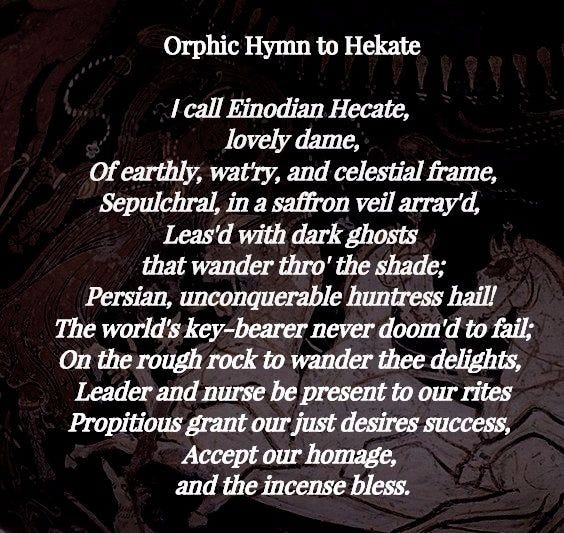
The Orphic Hymn to Hekate: Gateway to the Mysteries
The Orphic Hymn to Hekate establishes her as the primary gateway through which all other divine powers must be accessed. Hekate is Kleidoukhos, the Key-Holder who unlocks access to the entire pantheon and all mysteries beyond. This positioning reflects the ancient understanding that Hekate operates at the liminal boundary between human and divine realms. To bypass her would be to attempt entering a locked temple—the door remains closed without the key bearer’s consent.
The hymn explicitly addresses Hekate as both Kleidoukhos (Key-Holder) and Propylaia (Before-the-Gate), epithets that work in concert to describe her function. Propylaia positions her spatially—she stands before the entrance, guarding the threshold. Kleidoukhos describes her authority—she holds the keys that unlock passage through that threshold. The term propylaia itself carries architectural significance. In ancient Greek, a propylaeum was a monumental gateway or entrance structure leading to a sacred precinct—most famously, the Propylaea at the Acropolis in Athens. By calling Hekate Propylaia, the hymn positions her as the grand entrance to the sacred, the architectural threshold through which one must pass to reach the divine.
“…Keyholding Mistress of the universe
Ruler, Nymph, Mountain-wandering Nurturer of the young
Maiden, I beg you to be present at these sacred rites…” (Thomas Taylor Translation)
The hymn describes her as having “keys to the whole world”—going far beyond her association with physical thresholds and boundaries, but expanding to the cosmic keys that unlocking the structure of reality itself. This is Hekate as universal gatekeeper, the one who controls access to all realms: earth, sea, sky, and the spaces between them. Additionally, given the nature of The Orphic Hymns, it solidifies her as the key bearer to the mysteries.
Hekate in the Greek Magical Papyri
The Greek Magical Papyri (PGM) is a collection of magical texts written primarily in Greek (with some Demotic Egyptian and Coptic) dating from the 2nd century BCE through the 5th century CE. These papyri were discovered in Egypt and represent a remarkable syncretism of Greek, Egyptian, Jewish, and Christian magical traditions. The texts contain spells, rituals, hymns, and invocations for a wide range of purposes—from love magic and healing to protection and divination. They offer an invaluable window into the practical magic of the ancient Mediterranean world, revealing how everyday practitioners (rather than elite philosophers or priests) actually worked with deities and supernatural forces. The PGM demonstrates that magic was not a marginal practice but a vibrant, widespread tradition that drew on multiple cultural sources and adapted freely across religious boundaries.
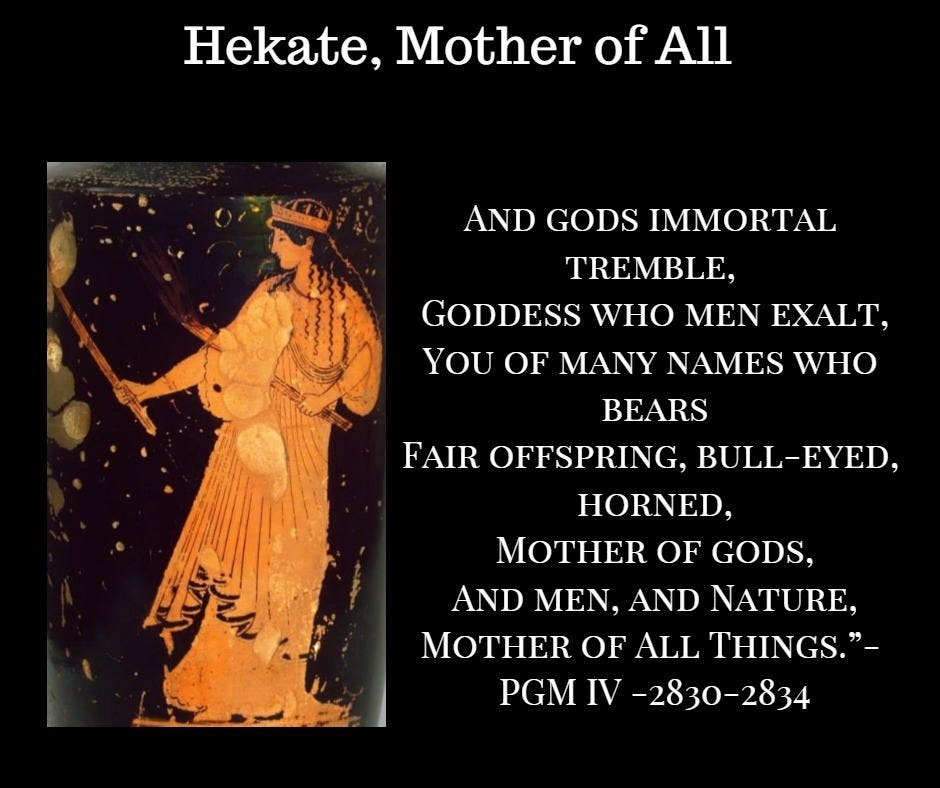
Example of an excerpt from the PGM invoking Hekate as “first among gods,” providing a link with her position in The Orphic Hymns.
Within the Greek Magical Papyri, Hekate appears frequently and prominently as a powerful goddess invoked for protection, revelation, and magical workings of all kinds. She is called upon by numerous epithets and identified with other goddesses (particularly Selene and Artemis) in the syncretic style characteristic of these texts. The PGM portrays Hekate as a goddess who responds to practitioners’ calls, grants visions, protects against harmful magic, and empowers spellwork. Her keys appear as sacred symbols in invocations, representing her authority to open pathways, unlock mysteries, and grant access to hidden knowledge. The papyri reveal Hekate as a goddess actively engaged with human practitioners—not distant or abstract, but present, responsive, and willing to work with those who approach her with proper offerings and invocations.
The Greek Magical Papyri invoke her association with keys, gates and thresholds in multiple incantations. This collection of fragments reflects the syncretization that was common in Egypt during this time.
…Watch and are watched. I look at you, you look
At me. Then, too, I’ll speak the sign to you:
Bronze sandal of her I who rules Tartarus,
Her fillet, Key, wand, iron wheel, black dog,
Her thrice-locked door, her burning hearth, her shadow… - from The Greek Magical Papyri (PGM; IV. 2241-2358)
And this example, from a spell in the PGM invoking Hekate-Ereskigal: Hekate is referenced in many places, including these three short spells. By this time, Ereskigal had become subsumed by Hekate as the Greek influence over Egypt had grown:
“…Ereskigal, virgin, bitch, serpent, wreath, key, herald’s wand, golden sandal of the Lady of Tartaros.”
Hekate in the Chaldean Oracles
The Chaldean Oracles represent one of the most profound and philosophically sophisticated portrayals of Hekate in ancient literature. Composed in the 2nd century CE, these enigmatic verses were attributed to Julian the Chaldean and his son Julian the Theurgist, though they survive only in fragments preserved by later Neoplatonist philosophers like Proclus, Porphyry, and Iamblichus. Unlike the practical magic of the PGM or the devotional hymns of the Orphic tradition, the Chaldean Oracles present a complex cosmological system in which Hekate occupies the highest metaphysical position—not merely as a goddess to be invoked, but as the very structure of reality itself.
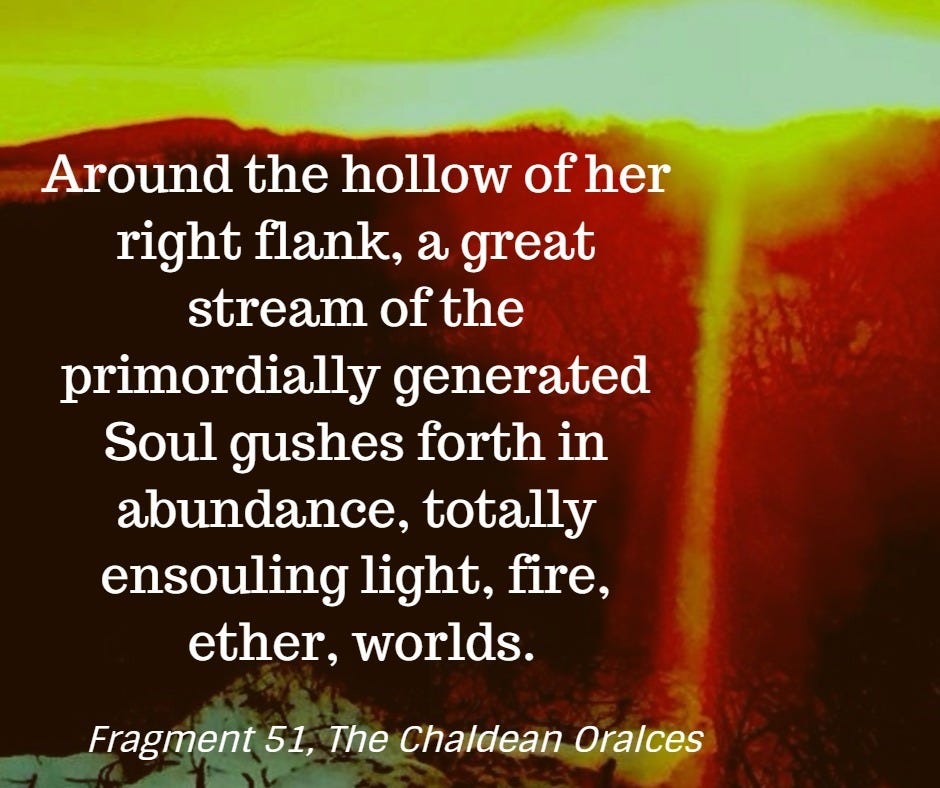
In the Chaldean system, Hekate is Anima Mundi—the World Soul—the cosmic principle that mediates between the transcendent divine realm (the Father/First Principle) and material creation. She is described as the “womb-encircling membrane” that both separates and unites these realms, making her the essential bridge through which divine power flows into manifestation. The Oracles call her the “fiery flower” and position her as the cosmic key bearer who unlocks the pathway of ascension for human souls seeking to return to their divine source. This is Hekate operating at the highest level of mystical experience—not as a deity among others, but as the fundamental organizing principle of the cosmos.
The Chaldean Oracles introduced the concept of theurgy—divine work or god-making—as the primary means of spiritual ascension. Unlike thaumaturgy (wonder-working or practical magic like in the PGM), theurgy aimed at uniting the practitioner’s soul with the divine through ritual acts that aligned human consciousness with cosmic principles. Hekate, as World Soul, was the key to this theurgic practice. By working with her, practitioners could unlock their own divine nature and ascend through the cosmic levels back to the Source. The Oracles describe her as having “keys to the whole world,” emphasizing that she controls access not just to physical or spiritual realms, but to the very structure of existence itself.
Several fragments specifically reference Hekate’s role as cosmic mediator and key bearer:
“There is a certain Intelligible which you must perceive by the flower of the mind... For the Paternal Mind has sown symbols throughout the world, He who is the first to leap forth, and the channel of the Life-giving Fire, the constructor of the fiery worlds, is the Demiurge of the universe... But the Womb of Hekate, which contains all things, is the Separator.”
The Key Bearing Ceremony at Lagina
The most compelling archeological evidence of Hekate’s role as Kleidoukhos comes from the archaeological remains of her temple at Lagina in ancient Caria (modern-day Türkiye). This is the only surviving ancient temple dedicated solely to Hekate, and excavations there have revealed extensive written records describing her worship. One particularly beautiful inscription describes a ceremony in which a young girl on the cusp of adolescence—the threshold between childhood and womanhood—carries a great key and leads a procession through the city. This kleidophoria (key-bearing) ritual was central to Hekate’s worship at Lagina and reveals multiple layers of meaning. The archeological evidence indicates that Lagina was a major center of Hekatean worship dating back to the 4th century BCE, but probably much older.
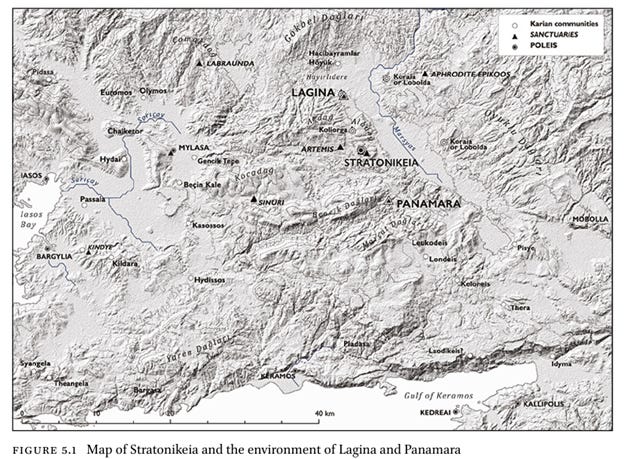
Image from Williamson, Christina G. “Festival Networks: Stratonikeia and the Sanctuary of Hekate at Lagina.” In Urban Rituals in Sacred Landscapes in Hellenistic Asia Minor. Brill, 2021. Chapter 5, pages 241–330.
The documentation (dating to 81 BCE) about a specific festival, known as the Hekatesia-Romaia festival, with a key procession the central ritual act:
On these occasions, people would have been expected to move through the sacred space in patterns prescribed by ritual. During the kleidos agoge, which lasted several days, games were played, music was performed, hymns to the goddess were sung, and sacrifices were made. The highlight of the rites was the Procession of the Key, in which the kleidophoros, or key bearer—a young daughter of the priest of Hekate—carried the key in a procession from its normal resting place at Lagina along the road to Stratonikeia. While in Stratonikeia, visitors made sacrifices to the goddess at an altar to Hekate, probably located inside the bouleuterion, before the key was returned to the goddess’s main temple and further celebrations were enacted.
The road from Stratonikeia to Lagina ended at the sanctuary’s monumental propylon. This consisted of three separate doors—a large one at center and two narrower ones on either side. The jambs of the middle door were highly decorated with floral and linear designs, and an inscription was carved across the lintel above. Written in Greek and still visible, it reads:
The Emperor Caesar, son of a god, the godly Sebastos, father of the nation, whose piety excels everywhere, after the profanity against the goddess Hekate, provided from himself for her, foreseeing the truthful idea that from the beginning gods have lived among men.
The above excerpt demonstrates the multilayered meaning of Hekate Kleidoukhos:
Hekate’s role as a civic goddess, much like a great mother, is demonstrated through the embedded nature of the ritual, linking the temple to the town of Stratonikeia. The festival, and it’s key procession, served to honor Hekate while strengthening the power of the region. This links the earliest known written description of Hekate (Hesiod’s Theogony, 8th century BCE), where she is depicted very much as a civic goddess, attending sporting events, legal affairs, and so on. The festival lasting “several days” with games, music, hymns, and sacrifices mirrors the structure of other major Greek religious festivals (like the Eleusinian Mysteries or Panathenaia), positioning Hekate’s worship within the mainstream civic-religious framework. Placing Hekate’s altar inside the council chamber (bouleuterion) explicitly connects her worship to civic governance and political authority, reinforcing her role as protector of the polis and advisor to leaders - echoing Hesiod’s description of her attending assemblies and law courts. The inscription at the end of the quote above indicates that the temple had needed to be restored, indicating that it was important enough to warrant this costly project.
It connects Hekate with the transition of girls into womanhood, establishing her as Kourotrophos—nurse of the young—who presides over this crucial threshold. The girl carrying the key is herself a liminal figure, standing between two states of being, just as Hekate stands between worlds. The choice of the priest’s young daughter as key bearer creates a powerful embodiment of liminality—she represents both hereditary religious authority (priest’s daughter) and transitional status (youth approaching womanhood), making her the perfect vessel for carrying Hekate’s key between worlds
Hekate’s interconnected role as Propylaia and a nod to her threefold nature (although at Lagina, she was solely portrayed in singular form) is shown in the temple entrance. The three-door propylon (large center door flanked by two smaller ones) physically manifests Hekate’s triple nature in the temple architecture itself, even though her cult statue at Lagina was singular. The architecture creates a triformis experience for worshippers entering the sacred space
The walk itself can be connected to her role as Enodia, adapted by the Greeks as they syncretized Hekate with a Thessalian goddess, as a guiding spirit during the transition from one place to another, leading to Propylaia, and having the key to enter the temple. The mention of “visitors” making sacrifices suggests this wasn’t just a local festival but drew pilgrims from surrounding areas, who travelled to get to the festival and then do the ritual walk. Thus indicating Lagina functioned as a regional cult center and Hekate’s worship had broader geographic significance.
The physical journey from Lagina to Stratonikeia and back creates a ritual narrative arc—the key leaves the goddess’s temple (departure from divine realm), enters the civic space where mortals make offerings (intersection of divine and human), then returns to the temple (completion of the sacred circuit). This movement itself enacts Hekate’s mediating function, which is found in the Homeric Hymn to Demeter, when Hekate guides Persephone and facilitates her alliance with Hades.
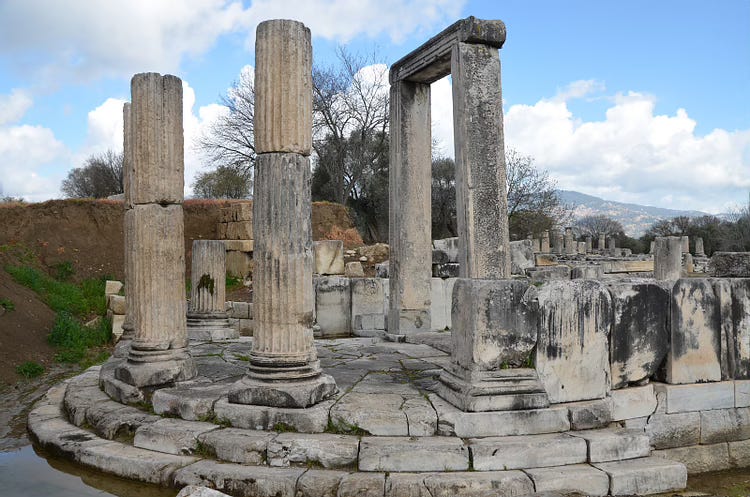
The propylaeum at the Temple of Hekate in Lagina. A new article with an update on the excavation HERE.
The Keys of Hekate Soteira
The archaeological evidence from Lagina demonstrates Hekate’s role as civic protector and key-bearer in ritual practice, a function that scholars have connected to her broader salvific powers across the ancient Mediterranean world. Modern scholarship has deepened our understanding of Hekate as key-bearer, particularly through the groundbreaking work of Sarah Iles Johnston. Johnston argued that Hekate’s keys represented her power to save (Soteira – The Savior) from not only worldly entrapments, but also the soul.
Johnston also explored how Hekate’s keys connected to her role as mediator between realms. In ancient cosmology, the universe was understood as having multiple levels—from the highest divine realms to the material world to the underworld. Hekate, as world soul and cosmic mediator, held the keys that allowed movement between these levels. She could unlock the gates of the underworld to guide souls, unlock the gates of heaven to bring divine wisdom to earth, and unlock the gates of human consciousness to grant mystical vision.
This scholarly work restored complexity to our understanding of Hekate’s keys. They weren’t just spooky symbols of a “dark goddess” who haunted graveyards—they were symbols of cosmic authority, protective power, and the ability to grant access to transformation.
There are also grave stele’s (tombstones) that call upon Hekate Soteira, reinforcing her role as Psychopomp – Guide of Souls. Johnston wrote more about this aspect of Hekate in her book, “The Restless Dead.”
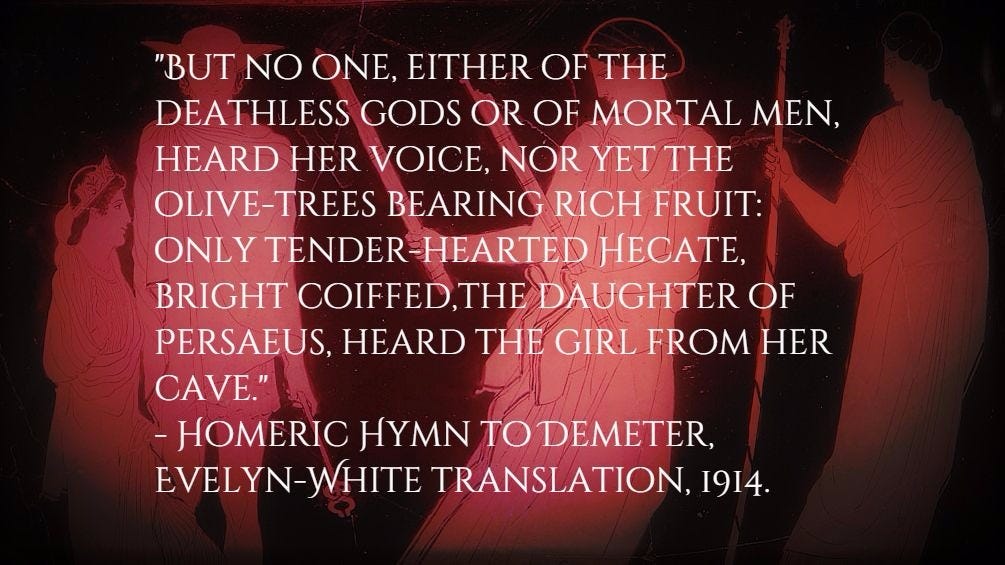
In Persephone’s tale, told in The Homeric Hymn to Demeter, Hekate is divine meditator, threshold keeper, and psychopomp, aligning to Johnston’s work.
Proclus and the Cosmic Keys
Johnston’s scholarship on Hekate Soteira provides essential context for understanding how ancient philosophers like Proclus interpreted the goddess’s role as key-bearer. Her analysis reveals that Hekate’s keys represented not just physical access or even spiritual protection, but cosmic authority—the power to save by unlocking pathways, binding disparate elements into harmony, and granting souls access to their ultimate fulfillment. This salvific function of the key-bearer finds its most sophisticated philosophical expression in the writings of Proclus, who experienced Hekate not as distant mythology but as living divine presence.
The Neoplatonist philosopher Proclus (412-485 CE) experienced direct visions of Hekate and wrote extensively about her role in the structure of reality. For Proclus, Hekate’s keys were not merely symbolic—they were the actual mechanism by which the cosmos functioned. In Hekate Soteira, Johnston wrote:
“Key-holder described aspects of Hekate that agreed with his (Proclus) portrayal of her as having the ability to bind together and harmonize diverse elements, to close the boundaries of things within the Cosmos, to bring individual souls to fulfillment - in short, as an entity much like The Cosmic Soul.”
— Sarah Iles Johnston, Hekate Soteira
In Proclus’s cosmology, derived partly from the Chaldean Oracles, Hekate is the world soul—the animating principle that connects all levels of existence. She is the “womb-encircling membrane” that both separates and unites the transcendent divine realm with material creation. Her keys unlock the flow of divine power into the physical world and unlock the human soul’s capacity to ascend toward the divine.
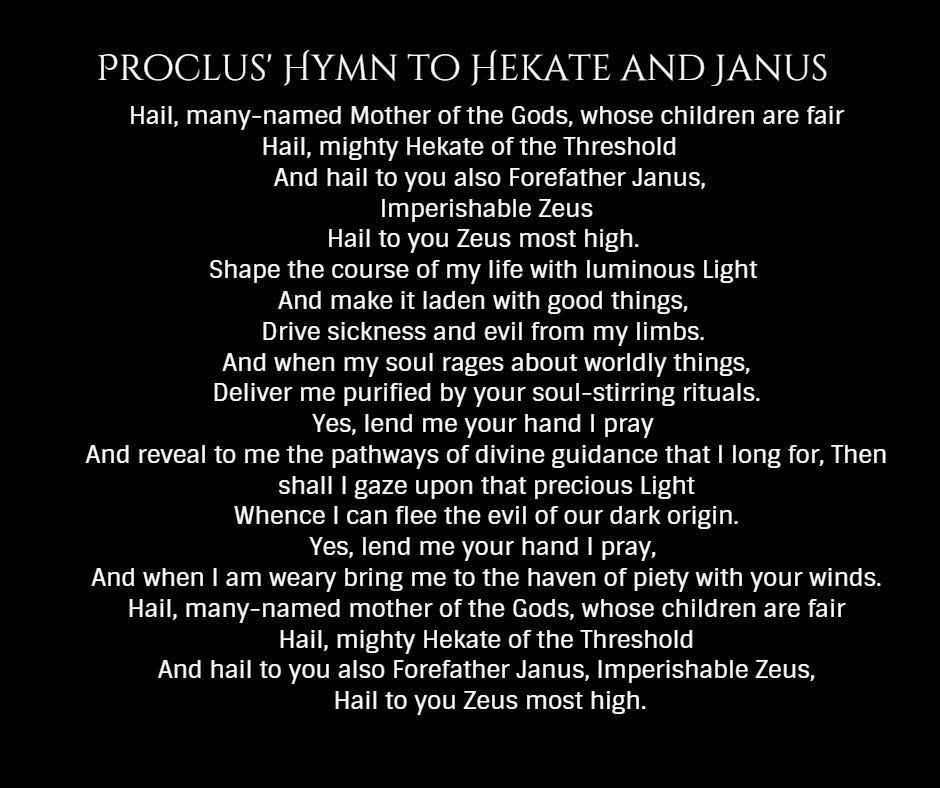
Proclus’ Hymn to Hekate and Janus reinforces his views.
Proclus understood that Hekate’s keys operated on multiple levels simultaneously. On the cosmic level, they controlled the structure of reality itself. On the spiritual level, they granted access to mysteries and gnosis. On the practical level, they protected against harm and opened pathways to blessing. This multilayered understanding of her keys as Kleidoukhos reveals why she was invoked first in the Orphic Hymns—without her keys, nothing else could be unlocked.
Keys, Thresholds, and Boundaries
Hekate’s role as Kleidoukhos is inseparable from her role as Propylaia—Before-the-Gate (referencing the Orphic Hymns placement of the two hymns to her being first and second – I didn’t discuss the second hymn to Prothyraea in this article) —and her association with thresholds and boundaries. Keys exist because boundaries exist. Hekate presides over all such boundaries: the threshold of the home, the crossroads where three paths meet, the gates of cities, the entrance to temples, and most significantly, the threshold between life and death, between the visible world and the deeper realms.
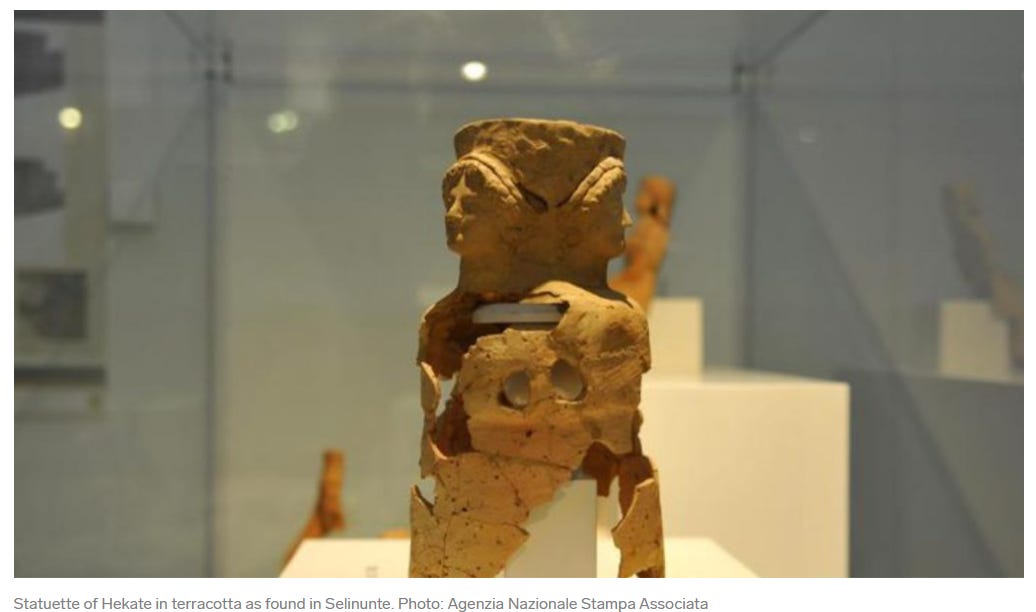
This intriguing statue is one of the oldest relics depicting Hekate, perhaps it served as a threshold protector. SOURCE.
In ancient Greece and Rome, Hekataia—three-formed statues of the goddess—were placed at these liminal spaces. She watched over them with her three faces, able to see in all directions, able to identify threats and opportunities. But she didn’t just watch—she controlled access. With her keys, she could lock out malevolent forces and unlock blessings. She could seal boundaries against intrusion and open pathways for those she favored.
This is why offerings were left for her at crossroads during the Deipnon, her sacred supper on the Dark Moon. The food wasn’t just for Hekate—it was for the restless dead and wandering spirits who gathered at these threshold spaces. By feeding them, by honoring Hekate as the one who controlled these liminal zones, ancient practitioners ensured that boundaries remained secure and that passage through dangerous transitions would be safe.
From Ancient Keys to Modern Practice
I was so enchanted by Hekate Kleidoukhos that I named first my blog, then the website, and the following book, “Keeping Her Keys.” To me, this was a radical act of identifying as one of Hekate’s modern witches. While the ancient history is compelling, I abide at the contemporary crossroads. To claim the keys she offered meant to fully embrace my own complex, multiple identities as keys to knowing myself. In a mystical sense, Hekate had given me the keys to follow the path she set out for me - very much inspired by the ancient tale of Persephone - while keeping them as a devotional service to her. We inherit the rich history, while honoring them as tools of transformation, symbols of authority, and mechanisms of access to mysteries both ancient and personal. Perhaps my introduction to other’s reflections on Hekate as Kleidoukhos first occurred in the 2009 Bearing Torches: A Devotional Anthology for Hekate:
“They call you Kleidouchos who bears the three worlds’ keys and you do reign in heaven, earth and sea. Yet most important: you’re the one who sees into all hidden secrets, dark and light. I call you, Hecate, from soul and heart, Trioditis, key-bearer, daughter of the night, that your dark wisdom onto me impart and with your torch illuminate my path.”
In modern Hekatean practice, we can work with her keys in multiple ways. We can invoke her as Kleidoukhos when we need to unlock stuck situations, open new pathways, or gain access to hidden knowledge. We can create key talismans—either using actual antique keys or crafting symbolic ones—and consecrate them to Hekate as tools for our magical work. We can place keys on our altars as offerings and reminders of her power to open what is closed and close what must be protected.
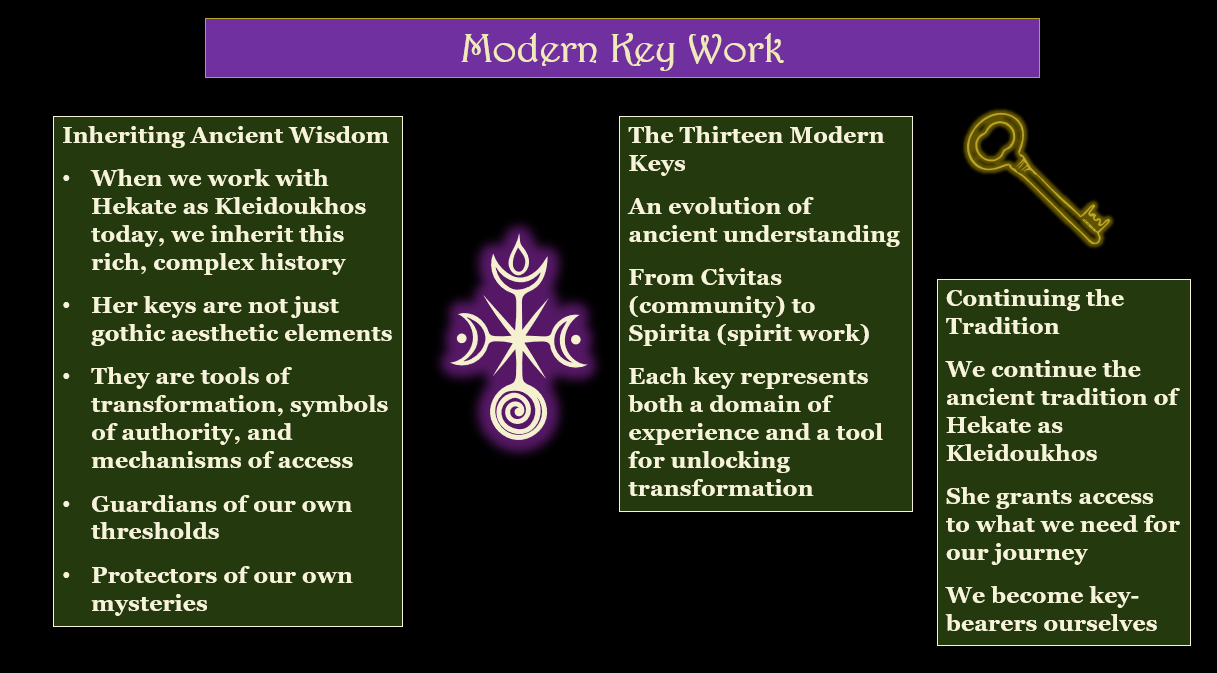
A sample of the PDF of the slides from the talk at the beginning of this article. I wanted to include the modern Sigil of Hekate, as it contains one central key “head” and three extending keys, along with the crossroads. Design by me and my lovely wife, Christen Bennett.
We can also understand our own lives through the metaphor of keys and thresholds. What doors have we unlocked? What keys have we been given—or claimed for ourselves? What thresholds have we crossed, and what boundaries do we now guard? When we map our personal journey to Hekate’s crossroads, we can identify the keys that have unlocked crucial transitions: the key of education that opened intellectual doors, the key of therapy that unlocked psychological healing, the key of initiation that granted access to mysteries, the key of claiming our identity as witches that opened the door to our true power.
In Entering Hekate’s Cauldron, I discussed how I associated Kleidoukhos with the upper world, as the cosmic key bearer of the mystical: “The mystical typically is the domain of the higher self and the upper world, reflected in Hekate Kleidoukhos (Keeper of Keys), Ourania (Celestial), and Astrodia (Star Walker). “ This episode is part of a series that includes an earlier one on Ourania. Look for forthcoming articles and episodes on Phosphoros (Light itself, different closely named epithets share the same meaning) and Noeros (The Intellective/Divine Mind). Next month’s episode will explore the major historical documents as source knowledge, and Phosphoros will be released the following month.
I hope this lengthy discussion of the historical origins and modern meaning of Hekate Kleidoukhos has led to her offering you the keys - of her choice - that you claim and keep. I’m concluding with a section from The Witches Prayer to Hekate, located at the beginning of the Keeping Her Keys book, as a demonstration of the contemporary crossroads of personal gnosis and the rich history.
Mighty Hekate, Queen of the Witches,
My journey is a blessed one,
Each key you give me unlocks great power,
Grateful I am for all your keys
The key of acceptance for that which I cannot change,
The key of courage to overcome adversity,
The key of compassion for myself and others,
The key of pain through which I discovered my own strength,
The key of suffering in which I found healing,
The key of peace that brings me contentment,
The key of wisdom so that I may live a life of truth.
Hail Hekate Kleidoukhos, Keeper of Keys.
Learn more about Keeping Her Keys: An Introduction to Hekate’s Modern Witchcraft.
References
Primary Ancient Sources
Athanassakis, Apostolos N., and Benjamin M. Wolkow, translators. The Orphic Hymns. Johns Hopkins University Press, 2013.
Betz, Hans Dieter, editor. Greek Magical Papyri in Translation. University of Chicago Press, 1986.
Majercik, Ruth, translator. The Chaldean Oracles. Brill, 1989.
Pausanias. Description of Greece, 2.30.2.
Proclus. Commentary on the Timaeus of Plato.
Scholarly Works
Büyüközer, A. “The Sanctuary of Hekate at Lagina in the 4th Century BC.” Arkhaia Anatolika, vol. 1, 2018, pp. 15-30, doi:10.32949/Arkhaia.2018.1.
Butler, Edward P. “Flower of Fire: Hekate in the Chaldean Oracles.” Bearing Torches: A Devotional Anthology for Hekate, edited by Sannion et al., Bibliotheca Alexandrina, 2009, pp. 140-157.
Herring, Amanda. “Hekate of Lagina: A Goddess Performing Her Civic Duty.” Anatolian Studies, vol. 72, 2022, pp. 141-165, doi:10.1017/S0066154622000072.
---. “Reconstructing the Sacred Experience at the Sanctuary of Hekate at Lagina.” Journal of the Society of Architectural Historians, vol. 79, no. 3, Sept. 2020, pp. 247-263, www.jstor.org/stable/e48514132.
Johnston, Sarah Iles. Hekate Soteira: A Study of Hekate’s Roles in the Chaldean Oracles and Related Literature. American Classical Studies 21, Scholars Press, 1990.
---. Restless Dead: Encounters Between the Living and the Dead in Ancient Greece. University of California Press, 1999.
Karatas, Aynur-Michèle-Sara. “Key-bearers of Greek Temples: The Temple Key as a Symbol of Priestly Authority.” Mythos, 2019, doi:10.4000/mythos.1219.
Kraus, Theodor. Hekate: Studien zu Wesen und Bild der Göttin in Kleinasien und Griechenland. Heidelberg, 1960.
Williamson, Christina G. “Festival Networks: Stratonikeia and the Sanctuary of Hekate at Lagina.” Urban Rituals in Sacred Landscapes in Hellenistic Asia Minor, Brill, 2021, pp. 241-330, doi:10.1163/9789004461277_006.
Archeological Sources
Austrian Archaeological Institute. Excavations at Lagina, modern Türkiye. Temple architecture, inscriptions, and ritual descriptions.
Excavations at Brauron sanctuary. Votive reliefs and architectural remains showing Hekate at temple entrance.
Statue base and inscriptions from the Acropolis, Athens, documenting Hekate’s placement before the Parthenon.
Modern Hekatean Practice
Brannen, Cyndi. Entering Hekate’s Cauldron: The Path of Transformation and Healing. Moon Books, 2024.
---. Keeping Her Keys: An Introduction to Hekate’s Modern Witchcraft. Moon Books, 2019.
d’Este, Sorita, and David Rankine. Hekate Liminal Rites. Avalonia, 2009.
Sannion, et al., editors. Bearing Torches: A Devotional Anthology for Hekate. Bibliotheca Alexandrina, 2009.