

In this talk taken from a seminar in the course I taught over the summer of 2026, known as Hekate's Keys of The Cauldron, I explore the vast, living world of spirits through the lens of Hekate, ancient mistress of the horde. Drawing from Chapter 15 of my book, Entering Hekate's Cauldron, I discuss the historical origins of Hekate's connections with the deeper world, root the talk in a grounding taxonomy of spirits (from the divine to the restless dead), unpack the concept of our own inner hungry ghosts, and share some accessible practices for connecting with the spirit world safely and with discernment. Whether you are new to spirit work or deepening a long-standing practice, this talk offers both a map and an invitation - to recognize that the spirit world is not somewhere we go, but somewhere we already are. Includes practical tips for cleansing, protection, working with sumbola, and building genuine spirit alliances rooted in reciprocity.
In the video, I refer to Khernips and working with a spirit guide. You can find more about these in Entering Hekate's Cauldron.
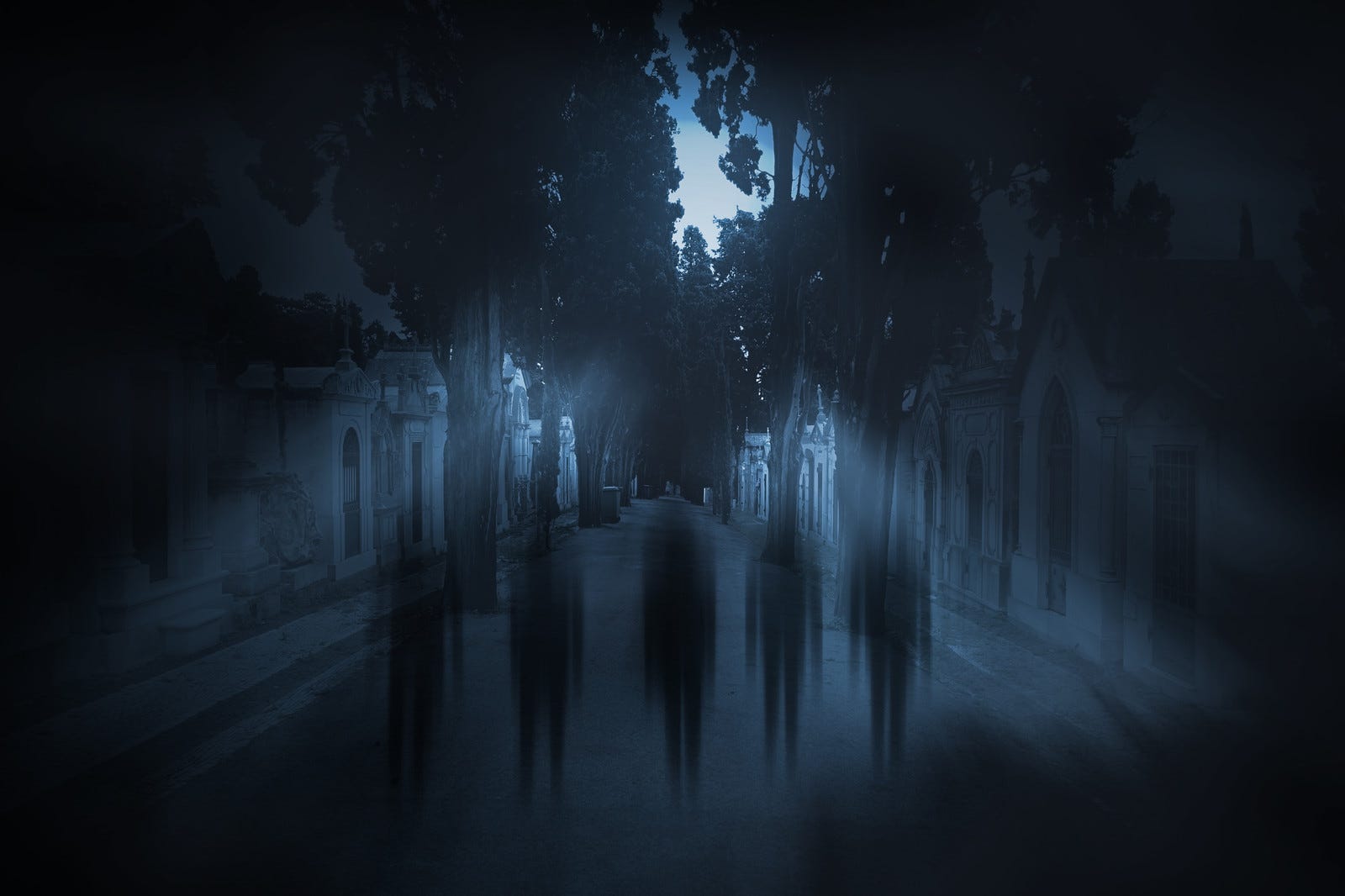
The night comes alive. Black hounds howl. The Queen beckons her chosen now. Your feet twitch, and your soul awakes. Crossing the threshold, entering the mysteries. Found in the depths of Hekate’s Cauldron, where spirits abound.”
- Chapter 15, Crossing the Threshold: Spirits of the Deeper World, Entering Hekate’s Cauldron
Spirits are always with us. From our altar to the wandering ghost we sense in an unfamiliar room, the world is enchanted. In Chapter 15 of Entering Hekate’s Cauldron, I write about this directly: “If we shift our gaze beyond the illusory veil of separation between the physical and the etheric, we can see how much we are already walking in their world.” This is not metaphor. It is the lived reality of the witch’s path, and it is the reality Hekate has always presided over.
This article is drawn from a talk I gave as part of a seminar. You can watch the talk on YouTube or listen to as a podcast episode wherever you get your podcasts. What follows expands on those ideas, woven together with material from Chapter 15 of Entering Hekate’s Cauldron. My hope is that it gives us a richer foundation for understanding Hekate’s alliance with the spirit world; its history, its structure, and how we can begin to navigate it with confidence, discernment, and genuine connection.
Hekate’s Trail of Spirits
The complexities of Hekate’s history speak of the multitudinous ways her connections with spirits of the deeper world can present themselves to us as contemporary practitioners. While I will always say that the version of Hekate that matters most is our personal understanding, reviewing the historical interpretations of her helps us to interpret our experiences. It is undeniable that wherever Hekate is, there are spirits. Yet how – and who – is encountered can be filtered through the times in which we live and what information we’ve learned. I’ll start with a story. Many years ago, I read an essay by an author I greatly admired. She went deep into how Hekate was dangerous. It felt like the blogger was saying that she alone had the special power to work with Hekate, because she was so heavy-handed in her description about Hekate being quite nasty. Specifically, the author cited that children couldn’t be present when one was working with Hekate because she was dangerous to them. I found this odd, given the historical references to Hekate as a Kourotrophos, or guardian of the young. Is Hekate dangerous? Not in my experience. Does working with her make us vulnerable to harmful entities? Not in my experience, either. If one knows a small fraction of Hekate’s history, it’s easy to see why someone might think she’s nefarious. However, surveying the almost 3,000 years of history about her, reveals that how she is seen varies greatly by the time and place.
This quote captures a great deal of that complex history:
“And yet, none of the earliest evidence for Hecate presents her as anything but a normal-indeed rather benign-goddess. ... Hecate’s entry into Greek literature is the famous “Hymn to Hecate” from Hesiod’s Theogony, where far from displaying any frightening traits, she is highly praised as a goddess who can bring a variety of benefits to different people-fishermen, kings, and children, to mention just a few. Even after she begins to be associated with restless souls, the beneficent side of her personality does not disappear. Pindar describes her as a kindly messenger who announces to the Abderites that they will be victorious. It was probably her role as guardian of entrances that led to Hecate’s identification by the mid fifth century with Enodia, a Thessalian goddess. Enodia’s very name (”In-the-Road”) suggests that she watched over entrances, for it expresses both the possibility that she stood on the main road into a city, keeping an eye on all who entered, and in the road in front of private houses, protecting their inhabitants.” Sarah Iles Johnston, Restless Dead: Encounters Between the Living and the Dead in Ancient Greece (Published by University of California Press, 1999)

Ancient Hekate-Enodia, from a votive relief from in Macedonia. Permanently preserved and exhibited at the Archaeological Museum of Kozani, Greece.
Hekate’s Ancient Spirits
Hekate’s ancient relationship with spirits is fascinating. In ancient sources, Hekate is described as ever-companioned by spirits. She presides over the restless dead, the etheric beings, the companion animals, and the vast array of entities that populate the deeper world. The ancient Greeks understood the spirit world as layered and complex, a living, breathing ecosystem of beings with their own wills, their own wisdom, and their own relationships to the living. Hekate was the one who moved through all of it, torch in hand, illuminating what others could not see. Hekate’s governance over thresholds was embedded in how the Greeks understood this foreign goddess that they had found in ancient Anatolia. She was the one who controlled all unpleasant spirits, whether they were the restless dead or uncompliant foreigners.
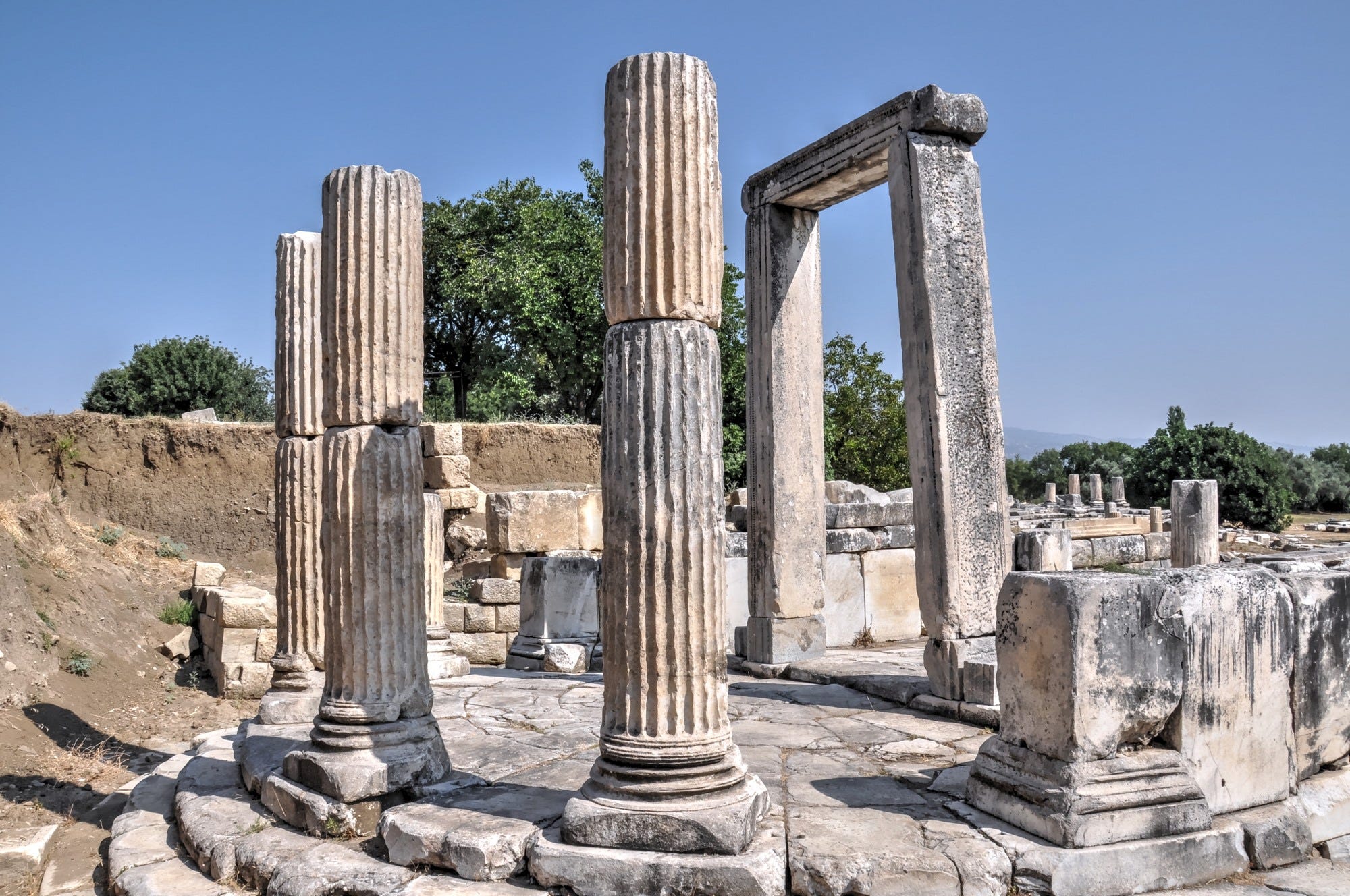
There is a temple of Hecate at Lagina in Caria where the goddess was worshipped as soteira, Megiste, and epiphanestate; her exalted rank and function here are unmatched in cults of Hecate elsewhere. Her cult statue, represented on coins of Stratonikaia and on the north frieze of her temple in Lagina, was not trimorphic but exhibited the “original” form of the goddess. Hecate: Greek or “Anatolian”? William Berg. Numen, Vol. 21, Fasc. 2 (Aug. 1974), pp. 128-140
The Crossroads of Cultures
There is also the way the Greeks syncretized their understanding of Hekate with the goddess Enodia from Thessaly. Anatolia to the south, Thessaly to the north, these unwieldly lands were the source of great stress to the ancient Greeks. It is perhaps unsurprising then, that Hekate-Enodia became so entwined with a horde of spirits that the Greeks didn’t want to deal with.
Ennodia is a distinctive Thessalian deity originally worshipped as a local goddess, later assimilated with Artemis in various regions, and associated with Artemis or Hecate in literary sources. Scholars debate her true portrait, viewing her either as a local chthonian goddess and Thessalian Hecate sharing interests in childbirth, poisons, and witchcraft, or as the local Persephone...”
- Maria Mili, Religion and Society in Ancient Thessaly (2015), Chapter 3, Section 3.4.2: “On the Road: the Cult of Ennodia”.
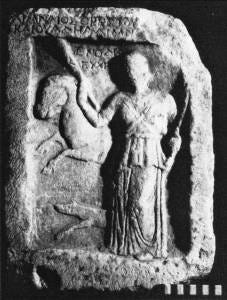
Ancient Hekate-Enodia, shown with a dog, torch and horse. Permanently preserved and exhibited at the Archaeological Museum of Kozani, Greece.
The Connection with Witches
Over time, especially in plays and prose, the Hekate of the Classical Greek work was very different than how she was known in ancient Anatolia. She had become, especially in fictional works, a figure who was associated with spirits, ghosts, witches. The Romans reinforced these ideas about her, and, as the centuries passed, she became the undeniable Queen of Phantoms. By the time Shakespeare brought her into his plays, she was purely associated with dangerous spirits and witches. The renewed Victorian interest in all things Greco-Roman brought new scholarship and translations of ancient texts that had been preserved through Medieval scribes. Within their perspective, Hekate was nefarious, the antithesis of a “good Christian woman.” The influence of these authors lingers today, much like the restless dead.
…she came to be regarded as a spectral being, who sent at night all kinds of demons and terrible phantoms from the lower world, who taught sorcery and witchcraft, and dwelt at places where two roads crossed, on tombs and near the blood of murdered persons. She herself wandered about with the souls of the dead and her approach was announced by the whining and howling of dogs. Smith, William. A New Classical Dictionary of Greek and Roman Biography, Mythology and Geography. Edited by Charles Anthon, Harper & Brothers, 1851.
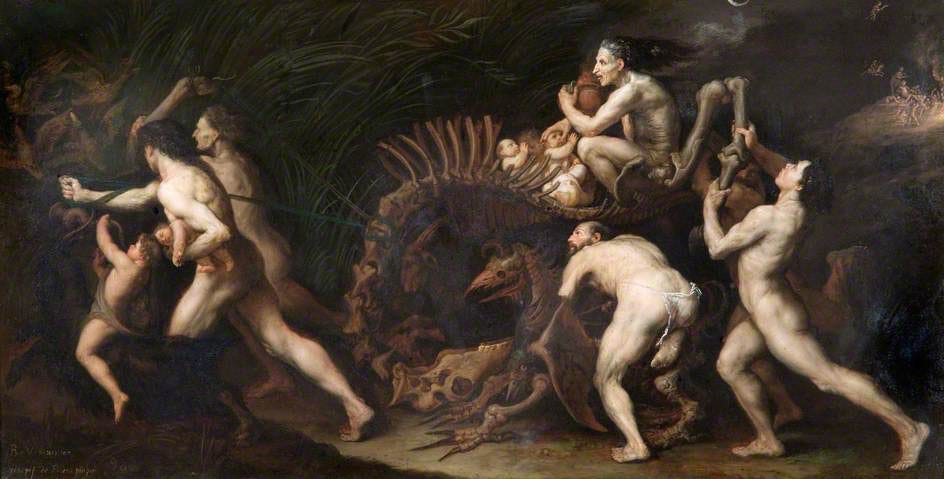
Hecate: Procession to a Witches’ Sabbath (alternatively known as La Carcasse: A Witch Being Drawn on the Skeleton of a Monster). Artist: Jusepe de Ribera (Spanish Baroque, 1591–1652)
Hekate’s Suppers: Keeping Spirits Out of Bounds
Hekate’s Suppers (Deipnon) were held in order to prevent these spirits from invading the “within boundaries,” areas of the Greeks. Homes, perhaps only those of the wealthy according to some ancient sources, were cleansed of miasma through practices including ritual sacrifices, which were disposed of (oxuthemia), as well as a “fine meal,” being left at a crossroads on the night when the moon was dark. These were apotropaic rites designed to curry Hekate’s favor and keep her “hungry ghosts” fed. It should be noted that the night when the moon was dark, which we call the new moon, was the of the month for the Greeks. The end of the month was widely regarded as a day when the dead were more connected to the living. Part of this ritual process was to never look back after leaving the meal because doing so meant that one could be entrapped by Hekate and her horde of frightening entities. While this is very different from my own approach to honoring Hekate on the Dark Moon, understanding the historical roots has helped me to contemplate how Hekate’s association with spirits flows through ancient texts.
“When depositing the purifications (katharmata) at the triple-crossroads, turn away and walk back without turning around, lest you look upon the terrifying phantoms of the goddess and lose your mind.” - Scholia on Theocritus, Idyll 2.12
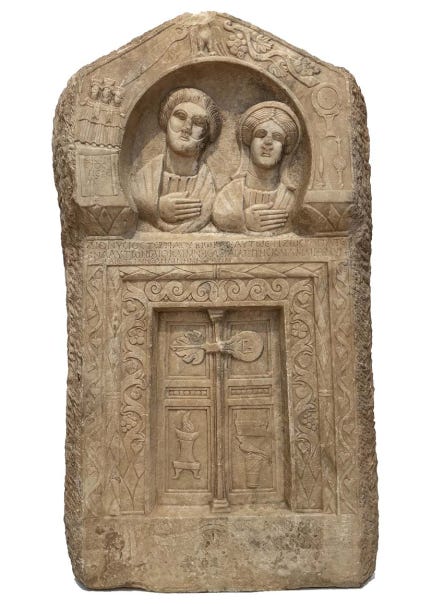
A funerary stele (tombstone) featuring Hekate. A topic I didn’t get into is Hekate’s soteriological aspect. Learn more here.
Hekate and Spirits in Ancient Magic: The Greek Magical Papyri, Curse Tablets and Tombstones
The literary association of Hekate with spirits and the practice of Hekate’s Suppers is reinforced by ancient incantations. The richest source of Hekate’s connection with spirits in the ancient world being used for magic comes from a collection of fragments depicting spells and rituals that are collectively known as The Greek Magical Papyri (PGM). Within their incantations, her connection to spirits is woven into her most ancient epithets. The practitioner’s words thrum with power as they invoke her epithets in connection with summoning spirits. The ancients believed that daimons – spirits of animals, people and so on – could be summoned and controlled with Hekate’s assistance. Additionally, ancient curse tablets do the same thing. There are also stele – tombstones – that call upon her watchful guidance over the spirits of the departed.
“Hail, goddess, and attend your epithets, O heavenly one, harbor goddess, who roam
The mountains and are goddess of the crossroads; O nether one, goddess of depths, eternal,
Goddess of dark, come to my sacrifices.
Fulfill for me this task, and as I pray
Give heed to me, Lady, I ask of you.” PGM IV. 2441-2621: Spell of Attraction
Many of the spells, such as this one, are erotic in nature, calling her forth to do bidding to win over affection, or bring suffering to the one who rejected amorous advances. The sending of spirits directed by Hekate to enact these outcomes is embedded into the ancient practitioner’s understanding of the nature of daimons.
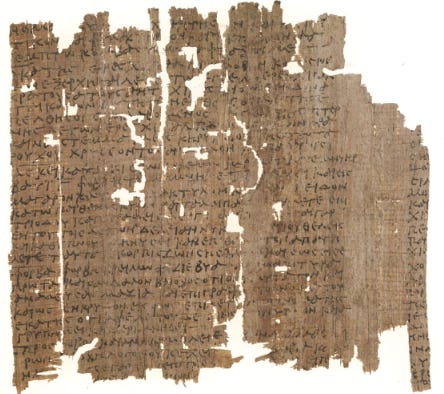
Fragment from the PGM. Source.
Hekate as The Mediator of Spirits
Now we arrive at Hekate who may appear to be very different than the versions of her I’ve mentioned so far. In The Chaldean Oracles, Hekate is positioned as the cosmic container that links and mediates the realms of humans with the deeper world (it’s a lot more complicated than that, but I’ll stop there for now). She is linked with angels - fierce messengers of the divine who serve as communicators and protectors. This is not the soft, pastel-winged imagery of popular culture. These are powerful, sometimes terrifying beings who carry divine fire. Hekate’s association with them tells us something important: the spirit world she governs is not gentle or decorative. It is vast, fierce, and alive with intelligence. It also brings to life a connection to spirits that aren’t troublesome, aren’t doing a magician’s legwork, and aren’t watching over souls as they transition between the physical world and the deeper one.
“Hecate pours forth the great strength of the powerful and vivifying fire... She is the ruler of the intermediate realms, the Mother of Angels, directing the celestial guides who shine inflexibly.” Chaldean Oracles, Synthesis of Fragments 32 & 36
Putting all the Ancient History Together
All of this complex web, from keeping Hekate’s horde at bay, to conjuring her assistance in spells, calling upon her guidance for the departed, and her more cosmic presentation in The Chaldean Oracles (and other Neoplatonic writings, especially those of Proclus), demonstrate that she is, above all, the connector between humans and all that abides in the deeper world – ancestors, the restless dead, etheric beings and such. This is the world we step into when we follow her torches.
Ultimately, looking at Hekate through this multi-layered historical lens reveals a vital truth: she was never just a goddess of the margins, nor was she merely an abstract cosmic force. She is the sovereign of the ecosystem of the unseen. Whether the ancients were frantically sweeping out their homes during the Deipnon to keep her spooky horde at bay, or the Neoplatonists were invoking her cosmic lightning as the Mother of Angels, they all recognized her absolute authority over transition. When we step to the crossroads on the dark moon today, we aren’t just engaging in historical roleplay; we are stepping into a centuries-old current of spatial hygiene, learning to govern the boundaries of our own lives under the watchful, torch-lit gaze of the Queen of Spirits.
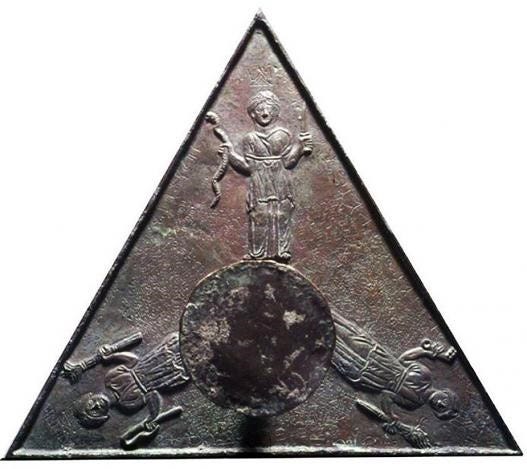
The Pergamon Magic Tablet, which may have been used for speaking with spirits. SOURCE.
A Taxonomy of Spirits: The World Hekate Governs
In Chapter 15 of Entering Hekate’s Cauldron, I attempted to organize the types of spirits into a taxonomy. The spirit world can feel overwhelming, just like navigating the complexities of her history. It is vast, shapeless, and nonrational, and having a map to orient ourselves within it can be helpful.
The Divine
At the highest level, we have the divine: Hekate herself, and the forces she embodies, including the realms, the elements, the celestial cycles, the deep time of the universe known as kairos. These are the foundational archetypal forces that underpin everything else.
Ancestors
Then we have ancestors: our blood relatives who have passed, and our spirit ancestors; the long-departed whom we honor as part of our spiritual lineage. Witch ancestors. Healers. Those who walked this path before us and who reach across time to guide us still.
Higher Order Spirits
Higher order spirits include angels and the Mighty Dead. They are ascended beings who were once human and have evolved beyond mortal limitations. They come as teachers, descending from the celestial into our visions and dreams. They are fierce communicators, and they are extraordinary allies when the relationship is built with respect.
Middle Order Spirits
Middle order spirits are the dead who are still tethered to the earth plane, along with certain land and sea spirits brimming with intelligence and personality. Nature spirits, such as the fae, dryads, wights, can be included here as well. They can be willful, but they are generally mature and capable of genuine relationship.
Lower Order Spirits
Lower order spirits are denser entities that lead with emotion and instinct rather than will or wisdom. The restless dead. Disruptive ghosts. Certain land spirits prone to interference. These are the ones we most need protection from, not because they are inherently evil, but because they are unrefined, reactive, and drawn to unguarded energy. They can also, at times, act as protectors, which is part of what makes discernment so essential.
Spirits With Flesh
Beyond the purely etheric, the spirit world also includes what I call corporeal spirits: beings with physical form. Animals, plants, stones. Locations and physical spaces like haunted places, crossroads, monuments. Magical objects that develop their own personality and will. Relationships and groups that generate their own spirit over time. Even our emotions carry archetypal weight far greater than our personal experience of them.
Animism, which is the understanding that all beings, objects, and locations have a spirit is the recognition of the enchanted nature of reality. And it is entirely consistent with what Hekate has always taught: the veil between the physical and the etheric is illusory. We are already walking in their world. And they walk in ours.
Connecting with Spirits: Practical Practices
Understanding the taxonomy is one thing. Actually connecting is another. Keeping ourselves safe from harm is imperative. Yet, we need to be open enough to sense their presence. Abiding at the crossroads means developing skill at both receptivity and defensive boundaries. We don’t want to miss beneficial entities, yet we need to avoid trouble. Some of the most powerful spirit connections happen in the simplest moments; a dream that lingers, a stone that seems to pulse in our hand, a sudden knowing that arrives from nowhere.
I’ve been teaching Modern Hekatean Witchcraft for a long time. What I know for certain is that Hekate connects us with spirits, and as we develop our skills, the spirits she presents will increase in complexity. Start at the start. Avoid spiritual bypassing. I’ve seen this in some students. Those who want to practice mediumship but don’t have a steady foundation in a daily practice usually end up exposed to risk, burnt out and chaotic. While I appreciate being called to mediumship and channeling, and I certainly do both, I strongly caution against either unless the practitioner has rooted themselves through established practice. Spirits can possess, misguide and inhabit. They are not to be trifled with. I’ve yet to meet anyone who has a solid practice, which doesn’t need to be complicated, who has gotten into deep trouble in the deeper world.
What follows are some practices that are accessible, grounded, and deeply rooted in the tradition Hekate herself embodies. For those who want to go deeper - including full instructions for the Khernips purification ritual and guided spirit meditations - all of this is covered in detail in Entering Hekate’s Cauldron. I’m not going to explain how to summon spirits or speak directly to the dead in a blog article. Such things should be reserved for a more appropriate setting. These basic practices will help develop a steady foundation.
Tending The Altar
Our altars are the focal point for the spirits we work with. As I write in Entering Hekate’s Cauldron, we enliven them through our work, and they have much to teach us. An altar does not need to be elaborate. A candle, a stone, an image of Hekate, a small offering of water or herbs are enough to create a contained threshold, a place where the seen and unseen can meet in a protective space. The act of tending it regularly as daily practice, such as lighting a candle, making an offering, and speaking a few words of acknowledgment, is itself a form of spirit communication. We are saying: I see this world. I am here. I am listening.
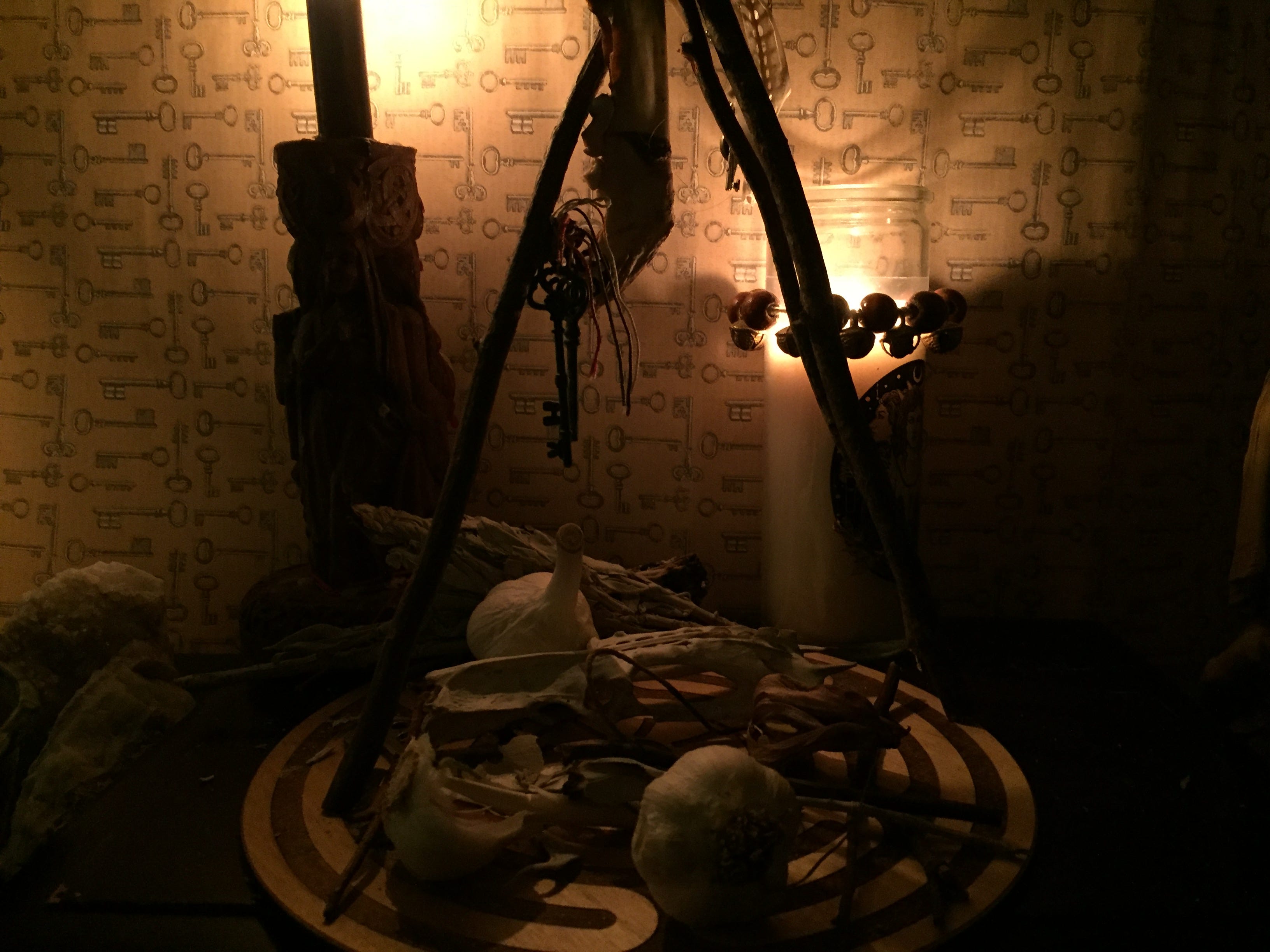
A crossroads altar with a simple Hekate’s Supper.
Walking in the Dreamworld
All of us travel in Hekate’s country every night. The dreamworld is the juncture of our personal lives with the realm of spirits, and it offers rich treasures for understanding ourselves and the universe. Keeping a dream journal, setting an intention before sleep to receive guidance, and paying attention to recurring symbols or figures, these are simple, powerful ways to begin building relationships with the spirit world. Spirits communicate symbolically. Dreams are their native language. I wrote about the dreamworld in Entering Hekate’s Cave:
When I’m asked about beginning a relationship with Hekate, my response is always to look to your dreams. Trust me, she’s been trying to get your attention your entire life. Dreams can offer illumination into your own darkness; from aspects you need to heal to long-abandoned desires. They can also be about the external world, providing insight into relationships, situations, and others. Dreams are communications from the unconscious. Their symbols can evoke strong emotions. When we enter the darkness of sleep, we go into Hekate’s world. As we wander in the dreamscape, our physical selves vanish into something more. We walk among archetypes, tread in the web of the universe, and stretch beyond our mortal limitations. It is a sad state of affairs that our culture devalues the importance of dreams.
Invoke Hekate Through Her Epithets
One of the most direct ways to connect with Hekate as guide and guardian of the spirit world is through her epithets. Each epithet is an archetypal doorway; a focused point of connection with a specific aspect of her vast nature. Epithets that can help us with spirit work include Enodia (for mundane issues), Psychopomp (for guiding souls to the other side) and Anassa Eneroi (Queen of the Dead) for calling upon the departed. Pyriboulos, the fiery counselor, brings discernment and illumination. Physis connects us to the wholistic spirit of nature. Invoking these names in ritual, in meditation, or even in a quiet moment of prayer opens a channel that is both ancient and immediate. She has been answering these calls for millennia. She knows the way.
Cleanse and Protect Your Space
Regular spiritual hygiene is not optional for those of us who work with spirits. Our spaces accumulate energetic residue - from our own emotional states, from visitors, from the land itself. Simple practices make an enormous difference: an open dish of salt at the entrance to our home, amplified with lavender or juniper, wards off unfriendly spirits. Walking counterclockwise around our space with salt and clear intention creates a protective boundary. Keeping mirrors covered when not in active use prevents unintended spirit contact. These are small acts with significant effects, and they are the foundation upon which deeper spirit work is safely built. For a full purification practice rooted in ancient tradition, the Khernips ritual in Entering Hekate’s Cauldron is my preferred method.
“The words spoken in the ritual are drawn from the classical underworld mysteries, specifically adapted for our coven’s needs. The script-”Procul o procul este profani, sit mihi fas audita loci”-is rooted in Book VI of Virgil’s Aeneid. In this epic, the words are shouted by the Sibyl, the powerful prophetess of Cumae, just as she prepares to guide Aeneas down into the realms of the Dead. It was a literal command to keep the uninitiated away from the sacred, terrifying mysteries of the Underworld. By using this command to anchor our modern khernips, we are doing more than reciting historic poetry. We are using a tried-and-tested acoustic key designed to drop a heavy curtain between the waking world and the deeper realms of spirit. It announces to the environment that the space has officially been claimed by the initiated.” From The Covina Traditions Khernips Ritual of Purification Guidebook,” available for students in The Via Hekate.
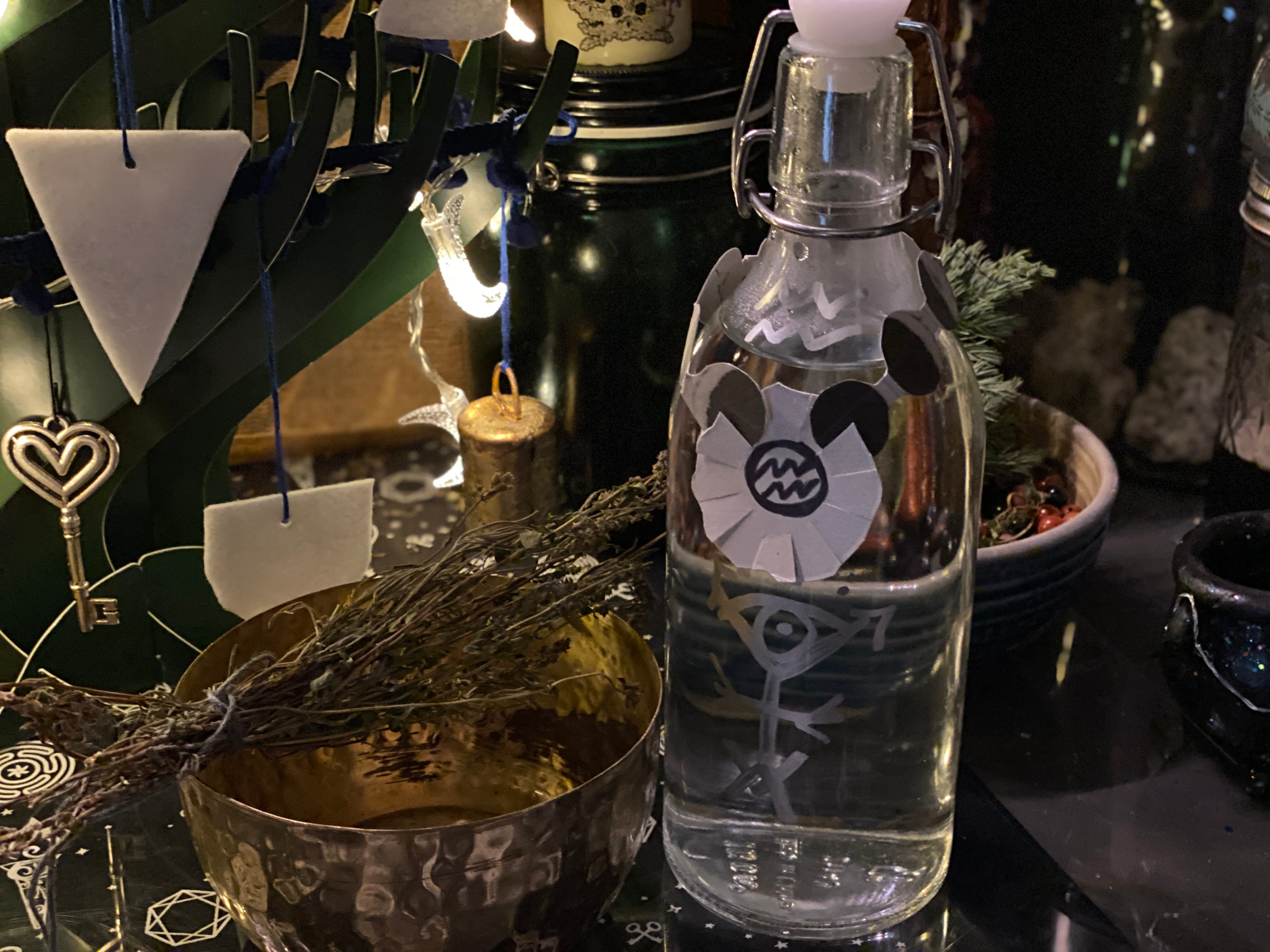
Khernips ready, with Psychopomp moon water.
Pay Attention to Signs and Sumbola
A sumbolon is a material object found or given to us, such as a stone discovered on a significant walk, a feather that appears at a meaningful moment, an object that arrives in a dream and then manifests in waking life. These are links between us and the spirit realm, and they deserve our attention. Sigils can be created based on sumbola, used as focal points for ongoing connection, or simply honored as evidence that the spirit world is already reaching toward us. The conversation is already happening. Our work is to notice.
Owning Our Hungry Ghosts
The spirit world is not only out there. It is also within us.
The concept of hungry ghosts comes from Buddhist teachings. They are beings trapped in a state of insatiable craving, unable to be nourished no matter how much they consume. In a spiritual and psychological sense, we all carry hungry ghosts: our trauma wounds, our shadow aspects, our inherited patterns, the parts of us that are still starving for something we may not even be able to name.
I have several chronic conditions. I’ve had them most of my adult life. I function well, I’m fortunate in that, but they are part of my daily reality. For a long time, I understood the hungry ghost to be the illness itself. The more I sat with it, however, the clearer it became: the hungry ghost is the trauma that most likely gave rise to the conditions. It lives in my DNA, in my genetic predispositions. It lives in the environment where I grew up in, which was a heavily polluted town where chronic disease is rampant, where the very air carried harm. The illness is a consequence. The hungry ghost is the wound beneath it.
This distinction matters. When we name the ghost correctly, we can begin to relate to it honestly. Some hungry ghosts can be banished. Through ritual, through healing work, through the slow alchemy of self-awareness, we can release them. But others, like the ones woven into our biology, our lineage, our earliest formation, are simply part of our personal horde. Like Hekate’s own horde of spirits, they travel with us. Our work is not always to eliminate them, but to govern them. To manage their restlessness. To understand their miasma and not let it overtake us. This is what spiritual maturity looks like in practice. Not the absence of shadow, but the capacity to hold it without being consumed by it.
The Spirits That Are Drawn to Us
Unhealed wounds can act as beacons. When we are caught in the chaos spiral, when our shadow aspects are running the show, certain spirits are drawn to that energy. Not all of them are benevolent. In my earlier years of practice, before developing real discernment and protection, I had encounters with malevolent spirits of place. Land spirits that were disruptive. Ancestral presences that were unresolved and heavy. These are what the book calls lower-order spirits. These are denser entities that lead with emotion and instinct rather than wisdom. They can interfere. They can drain. And they are particularly attracted to the unguarded, the unhealed, the spiritually open but unprotected. The same liminal nature that makes us witches creates our capacity to weave between worlds, to sense what others cannot, but it also means we need to be intentional about what we allow into our field.
There are also spirits who are fierce, even intimidating, but who are absolutely on our side. Shadow allies. Spiritual bodyguards. The discernment required is not whether we feel fear, but whether we are frightened of them, or whether they are simply frightening in general. Hekate, as mistress of the horde, is the ultimate guide in making that distinction.
Worth naming, too, is something that does not always receive sufficient attention: toxic bonds with the living and the dead can function like spirit attachments. Relationships that drain us, ancestral patterns that bind us, the energetic residue of those who have harmed us - these are all part of the spirit ecology we carry. Regular cleansing and conscious boundary-setting are not optional extras for the serious practitioner. They are foundational.
The Nature of Genuine Spirit Alliance
Having a spirit guide as ally for working with spirits has been central to my practice for decades. Not a vague sense of guidance, but a specific relationship - a being with their own personality, their own wisdom, their own way of communicating. A specialist, in a sense, for the particular terrain of our path.
The nature of genuine spirit alliance is reciprocity. Mutual respect. Connection that flows in both directions. As I write in Entering Hekate’s Cauldron, we can develop enduring relationships with spirits, or call upon them for specific workings - but in either case, they are not push-button entities that perform on command. They come with their own will, their own wisdom, their own timing. We receive, and we also give. We call, and we also listen. We ask, and we also offer.
The guide who comes to us may be an ancestor. It may be an animal spirit. It may be a purely etheric being - what some of us would call an angel or an angelos. It may be one of the Mighty Dead, a figure from our spiritual lineage who has traveled across time to find us. Whoever arrives is right for us in that moment. Trust the arrival. And know that the relationship, once established, is one we tend - through offerings, through acknowledgment, through showing up consistently in our practice.
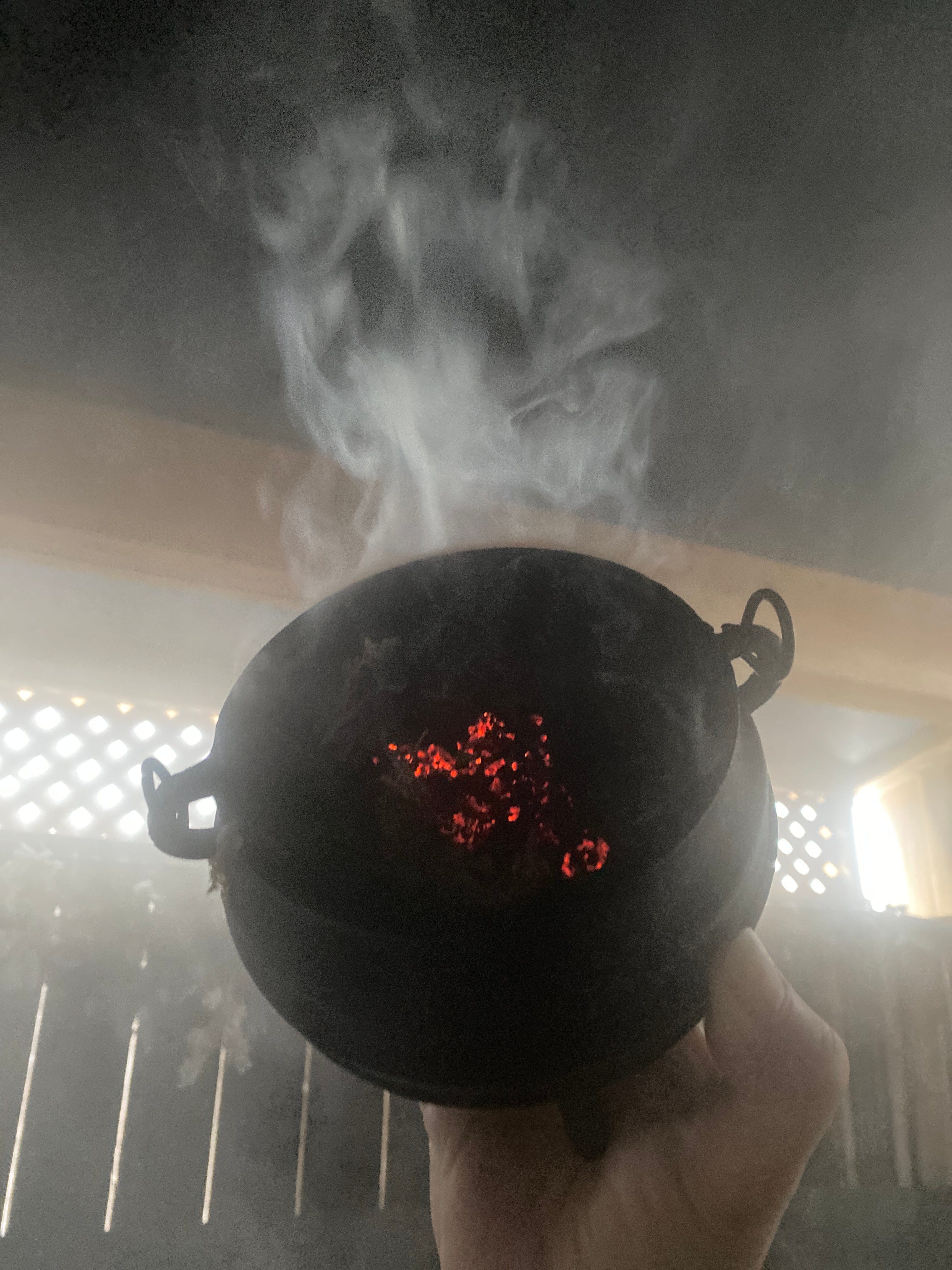
Burning leaves to cleanse, protect and connect to my spirit guides.
Tips for Working With Spirits
Drawing from the talk and Chapter 15 of Entering Hekate’s Cauldron, what follows are the practices I consider most essential for navigating this work with integrity and safety:
Cleanse regularly, inside and out. Salt scrubs for the body, open dishes of salt at entrances amplified with lavender or juniper, and regular energetic clearing of our spaces - these are foundational maintenance, not optional extras. Our own unhealed wounds can attract lower-order spirits, so keeping ourselves and our spaces clear is an act of spiritual self-governance. For a full purification practice, the Khernips ritual in Entering Hekate’s Cauldron is an excellent place to begin.
Know your hungry ghosts. Before we can work effectively with external spirits, we need to understand the spirits within us - our trauma wounds, our shadow aspects, our inherited patterns. Some can be released. Others we learn to govern. Either way, naming them honestly is the beginning.
Protect your space with intention. Walk counterclockwise around your home spreading salt. Place salt, a bay leaf, and black obsidian at entrances. Keep mirrors covered when not in active use. These practices create a container that supports genuine connection while keeping unwelcome visitors at bay.
Distinguish between fierce and harmful. Some spirits are intimidating but are absolutely on our side - shadow allies who act as protectors. The question to ask is not whether we feel fear, but whether we are frightened of them, or whether they are simply frightening in general. Our deeper knowing usually discerns the difference.
Let the mystery be the mystery. Spirits communicate symbolically - through dreams, visions, inner knowings, and the “clairs” (clairaudience, clairsentience, claircognizance). Not everything will resolve into tidy, immediately legible meaning. What does not make sense to the conscious mind may be perfectly understood by the deeper Self.
Pay attention to sumbola. A sumbolon is a material object found or given to us during a deeper-world experience - a link between us and the spirit realm. These can become the basis for sigils and ongoing connection. Honor what arrives.
Build relationships rooted in reciprocity. Whether working with ancestors, the Mighty Dead, land spirits, or purely etheric beings, approach with respect. Make offerings. Express gratitude. Acknowledge that these relationships flow in both directions - we receive, and we also give.
Work with Hekate as guide and guardian. She is the mistress of spirits, the keeper of the horde, the one who leads us through the deeper world with torches lit. Call upon her assistance. Always.
We Are Already Walking in Their World
The spirit world is not somewhere we go. It is somewhere we already are. Every altar we tend, every dream we remember, every moment of inexplicable knowing - these are the spirits, already in conversation with us. Our work is to become conscious participants in that conversation. To purify ourselves enough to hear clearly. To protect ourselves enough to engage safely. To open ourselves enough to receive what is genuinely meant for us.
Hekate walks with us through all of it. Her torches illuminate the path. Her horde reminds us that we are never alone in the deeper world - and that the deeper world is never truly separate from this one. She has been doing this work since before recorded history. She knows every spirit we will ever encounter. And she is willing to guide us - if we come with respect, with preparation, and with an open heart.
The hungry ghosts within us, the spirits around us, the guides who wait at the crossroads - all of it is part of the same vast, enchanted web. We are not separate from it. We are woven into it. And that is not something to fear. It is something to honor.
Resources
Ancient & Historical Primary Sources
The Chaldean Oracles – A 2nd-century CE collection of Neoplatonic philosophical fragments positioning Hekate as the cosmic Anima Mundi (World Soul) and “Mother of Angels”.
The Greek Magical Papyri (PGM) – A body of ancient Egyptian and Greek magical texts (specifically referencing PGM IV. 2441-2621: Spell of Attraction) utilizing her underworld epithets for summoning daimons.
Hesiod’s Theogony – The archaic literary origin point for her “Hymn to Hecate,” depicting her as a highly benevolent, multi-realm guardian (Kourotrophos).
Pindar – Classical choral poetry referencing her as a kindly messenger of victory.
Scholia on Theocritus (Idyll 2.12) – Ancient marginal commentary detailing the mechanics of the Deipnon, household katharmata (sweepings), and the ritual taboo of not looking back.
Virgil’s Aeneid (Book VI) – The classical underworld epic used as the acoustic ritual key (“Procul o procul este profani...”) for modern spatial purification.
Modern Academic Resources
Berg, William – “Hecate: Greek or ‘Anatolian’?“ published in Numen, Vol. 21, Fasc. 2 (Aug. 1974), pp. 128-140. Focuses on her original, single-bodied cult statue at the temple of Lagina in Caria.
Johnston, Sarah Iles – Restless Dead: Encounters Between the Living and the Dead in Ancient Greece (University of California Press, 1999). Analyzes her transition from a benign gateway guardian to the mistress of restless souls.
Mili, Maria – Religion and Society in Ancient Thessaly (2015). Explores the cult of the crossroads goddess Ennodia and her subsequent synthesis with Hekate.
Smith, William (Ed. Charles Anthon) – A New Classical Dictionary of Greek and Roman Biography, Mythology and Geography (Harper & Brothers, 1851). A Victorian-era reference cataloging her late-classical and Roman shift into a spectral queen of phantoms.
Practical Books & Curriculum
Entering Hekate’s Cauldron: Foraging the Deep Witchcraft of the Goddess of the Crossroads
Entering Hekate’s Cave: The Journey Through Darkness to Wholeness
The Via Hekate / The Covina Tradition
About me: Cyndi Brannen, PhD, is a feminist scholar, modern witch, and the bestselling author of Keeping Her Keys. Abiding at the crossroads of modern life and the deeper world, she blends academic research with spiritual practices to teach Modern Hekatean Witchcraft. Her popular book trilogy: Entering Hekate’s Garden, Entering Hekate’s Cave, and Entering Hekate’s Cauldron explores green witchcraft, shadow work, and magickal practices in that order. Cyndi founded The Covina Institute, an online soul school dedicated to deep spiritual exploration, shadow work, and reclaiming personal wholeness, in 2018. Prior to that she taught in-person courses and did spiritual coaching. Way before that she was an academic focused on women's well-being, close relationships, and caregiving. Connect with her work, including meditations, podcast episodes, articles about Hekatean Witchcraft, courses and community at keepingherkeys.com.


