

To enter into the horde of Modern Hekatean Witchcraft is to step outside the curated walls of human exceptionalism and return to the wild, wet matrix of creation. This is a radical approach in our modern world where the dominant systems exploit nature for the almighty dollar. To enter into an animistic web that is woven collaboratively, where “power with,” rather than “power over” are the threads. This practice doesn’t treat animals as passive symbols, psychological projections, or convenient tools for sorcery. The animal kingdom is recognized for what it truly is: a sovereign realm of divine consciousness, unmediated gnosis, and absolute power, of which we are part. To build this practice with authentic structural integrity, I’m anchoring this work in three foundational pillars. Together, they form a trinity, bridging ancient cosmos-mapping with modern somatic reality. These are Hekate’s epithets of Physis, Potnia Theron, and Pyripnoa.
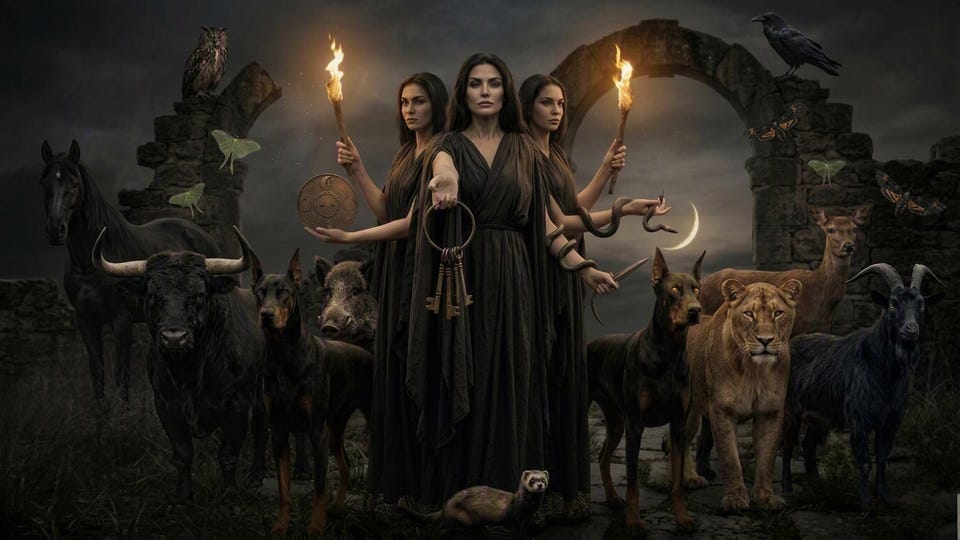
Hekate Physis: Nature Herself
Before we can understand Hekate’s relationship with individual animals, we first grasp her identity as Physis—Nature herself. This is not Hekate as ruler over nature, but Hekate as nature, the living web of interconnection that encompasses all beings, the intelligence inherent in ecosystems, the collaborative power of symbiosis and mutual aid.
Physis in Ancient Sources
The epithet Physis (Φύσις) appears in ancient sources as a title that positions Hekate as the fundamental principle of nature itself. In Greek philosophy, physis referred to the essential nature of things, the inherent order and growth principle within all living beings, the force that causes seeds to sprout and animals to follow their instincts. When applied to Hekate, this epithet elevates her from a goddess associated with nature to a goddess who is nature—the animating principle within all natural processes.
In the Greek Magickal Papyri, Hekate is invoked as the force that governs natural cycles, the power that moves through all living things, the consciousness that connects predator and prey, plant and animal, earth and sky. The practitioners who wrote these spells understood that to call upon Hekate Physis was to invoke the entire natural world as a unified, conscious entity.
The Chaldean Oracles present Hekate as the World Soul (Anima Mundi), the cosmic principle that animates all creation. In this theological framework, Hekate is not separate from nature but is the very consciousness that flows through it—the intelligence that guides the migration of birds, the instinct that teaches predators to hunt, the wisdom that causes plants to turn toward the sun. She is immanent divinity—present within creation rather than transcendent above it.
Physis and the Interconnected Web
To understand Hekate as Physis is to recognize that she embodies the fundamental truth of ecology: all beings are interconnected, all life forms participate in a vast web of relationship, and the health of the whole depends on the flourishing of each part. Nature doesn’t operate through domination hierarchies but through symbiosis, mutual aid, and ecological balance. The predator needs the prey, the prey needs the plant, the plant needs the soil, the soil needs the decomposers—each being plays its role in the great cycle of life, death, and rebirth.
Hekate Physis teaches us that there is no “great chain of being” with humans at the top and other creatures ranked below. Instead, there is only the interconnected web, where the worm is as sacred as the eagle, the beetle as divine as the lion, the serpent as wise as the human. All beings participate equally in the mystery of Physis—all are expressions of the same divine consciousness, all possess their own form of gnosis, all contribute to the sacred whole.
Immanent Divinity: The Divine Within Creation
The concept of Hekate as Physis challenges the patriarchal theological model that positions divinity as transcendent—separate from and above creation, ruling over nature from a distant throne. Instead, Hekate Physis represents immanent divinity—the sacred that dwells within all things, the divine consciousness that breathes in every leaf, hunts in every predator, dies in every prey, and is reborn in every seed.
This understanding has profound implications for how we relate to the natural world. If Hekate is nature, then to harm nature is to harm the Goddess herself. If animals are expressions of Hekate’s consciousness, then to exploit or dominate them is to reject the sacred. If the divine is immanent in all creation, then every encounter with the natural world is a potential encounter with the Goddess.
Working with Hekate Physis
· Spend Time in Nature: The most direct way to connect with Hekate Physis is to immerse yourself in wild places. Walk in forests, sit by rivers, observe animals in their natural habitats. Recognize that you are not visiting nature—you are participating in it, as one expression of Physis among many.
· Practice Ecological Awareness: Study the ecosystems in your local area. Learn which animals live there, what they eat, how they interact with each other and their environment. Understanding these relationships deepens your connection to Hekate as the intelligence that governs natural systems.
· Honor All Beings: Extend your reverence beyond charismatic megafauna (wolves, lions, eagles) to include the small, the overlooked, the “unlovely.” The spider, the worm, the beetle—all are sacred expressions of Physis. Practice seeing the divine in all embodied forms.
· Reject Extraction: Examine your relationship with nature. Are you taking from it, or participating with it? The “power with” model of Hekate Physis stands against extractive, exploitative relationships. You don’t take from Physis—you participate with Her.
· Invoke Physis for Healing: When ecosystems are damaged, when animals are threatened, when the natural world suffers, call upon Hekate Physis. Ask her to guide efforts toward restoration, to inspire humans to remember their place within the web, to heal the wounds inflicted by domination consciousness.
Signs of Hekate Physis’s Presence
· A sudden, profound sense of connection to all living things—feeling yourself as part of the web rather than separate from it
· Encounters with animals that feel significant, as if the animal is a messenger or teacher
· Dreams of being part of an ecosystem, of understanding the language of plants and animals, of seeing the world through non-human eyes
· Synchronicities involving natural cycles—noticing patterns in animal behavior, plant growth, or seasonal changes that speak to your current situation
· A growing awareness of ecological issues and a desire to participate in healing and restoration work
· Feeling the intelligence of nature—recognizing that the natural world is not unconscious matter but conscious, aware, and responsive
Potnia Theron: Lady Among the Beasts
From the vast consciousness of Physis—nature as living whole—we now turn to Hekate’s relationship with the individual beings who populate that web: the animals themselves. The ancient title Potnia Theron (Πότνια Θηρῶν) is often translated as “Mistress of Animals,” but this translation carries dangerous connotations of domination that fundamentally misrepresent the nature of this epithet. A more accurate understanding would be “Lady Among the Beasts” or “Sovereign of the Wild Community”—titles that emphasize participation rather than control, alliance rather than ownership.
Potnia Theron in Ancient Sources
The title Potnia Theron appears in ancient Mediterranean cultures long before it was applied to Hekate. In Minoan art, we see the goddess flanked by lions, standing between them in a pose that suggests neither domination nor submission but rather recognition—she is acknowledged by the beasts as one who belongs among them. In Mycenaean culture, the Potnia appears with various animals, always in relationship rather than in command.
By the classical Greek period, Potnia Theron was most commonly associated with Artemis, the huntress goddess who roamed wild places accompanied by her sacred deer and hounds. But the title also appears in connection with other goddesses including Kybele and eventually Hekate, particularly in her chthonic and liminal aspects. What all these goddesses share is not power over animals but power with them—they are recognized by the animal kingdom as kin, as allies, as ones who understand and honor the sovereignty of non-human consciousness.
In the Greek Magickal Papyri, Hekate is invoked as one who commands the spirits of animals, but this “command” can be reframed for a contemporary context. The ancient practitioners were not calling upon a goddess who enslaved animal spirits but rather one who could coordinate their collective power, who could speak the language of beasts, who could facilitate communication between human and animal consciousness. She was the mediator, the translator, the one who stood at the crossroads where human and animal worlds met.
The Matrix of Mutual Sovereignty
To understand Hekate as Potnia Theron is to recognize her as the archetype of the cosmic coordinator—the one who sits at the center of the web, not as spider controlling trapped prey, but as the point of connection where all threads meet. She runs with the pack, understanding pack dynamics from within. She flies with the swarm, moving as part of the collective intelligence. She holds the structural tension between hunter and hunted, recognizing that both are necessary, both are sacred, both are expressions of the same divine consciousness.
This is not the hierarchy of domination but the web of relationship. In nature, there is no “ruler” of the animals—there are only ecosystems where each being plays its role, where predator and prey exist in dynamic balance, where the death of one feeds the life of another in an endless cycle of transformation. Hekate as Potnia Theron embodies this ecological consciousness. She doesn’t impose order from outside the system—she is the intelligence within the system, the awareness that flows through all participants, the recognition that each being’s sovereignty contributes to the health of the whole.
When we invoke Hekate as Potnia Theron, we’re not asking her to control animals for our benefit. We’re asking her to help us understand our place within the wild community, to teach us how to walk as sovereign beings alongside other sovereign beings, to show us how to honor the unique gifts, boundaries, and magick of every non-human species. We’re asking to be initiated into the mystery of mutual recognition—where the human sees the divine in the animal, and the animal recognizes the human as kin rather than threat.
The Antidote to Exploitation
In Modern Hekatean Witchcraft, invoking Hekate as Potnia Theron establishes our ethical framework for working with animal spirits and the natural world. This epithet stands as a direct challenge to the exploitative, extractive relationship with nature that has characterized much of human civilization, particularly in the post-industrial West. We do not “command” animal spirits as if they were servants. We do not appropriate their power to serve our human egos. We do not treat them as resources to be used and discarded.
Instead, we enter into alliance based on mutual recognition. We acknowledge that animals possess their own forms of consciousness, their own ways of knowing, their own spiritual authority. We recognize that they have gifts to offer—not because we can take those gifts by force, but because they may choose to share them with those who approach with respect. We understand that working with animal allies is not about bending them to our will but about learning to align our will with the greater patterns of nature that they embody.
Hekate as Potnia Theron teaches us how to walk as sovereign beings alongside other sovereign beings. She shows us that true power comes not from domination but from relationship, not from control but from coordination, not from exploitation but from reciprocity. She models a way of being in the world that honors the autonomy of all creatures while recognizing our fundamental interconnection.
From the Whole to the Individual
Where Hekate Physis represents nature as unified whole—the living web of interconnection, the intelligence inherent in ecosystems—Hekate Potnia Theron represents her relationship with the individual beings who comprise that whole. Both aspects are necessary for complete understanding. We need to grasp the big picture of ecological interconnection (Physis), and we need to honor the particular consciousness of each species and individual creature (Potnia Theron).
This movement from whole to particular mirrors the structure of creation itself. The divine consciousness (Physis) manifests in infinite particular forms (the animals themselves), and the goddess who is nature (Physis) is also the goddess who walks among the beasts (Potnia Theron), recognizing each one as a unique expression of the sacred. She is both the forest and the individual trees, both the ocean and the individual fish, both the sky and the individual birds.
When we work with Hekate’s animal aspects, we’re learning to hold this same dual awareness—to see each animal as part of the greater whole while also honoring its individual sovereignty, to understand ecosystems while also respecting the particular consciousness of each creature we encounter. This is the wisdom of Potnia Theron: the ability to coordinate collective power while respecting individual autonomy, to facilitate communication across species boundaries while honoring the unique language of each being.
Working With Hekate Potnia Theron
· Develop Relationships With Individual Animals: While Physis work involves connecting with nature as a whole, Potnia Theron work involves developing relationships with specific animal species and individual creatures. Choose an animal ally and learn everything you can about them—not just symbolic meanings but actual behaviors, ecology, and role in their ecosystem.
· Practice Interspecies Communication: Hekate as Potnia Theron is the mediator between human and animal consciousness. Ask her to help you understand the language of animals—not through anthropomorphizing them but through learning to perceive the world as they do, to understand their ways of knowing.
· Honor Animal Sovereignty: In all your work with animal spirits, remember that they are sovereign beings with their own agency. You cannot command them, only invite them. You cannot take their power, only receive what they choose to share. Approach with respect, make offerings, ask permission.
· Recognize Your Place in the Web: Humans are part of the animal kingdom, not separate from or above it. Hekate Potnia Theron teaches us to remember our place as one species among many, to honor our animal nature while also recognizing our particular gifts and responsibilities.
· Advocate for Animal Welfare: If Hekate is Lady Among the Beasts, then those who honor her must also honor the beasts themselves. This means working against exploitation, supporting conservation efforts, making ethical choices about how we interact with animals in our daily lives.
Signs of Hekate Potnia Theron’s Presence
· Encounters with animals that feel significant, as if the animal is a messenger or teacher
· Dreams where you communicate with animals or see through their eyes
· A growing ability to understand animal behavior and body language
· Synchronicities involving your animal allies appearing in unexpected places
· A deepening sense of kinship with the animal kingdom and grief over their suffering
· Experiences of shapeshifting consciousness—temporarily perceiving the world as an animal would
· Recognition from animals in the wild—they approach you, they’re unafraid, they seem to acknowledge your presence as kin
Pyripnoa: The Fiery Breath of Animal Consciousness
Literally translated as “fiery breath” or “fiery voice,” Pyripnoa (Πυρίπνοα) represents one of Hekate’s most visceral and transformative aspects—the cosmic, animating breath that flows through all living beings, the divine spark that turns raw matter into conscious, breathing, instinctual life. Where Physis represents nature as unified whole and Potnia Theron represents Hekate’s relationship with individual creatures, Pyripnoa represents the animating principle itself—the breath, the voice, the vital force that makes life alive.
Pyripnoa in Ancient Sources
The epithet Pyripnoa appears in the Greek Magickal Papyri and related magickal texts as a title that captures Hekate’s role as the one who breathes life into form, who speaks creation into being through fiery utterance. In ancient Greek cosmology, breath (pneuma) was understood as the carrier of soul, the vehicle through which divine consciousness entered and animated the body. When combined with fire (pyr), this breath becomes Pyripnoa—the fiery exhalation that is simultaneously creative force and destructive power, the breath that gives life and the breath that consumes.
Ancient practitioners understood that breath was not merely a biological function but a sacred exchange between the individual and the cosmos. Every inhalation drew in pneuma—the world-soul, the divine breath that permeated all existence. Every exhalation released personal consciousness back into the collective field. When this breath carried fire—whether literal heat or metaphorical passion—it became a vehicle for transformation, a way of speaking truth that bypassed rational thought and emerged directly from the body’s knowing.
In the context of Hekate’s animal aspects, Pyripnoa takes on particular significance. Animals breathe differently than humans—their breath is unmediated by language, unfiltered by self-consciousness, directly connected to instinct and survival. The predator’s controlled breath as it stalks prey, the prey animal’s rapid panting as it flees, the serpent’s hiss, the wolf’s howl, the lion’s roar—all of these are expressions of Pyripnoa, the fiery breath that communicates without words, that expresses truth without translation.
The Breath That Animates: From Physis to Consciousness
If Physis is the substance of nature and Potnia Theron is the caretaker of animals, then Pyripnoa is what animates. In ancient philosophy, particularly in Stoic and Neoplatonic thought, pneuma was understood as the organizing principle that gave form and consciousness to matter. The Anima Mundi (World Soul) was conceived as a cosmic breath that flowed through all things, connecting individual consciousness to universal consciousness. Hekate as Pyripnoa embodies this principle in its most primal, instinctual form—not the refined breath of philosophical contemplation but the raw, animal breath of survival, desire, fear, and ecstasy.
This is the breath that rises from the belly, not the chest—the breath that bypasses the thinking mind and emerges from the body’s deep knowing. It is the breath that changes when we encounter danger, when we experience arousal, when we prepare to fight or flee. It is the breath that animals live by constantly, the breath that humans have learned to control and suppress but that remains the foundation of our embodied existence.
The Voice That Transforms: Speaking as Animal
Where breath is the internal movement of Pyripnoa, voice is its external expression. When we invoke Hekate as Pyripnoa, we are calling upon the power of utterance that transforms—not through the meaning of words but through the vibrational quality of sound itself. This is the voice that precedes language, the voice that animals use to communicate territory, desire, warning, and recognition.
The hiss of the serpent (Drakaina) is Pyripnoa—a sound that requires no translation, that communicates danger directly to the nervous system of anyone who hears it. The growl of the wolf (Lyko) is Pyripnoa—a vibration that establishes dominance, warns intruders, coordinates pack behavior without a single word. The roar of the lioness (Leaina) is Pyripnoa—a proclamation of sovereignty that can be heard for miles, that announces presence and power through pure sound.
When we work with Hekate’s animal aspects through shapeshifting practice, we learn to access this pre-linguistic voice. We allow sounds to emerge from our bodies that we would normally suppress—growls, hisses, howls, cries. These are not performances or imitations; they are the activation of Pyripnoa within our own bodies, the permission we give ourselves to speak as animals speak, to communicate through vibration and breath rather than through the constructed meanings of human language.
This practice is profoundly liberating because it bypasses the parts of consciousness that censor, edit, and control. The rational mind cannot interfere with a growl the way it interferes with speech. The social conditioning that teaches us to be polite, quiet, and controlled cannot suppress the body’s need to hiss when threatened or howl when in pain. Pyripnoa is the voice of unmediated truth, the sound of the body speaking its reality without permission from the mind.
The Vehicle of Shapeshifting: Breath as Transformation
In theurgic shapeshifting practice—the temporary inhabiting of animal consciousness—Pyripnoa is the primary vehicle of transformation. Before we can think like an animal, before we can move like an animal, we must breathe like an animal. The breath pattern is the key that unlocks the door to animal consciousness.
Consider the difference between human breathing and animal breathing. Humans, particularly in modern Western culture, tend to breathe shallowly from the chest, holding tension in the diaphragm, controlling the breath to manage emotion and maintain composure. This controlled breathing keeps us in our heads, maintains the dominance of rational thought, and separates us from the body’s instinctual knowing.
Animals breathe from the belly, deeply and without self-consciousness. A dog’s entire body moves with each breath. A cat’s purr is a continuous vibration of breath and sound. A horse’s nostrils flare with each inhalation, drawing in information about the environment through scent. Predators control their breath to remain silent while stalking; prey animals breathe rapidly to oxygenate muscles for flight. Every species has its own breath pattern, its own relationship with Pyripnoa.
When we practice shapeshifting, we begin by adopting the breath pattern of our chosen animal. If we’re embodying serpent consciousness (Drakaina), we slow the breath dramatically, allowing long pauses between inhalation and exhalation, feeling the body become still and patient. If we’re embodying wolf consciousness (Lyko), we breathe more rapidly, feeling the readiness in the muscles, the alertness in the senses. The breath pattern literally changes our nervous system state, shifting us out of human consciousness and into something more primal.
This is a somatic practice that produces measurable physiological changes. When we change our breath pattern, we change our heart rate, our hormone levels, our brain wave patterns. We activate different parts of the nervous system. We access different states of consciousness. Pyripnoa is the mechanism through which this transformation occurs—the fiery breath that burns away human self-consciousness and reveals the animal consciousness that has always existed within us.
The Heat That Rises: Pyripnoa as Kundalini
In many spiritual traditions, the awakening of consciousness is described as a rising heat, a fire that moves up the spine and transforms everything it touches. In yogic traditions, this is kundalini—the serpent fire that lies coiled at the base of the spine, waiting to be awakened. In alchemical traditions, this is the ignis noster—”our fire,” the internal heat that transmutes base matter into gold. In Hekatean practice, this is Pyripnoa—the fiery breath that rises from the belly, moves through the heart, and emerges as voice.
When we work with animal consciousness, we often experience this rising heat. The shapeshifting practice generates warmth in the body—sometimes subtle, sometimes intense. This is Pyripnoa activating, the divine breath moving through us, the fire of transformation beginning its work. We may feel tingling in the spine, heat in the belly, a sudden shift in body temperature. These are not side effects of the practice; they are the practice itself, the physical manifestation of consciousness shifting from one state to another.
The serpent is the perfect symbol for this process because serpents are cold-blooded creatures that must seek external heat to warm their bodies, yet they are also symbols of the internal fire of transformation. Hekate as Drakaina (Dragon-Serpent) embodies this paradox—she is both the cold-blooded patience of the serpent and the fire-breathing power of the dragon. When we invoke her as Pyripnoa, we are calling upon both aspects: the stillness that precedes transformation and the explosive heat of transformation itself.
The Non-Rational Voice: Bypassing Human Language
Pyripnoa is fundamentally non-rational—it operates below and beyond the level of human language and logical thought. This is why it is so powerful as a tool for accessing animal consciousness and for breaking through the barriers that human socialization erects between us and our instinctual nature.
Human language is a remarkable tool, but it is also a filter that separates us from direct experience. We think about things rather than experiencing them directly. We narrate our lives rather than living them. We explain our emotions rather than feeling them. Language gives us the ability to reflect, to analyze, to communicate complex ideas—but it also creates distance between consciousness and experience.
Animals do not have this problem. They experience life directly, without the mediating layer of language. When a wolf is hungry, it does not think “I am experiencing the sensation of hunger and should seek food.” It simply is hungry and acts accordingly. When a serpent senses danger, it does not analyze the threat—it responds instantly, instinctually. This is the consciousness that Pyripnoa gives us access to: unmediated, direct, embodied knowing.
When we allow ourselves to make animal sounds—to hiss, growl, howl, roar—we are bypassing the language centers of the brain and accessing more primal forms of communication. These sounds emerge from the body, not from thought. They express states of being that have no words: the readiness of the predator, the fear of the prey, the sovereignty of the alpha, the submission of the subordinate. They are Pyripnoa made audible, the fiery breath given voice.
This practice can feel uncomfortable at first because we are so conditioned to control our voices, to speak only in socially acceptable ways, to suppress sounds that might be considered “uncivilized.” But this discomfort is precisely what we need to work through. The ability to make animal sounds without self-consciousness is a marker of successful shapeshifting practice—it means we have temporarily released the human need for control and allowed animal consciousness to move through us.
Pyripnoa and the Three Selves
In Modern Hekatean Witchcraft, we work with the concept of the Three Selves: the Lower Self (instinctual, embodied, connected to survival and sensation), the Middle Self (rational, social, connected to identity and ego), and the Higher Self (transcendent, connected to divine consciousness and universal wisdom). Pyripnoa is the bridge between these selves, the breath that connects them and allows communication between levels of consciousness.
The Lower Self speaks the language of Pyripnoa—it communicates through sensation, through breath, through the body’s immediate responses to the environment. When we practice shapeshifting into animal consciousness, we are strengthening our connection to the Lower Self, learning to trust its wisdom, honoring its ways of knowing. The animal sounds we make, the breath patterns we adopt, the physical sensations we experience—all of these are the Lower Self speaking, and Pyripnoa is its voice.
The Middle Self often tries to control or suppress Pyripnoa because it operates according to social rules and rational thought. It wants to maintain composure, to be appropriate, to make sense. But when we invoke Hekate as Pyripnoa, we are asking for permission to temporarily set aside the Middle Self’s control, to allow the Lower Self to speak without censorship, to trust that animal consciousness has wisdom that rational thought cannot access.
The Higher Self recognizes Pyripnoa as sacred—as the divine breath that flows through all beings, connecting individual consciousness to universal consciousness. When we work with Pyripnoa, we are not descending into something “lower” or “primitive”—we are accessing a different form of divine consciousness, one that is embodied rather than transcendent, instinctual rather than intellectual, immediate rather than reflective.
Working With Hekate Pyripnoa
· Breath Work Practice: Begin by simply observing your natural breath without trying to change it. Notice where you breathe from (chest or belly), how deep or shallow your breath is, whether you hold tension anywhere. Then consciously shift to belly breathing—deep, slow breaths that move your entire torso. This is the foundation of Pyripnoa work.
· Animal Breath Patterns: Research the breathing patterns of your primary animal ally. How does this creature breathe when resting? When alert? When hunting or fleeing? Practice adopting these breath patterns, noticing how they change your state of consciousness and your relationship with your body.
· Vocal Exploration: In private space where you won’t be self-conscious, experiment with making animal sounds. Start with simple sounds like hissing or growling, then explore more complex vocalizations. Don’t perform or imitate—allow sounds to emerge from your body organically. Notice what it feels like to bypass language and communicate through pure sound.
· Shapeshifting Through Breath: Use breath as the primary vehicle for shapeshifting practice. Begin with your natural human breath, then gradually shift to your animal ally’s breath pattern. Allow the breath to change your posture, your movement, your consciousness. Stay with the breath pattern for at least 10-15 minutes, noticing what arises.
· Invoke Pyripnoa for Truth-Speaking: When you need to speak a difficult truth, when you need to express something that has no adequate words, call upon Hekate Pyripnoa. Ask her to help you bypass the filters of politeness and social conditioning, to speak from the body’s knowing rather than from the mind’s constructions.
· Fire Breath Meditation: Visualize each inhalation drawing in fire—not destructive flame but the sacred fire of Pyripnoa, the animating breath of the World Soul. Feel this fire moving through your body, awakening consciousness in every cell. With each exhalation, release what no longer serves, allowing the fire to burn away obstacles to embodied knowing.
Signs of Hekate Pyripnoa’s Presence
· Spontaneous changes in breath pattern—suddenly breathing more deeply, more rapidly, or with unusual rhythm
· Heat rising in the body, particularly along the spine or in the belly
· The urge to make sounds that aren’t words—growls, hisses, sighs, or other vocalizations
· A sense of your voice changing quality—becoming deeper, more resonant, or more primal
· Feeling suddenly more embodied, more present in your physical form
· The experience of speaking truth that bypasses your usual filters—words emerging that surprise you with their directness or power
· Dreams of breathing fire, of speaking in animal voices, or of your breath having visible power
· Synchronicities involving breath—noticing your breathing in moments of significance, encountering teachings about breath work, or experiencing breathwork as particularly powerful
Pyripnoa as Gateway to Gnosis
Ultimately, Pyripnoa is a gateway to gnosis—direct, unmediated knowing that bypasses rational thought and emerges from the body’s wisdom. When we breathe as animals breathe, when we speak as animals speak, when we allow the fiery breath of divine consciousness to move through us without the filter of human language and social conditioning, we access a form of knowing that is older, deeper, and in many ways more reliable than intellectual understanding.
This is the knowing that tells the deer to freeze when danger approaches, that guides the wolf pack in coordinated hunting, that allows the serpent to strike with perfect timing. It is knowing that lives in the body, that operates through instinct, that requires no explanation or justification. It simply is—and when we access it through Pyripnoa, we remember that we too are animals, that we too possess this unmediated knowing, that we too can trust the body’s wisdom.
Hekate as Pyripnoa teaches us that the breath is sacred, that the voice is power, that the body’s knowing is a form of divine consciousness. She shows us that we do not need to transcend our animal nature to access the divine—our animal nature is divine, our instincts are sacred, our bodies are temples where the World Soul breathes through us with every inhalation and exhalation.
When we invoke Pyripnoa, we are not calling upon something external to enter us—we are awakening what has always been present, the fiery breath that has animated us since our first gasp of life, the divine spark that makes us living, breathing, conscious beings. We are remembering that we are not separate from nature, not separate from the animals, not separate from the cosmic breath that flows through all creation. We are Pyripnoa embodied—the fiery breath made flesh, the divine voice given form, the sacred spark burning in animal consciousness.
Hekate Physis, Nature herself,
Potnia Theron, Lady among the Beasts,
Pyripnoa, Fiery Breath of Life.
I call upon you in the wild places,
In fur and fang, in claw and wing,
In the howl of the wolf and the serpent’s hiss.
You who run with the horde,
You who embody the untamed,
You who honor animal consciousness as sacred gnosis,
Teach me to see the divine in all embodied forms.
Find more on Hekate’s animals in Entering Hekate’s Cauldron.
Resources
The following resources informed the development of this guidebook and provide additional context for understanding the historical, archaeological, and anthropological foundations of human-animal relationships in spiritual practice.
Academic Sources
Schmölcke U, Grimm O. “A Special Relationship-Aspects of Human-Animal Interaction in Birds of Prey, Brown Bears, Beavers, and Elk in Prehistoric Europe.” Animals (Basel). 2024 Jan 27;14(3):417. doi: 10.3390/ani14030417. PMID: 38338060; PMCID: PMC10854542.
This archaeological study examines evidence of sacred human-animal relationships in prehistoric Europe, documenting how birds of prey, bears, beavers, and elk were honored as spiritual beings rather than merely exploited as resources. The research supports the understanding that reverence for animal consciousness is one of humanity’s oldest spiritual practices.
Ancient Sources
Hesiod. Theogony and Works and Days. Translated by M. L. West, Oxford University Press, 2008.
Betz, Hans Dieter, editor. The Greek Magickal Papyri in Translation, Including the Demotic Spells. 2nd ed., University of Chicago Press, 1996.
Animal Allies
Andrews, Ted. Animal-Speak: The Spiritual & Magickal Powers of Creatures Great & Small. Llewellyn Publications, 1993.
Caligan, Nicole. The Witch’s Familiar and Spirit Allies: Connecting with Guides, Guardians, and the Spirit Council. Crooked Path Publishing, 2026.
Ecofeminism
Ourkiya, Asmae. “Queering Ecofeminism: Towards an Anti-Far-Right Environmentalism.” NiCHE: Network in Canadian History & Environment, 23 June 2020, niche-canada.org/2020/06/23/queering-ecofeminism-towards-an-anti-far-right-environmentalism/.
Wrenn, Corey Lee. “Multispecies Life, Death, and Reincarnation in Ecofeminist and Pagan Spirituality.” Vegan Feminist Network, 23 June 2025, veganfeministnetwork.com/multispecies-life-death-and-reincarnation-in-ecofeminist-and-pagan-spirituality/.