

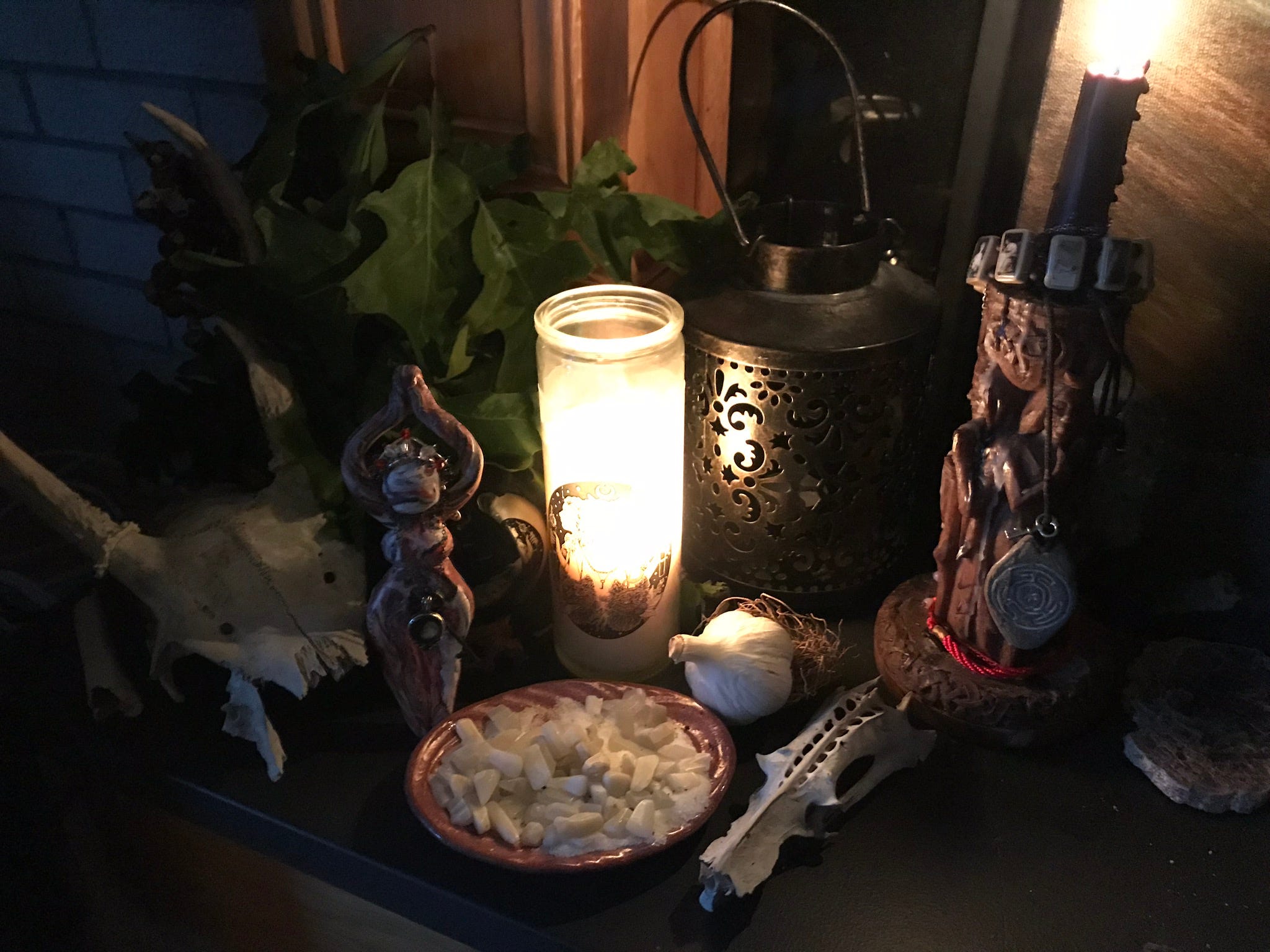
I light this flame as my anchor.
I step into the quiet of your crossroads.
I enter the wheel with my devotion.
I am the empty torch, ready to receive Your fire.
Hail Hekate,
darkness and dawn,
night and the light that ends it,
the cry of enough and the whisper of begin.
I am here.
I am ready.
I start now.
So it is.
Light the candle.
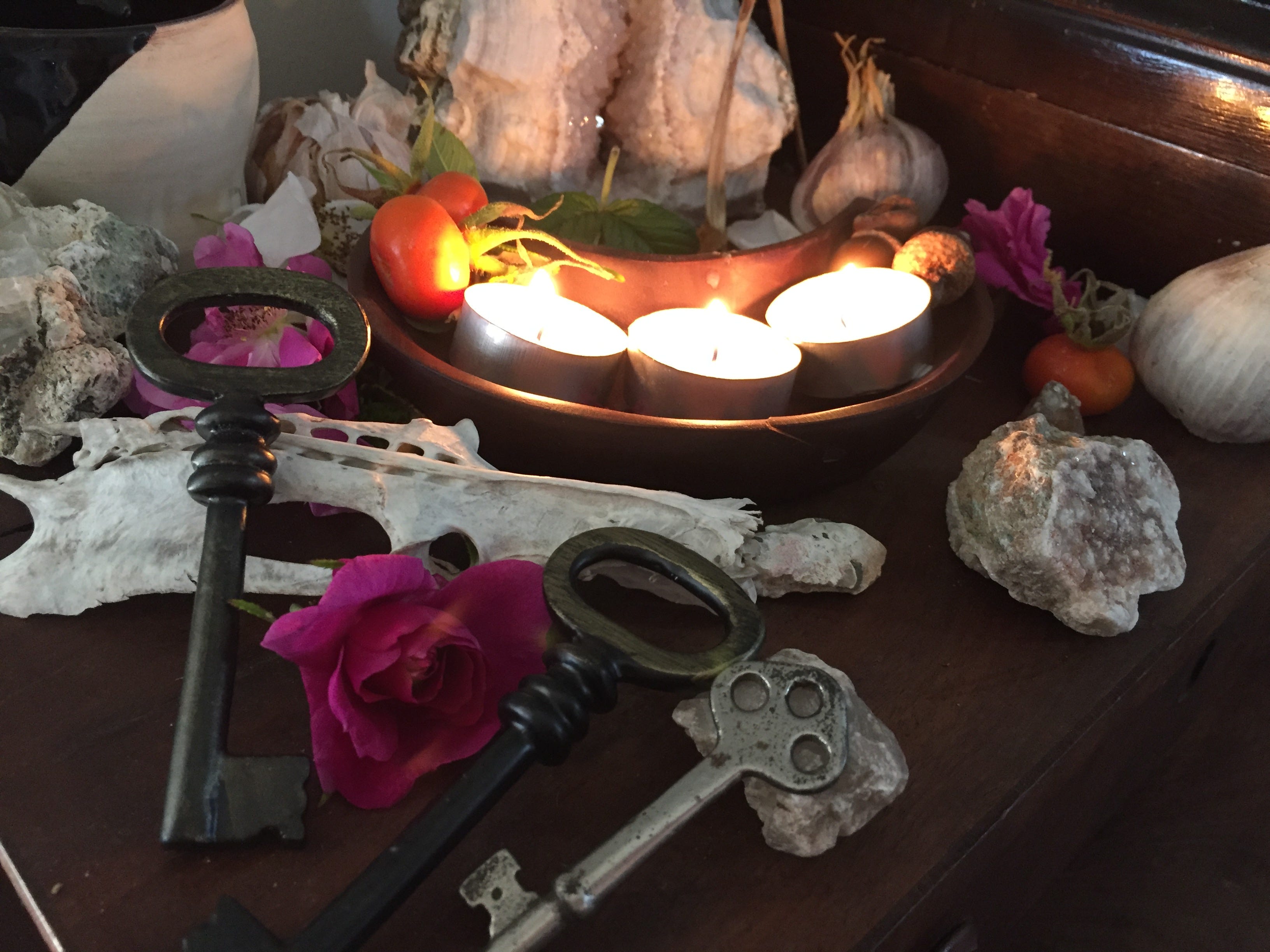
I’ve told the story of when Hekate first spoke to me while I was folding laundry late at night many times, including in the Keeping Her Keys book. It was an ordinary moment that cracked open a deeper world, a true moonlit summons. But if you were to ask me exactly how or when my devotional path truly began, I confess that I don’t know. I recall the moment it began, which was during a conversation with a friend who was a true soul mentor shortly after my moonlit summons. We were texting and I wrote that I wanted to show up in my own life. I recall that around that time, I started going out onto the deck before dawn, lighting a candle and simply sitting there. No performance, no script, no guidelines. She was the flame, and I was the empty vessel.
I didn’t have a plan. As I shared in the introduction to my book, Keeping Her Keys: An Introduction to Hekate’s Modern Witchcraft, my personal life at the time was a hot mess of divorce, financial ruin, and illness. There was no grand ceremony marking the transition from that initial laundry room summons to a dedicated devotee. The practice didn’t arrive with a thunderclap; it crept into my life like the dawn.
That phrase—like dawn—is deliberate. Dawn is the time of day I am naturally drawn to for my personal devotional practice. But more than that, it honors one of my primary epithets for Her: Hekate Erigeneia, the Early-Born, the Daughter of the Morning. In the ancient Greek Magical Papyri, She is invoked as the glory of the night who brings the light of morning to mortals:
“Three-faced Selene, come to me, beloved mistress
Graciously hear my sacred spells:
Image of Night, Watchful One,
Dawn-born light bringer to mortals
Who rides upon fierce-eyed bulls.
Queen, you who drive your chariot
On equal course with Helios,
We dance with the triple forms of the triple
Graces As we revel with the stars.” – Greek Magical Papyri, IV, 2785-2870
NOTE: Selene in the Greek Magical Papyri is often blended with Hekate, Artemis, Persephone, and other goddesses. This collection of fragments (often called the PGM) is a sort of ancient grimoire of spells, rituals, and esoteric knowledge.
Imagine my delight when I discovered this reference in the PGM many moons after my personal dawn practice had begun. Without realizing it, my practice began by mimicking that exact cosmic transition. One day I was just lighting a candle in the pre-dawn time, and some months later, I realized that flame had become my anchor. My life was no longer spiraling out of control. She was holding me in place, while the transformation rooted. By stepping into the quiet space of Erigeneia, I had accidentally stumbled onto a path that would rewrite my entire existence.
And that is perhaps the most accessible definition of devotion I can offer you:
Devotion to Hekate is the intentional practice of turning towards her every day, allowing ourselves to become open to her presence.
I became both sponge and mirror, vessel and transformer. I had been into goddesses, beginning with Artemis when I was a teenager, adding Persephone, Isis and others along the way, yet this was different. I felt like I had finally found my place in the world. I was a sponge, absorbing her personal messages and signs, and also a devourer of any information I could find about her. This was the early 2000s, and there wasn’t much online, but what there was led me to ancient texts like the PGM. I became a mirror, reflecting her presence outwards into all areas of my life. Not with bold proclamations, but quietly as my orientation to how I lived shifted. I saw that I was simply a vessel, and it was clogged with so much debris. The mirror was the cleansing – it was like a pure beam of light symbolized by her torches – that pierced through all my trauma, my performance, and my doubts. That was the transformation. I did show up in my own life. That, for me, is the essence of devotion.
“I whirl the wheel for you; Gaze at me as you gaze at yourself: For I am your mirror…,” PGM IV. 2241-2358
There was a time that I bristled at the word “devotion,” and I certainly didn’t want to be forced into a dogmatic approach. I’d already tried many paths of modern spirituality, and none fit right. Becoming her mirror clicked for me. It was a key. I wasn’t yielding my personal agency, I was actually claiming it. Centering myself in my own life for this first time.
Devotion to Hekate is dedication to following her light-beam along the crooked path of our own authenticity.
Devotion is Commitment
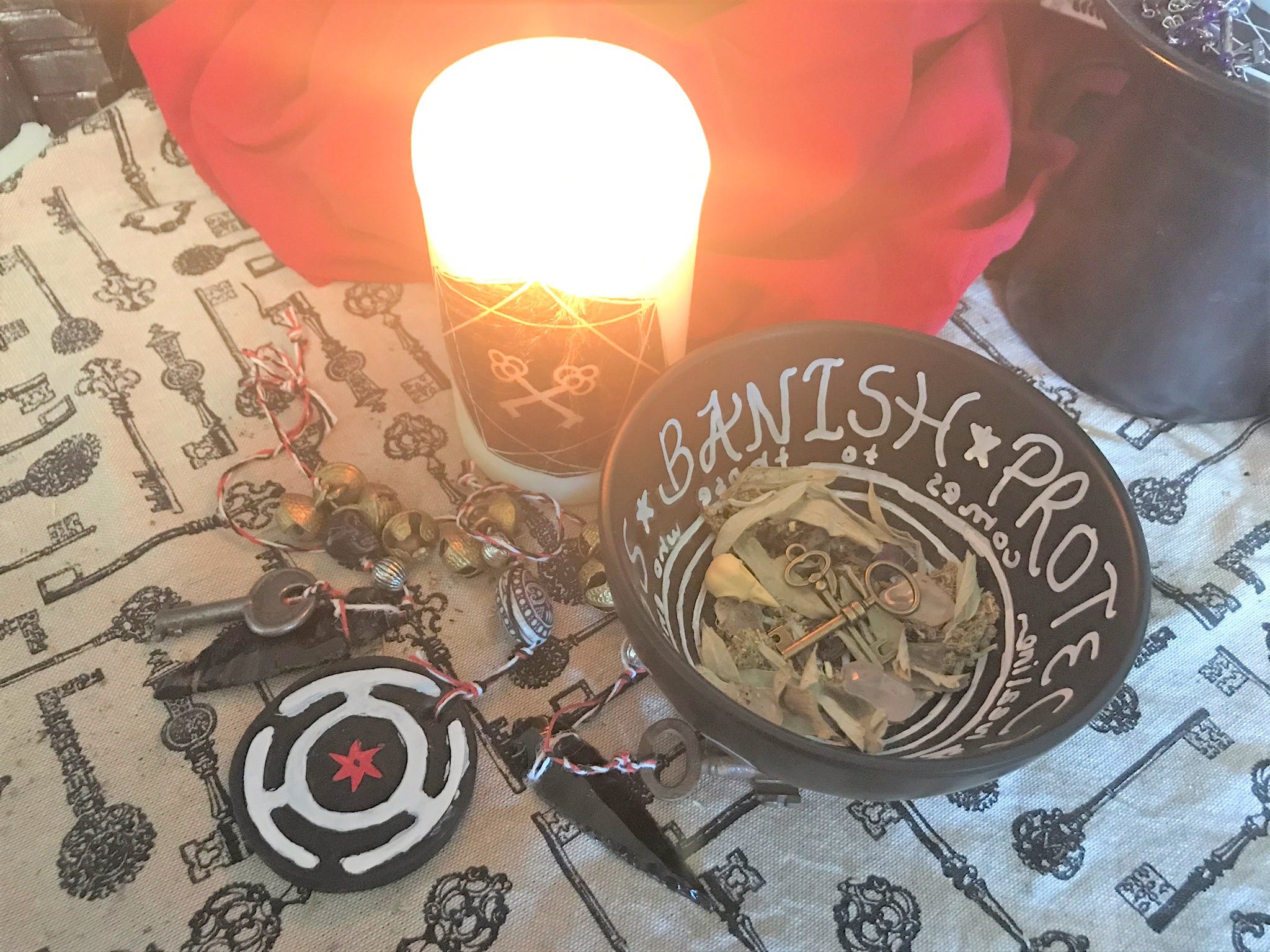
Devotion is the steady, organic commitment to pull back our scattered energy from the noise of the mundane world, light a single spark at the threshold of the day, and look directly into the torchlight of the Goddess to remember who we are beneath our armor. It is a relationship of sovereign reciprocity. We do not bow down to Hekate; we stand upright, communicate with Her honestly from the messiness of our contemporary life, and allow Her sacred fire to hollow us out into a clear, unyielding channel to receive her transmission and live exactly as we are meant to. Looking at times in my life when my daily practice wanes, it has typically been because I was overwhelmed with mundane realities. However, I’ve learned those times are exactly when I need the practice the most.
Hekate is a living force that is both creation and destruction, life and death. As in the excerpt from that ancient PGM spell, she is night and she brings the dawn. Part of the inspiration for my personal devotional journey is that it is a mutually beneficial relationship. A central tenet of my practice is that Hekate is a living Goddess who is completed through our devotion to Her; it is our commitment that renders Her into a form we can truly understand. We filter Her presentation through the lens of our own unique experiences, personality traits, and personal circumstances. As a system of modern witchery, this path is always focused on ‘better living through witchcraft’— the devotional path has been that for me.
“Even now, when an earthly man sacrificing fine offerings makes ritual propitiation, he invokes Hecate, and great favour readily attends him, if the goddess is well disposed to his prayers, and she grants him prosperity, for she has the power to do so.” From Hesiod’s Theogony and Works and Days, translated by M.L. West
While not as juicy as the PGM, I adore Hesiod’s description of Hekate, undoubtedly inspired by his ancestral roots in her worship found in ancient Caria. His words describe Hekate as a Great Mother goddess, who is present in all of the everyday world.
Devotion is a living journey that puts us at the crossroads, where Hekate not only meets us, but we are both transformed.
Devotion is Personal
It may seem radical to believe that my devotion has an impact on Hekate. After all, she is the World Soul, Keeper of Keys and Crossroads Queen. Something I’ve observed in all my years of seeking Hekate is that she is all those things. Those are immutable, yet how one practitioner perceives and interprets these varies greatly. I call this her “fixed fluidity,” and this accurately describes my personal devotional journey. As a scholar of her history, I am witness to how she has been transformed in religious practice, literature and art. How I understand her may vary from someone else’s experience. Devotion has freed me from dogma, opening up to how she is to me, rather than being rigidly confined to what anyone else thinks. I say this as an author and teacher. The system of Modern Hekatean Witchcraft I share is meant to be supportive scaffolding that inspires personal interpretation.
Make the course of my life radiant, weighed down with good things, but drive the evil diseases from my limbs; attract my soul, now madly raging around the earth, once it has been purified through the intellect-awaking rites. - Van den Berg, Robert M. Proclus’ Hymns: Essays, Translations, Commentary
No other ancient text has so influenced my personal devotion more than Proclus’ Hymn to Hekate and Janus. It bears pride of place on the fridge door, so that every time I am in the kitchen, it is with me. Because if your high theurgy cannot survive the heat of the kitchen, it cannot transform your life. Proclus is perhaps a surprising ally of mine, a personal spirit mentor who Hekate brought to me. This is how personal the relationship is. I’ve also found that Hekate does this for others, too. Far from being a goddess that demands a singular focus, she is typically a divine matchmaker, bringing us together with deities and allies that are meant to help our evolution.
Devotion is between you and Hekate, a personal relationship that inspires understanding, not rigid adherence. It is fundamentally dwelling in Hekate’s fixed fluidity.
Devotion is Spiritual Evolution
Devotion is a journey of spiritual evolution, with curves and many bumps along the road. We are shaped by her fire as it merges with that of our own soul. Not only does our mundane life change, but our practice does, too. We gain confidence. We learn to trust our intuition. As magickal practitioners, our workings take on new life, becoming extensions of us. We get centered within ourselves, no longer living through someone else’s eyes.
The strophalos, sometimes called Hekate’s Wheel, is a modern symbol with ancient roots. Inspired by artifacts and relics, but more importantly by ancient practices involving a spinning wheel, known as an iynx. It’s mentioned in one of the PGM quotes I shared earlier. I’ve got my own that I made, merging contemporary symbol with the ancient ‘whirly gig’ structure. I’m bringing this up now because I’ve done devotional cycles focused on whirring this wheel, and also that this is how I personally know her. She is the spinning wheel, emanating from the star-flower at its center.
I see that everyone of us has our own strophalos, too. Each one a small part of the interconnected matrix of the cosmic one that is Hekate’s divine flow. This is our permanent, unborn soul-essence—the fundamental hollowness that represents our eternal core. Devotion is the steady maintenance of this inner star-flower, which leads to spiritual evolution. By this I mean that we expand into Hekate’s field, whether through rituals, meditations, mediumship, healing others, and so on, we dial into her essence and are transformed beyond the physical plane. True spiritual evolution is not about abandoning the mundane to escape to the etheric realm; it is dwelling at the crossroads of both. Like the ancient Pythia, we remain firmly grounded in the dense, shaking realness of the Cave, while our heart center channels the Garden’s alchemical heat, and our crown reaches into the radiant emptiness of the Temple.
The Orphic Hymn to Hekate is evolutionary, taking us on a journey through her powers and paradoxes. Reciting this as part of a devotional practice takes us beyond the confines of the mundane world. If you are feeling drawn to a devotional practice, a moon cycle of reciting this daily is ideal.
Lovely Hekate of the roads and of the crossroads I invoke. In heaven, on earth, then in the sea, saffron-cloaked, tomb spirit reveling in the souls of the dead, daughter of Perses, haunting deserted places, delighting in deer, nocturnal, dog-loving, monstrous queen, devouring wild beasts, ungirt and repulsive. Herder of bulls, queen and mistress of the whole world, leader, nymph, mountain-roaming nurturer of youths, maiden, I beseech you to come to these holy rites, ever with joyous heart, ever favoring the oxherd.
— Orphic Hymn to Hekate; Athanassakis translation
This hymn, for me, is a “soul-stirring ritual,” (thanks, Proclus for that amazing line) that draws me from the horizontal plane of the mundane into the vertical column of transcendence. It pulls me down into the shadows, it lifts me up to the heights.
Devotion is a progressive evolution that merges an aligned everyday life with spiritual expansion into the mysteries.
Devotion is Sacred Ground
In addition to Erigeneia, one of my other primary epithets that are part of my sacred name is Phoinikopeza, which translates as “of ruddy feet.” There are so many layers to what this means in the ancient context. It is related to the adorning of feet with henna and other dyes before rituals, especially by priestesses. Yet also to Hekate being Enodia (of the road), hinting at her feet bearing the evidence of watching over journeys and thresholds. In the Orphic Hymn to Hekate, it is Enodia that is first honored. To follow her road is to walk on sacred ground. Our feet become the embodied testimony to the path. We center ourselves at her crossroads – where the practical magick and human life intersect with the dimension of the deeper world. That is our sacred ground. Our feet are sacred because we walk it. We are not separate, we are marked by her and our devotion. Each time we ground ourselves, standing before a candle or simply pausing in the moment to root into her road, that is devotion. That is sacred ground.
Should you be wondering when to commit to the devotional road, multiple sources from ancient history speak to the first of the month, which, for them, meant the new moon, as being sacred to Hekate. Here’s an example that mentions her as Phoinikopeza:
It was the first of the month when this befell, and the gracious Hekate, the maid of the ruddy feet, was thereby sending us a message that was longing for fulfilment. - Pindar, Paean 2 (trans. Sandys)
When I become the empty vessel, clearing away all the miasma of life, she communicates with me, giving guidance and support. Sometimes, with a tender nudge (Atala is the epithet), while at other times she commandeers my mindscape with roaring proclamations (Therobromon is the epithet).
Devotion is to walk the path that Hekate reveals, intersecting with our own unique experiences, rooted into our own sacredness.
If you are called to devotion, join me for this free class on October 3, 2026 at 11 AM ET. Click the button below to register.
Navigating the Devotional Road
I call this devotional road, “The Via Hekate.” While “via,” can be simply translated as “the way” or “the road,” its most ancient Proto-Indo-European root means “to go, to move, or to transport in a vehicle.”
The word “Via” is a declaration of movement, a linguistic crossroads that bridges vertical theurgical ascension with horizontal, practical everyday magick. Looking at it’s origins, the transition from ancient root to contemporary usage provides the perfect conceptual framework for a modern Hekatean devotee. From its very inception, the word implies active kinetic movement, momentum, and the physical act of carrying a load across a distance. It is the root that also gave birth to words like wagon, weight, and vehement—signifying that the road is a space of weight, friction, and fierce momentum. In ancient Rome, via explicitly denoted a built, prepared highway or road. Unlike a simple track (ita) or foot-path (semita), a via was a structured path engineered to connect major hubs, cross borders, and endure heavy traffic over generations. It was a public domain of exchange, encounter, and literal crossroads. Hekate’s triple nature is linked to such intersections, which the three-way versions were known as trivia to the Romans, which is also how they called upon her.
In late-antique mystery traditions and Neoplatonism, the word was elevated to spiritual geometry. It became the path of the soul’s ascent (Anagoge). The Latin Via became the translation vector for the Greek Hodos (as in Enodia—”She Who Stands on the Road”). It transitioned from a road you merely walk on to a disciplined, sovereign methodology for navigating the architecture of the cosmos. In contemporary language, the word operates simultaneously across physical, prepositional, and metaphorical frameworks. We use via to indicate a conduit or agency (e.g., “communicating via text” or “traveling via London”).
Hekate is the via of our spiritual evolution, she is the conduit that inspires our own agency. As we go deeper into devotion, we expand beyond absorbing the Hekatean current for personal development; we become rooted in Enodia, even being called to serve as a torch-light for others. In modern parlance, “via” is used to describe a chosen method, a practice, or a life-path (e.g., the Via Media or the Middle Path). It stands for a blueprint of living. It is “better living through witchcraft”—turning chronos time into kairos flow, and transforming empty chores into the active physical territory where our soul’s evolution is lived out. A final modern application of “via,” comes from engineering where it is used to describe paths of physical transport, including “vias” on electronic circuit boards—the microscopic vertical holes that allow electrical signals to pass cleanly between different layers of a circuit. This is the exact somatic mechanism of spiritual evolution. We become a conductive wire, utilizing internal “vias” to transcend the ordinary while having our “phoini” feet (“peza”) rooted in the everyday.
The “Via Hekate,” is much more than magick and rituals, it is to attune to her foundational nature as Anima Mundi, the Cosmic World Soul. When the ancient Orphic scribe recorded the hymn, they were dwelling in her thresholds of multiplicities – as a goddess among the everyday, like Hesiod’s depiction, and as the crossroads of the mysteries, found in neoplatonic texts and the divinely transmitted Chaldean Oracles. I wouldn’t recommend these oracles for a beginner, but they are undeniably source code for the transcendent devotion. We can’t achieve true anagoge ascension when we are bypassing human reality; our feet must be firmly planted at the geologic fault lines of contemporary life while our crown reaches into the starry road. Nor can we transcend by chaotic, sporadic, and nondirectional practice. Spiritual bypassing, the rushing for the divine union without steady practice won’t get us far, either.
When we track this axis to Her supreme cosmic origin, the ancient lines crackle with this raw force:
“For Implacable Thunders leap from him and the lightning-receiving womb of the shining ray of Hecate, who is generated from the Father. From him leap the girdling flower of fire and the powerful breath (situated) beyond the fiery poles.”— The Chaldean Oracles, Fragment 53
Rather than this understanding of Hekate being disparate from her Greco-Roman governance of magick, I see it as the explanation. My devotional practice is both mystical and practical magick. There is no separation. Whether I’m crafting pages for my Book of Shadows from scraps of paper to leading ceremonial rituals, it is all in her service. But none of this would happen if I hadn’t answered that moonlit summons.
Devotion is the Via Hekate, but first we must step onto the path, in ways small and large, from a moment of connection to conscious shifting transcendence.
Steps on The Road
I’m sure you’ve heard of the maxim “a journey of a thousand miles starts with a single step,” but what about all the steps that come after? That is devotion – showing up every day, not just for occasional rituals or making hasty new moon offerings. Yet not all steps are equal. There are the times when we feel in lockstep with our spiritual journey and Hekate. There are others when we don’t. Then there are the times when our feet – and our entire beings – feel the heat of her fire. When our ochēma becomes filled with this intense flame, we undergo what I call “spiritual upgrades.” It’s like a leveling up into a new part of the journey. I wrote about these episodes in Entering Hekate’s Cauldron. Here are some of the characteristics:
Somatic & Physical Symptoms
Intense crown or third-eye headaches; a radiating heat that makes our heart center feel literally “on fire”; sleep disturbances and vivid, cinematic dream oracles; fluctuating energy levels and extreme hypersensitivity to lights, smells, colors, and temperatures.
Psychic & Emotional Intensity
Rapidly alternating emotional landscapes; sudden purges of old grief or ancestral burdens; mood swings and a powerful, visceral questioning of our core beliefs.
Relationship Changes
Natural, sometimes painful restructuring of our social environment where we outgrow old attachments and experience a strong urge to detach from relationships that no longer match our frequency.
Look to the Pythia when the heat of this crucible feels overwhelming. The ancient vapors beneath her tripod triggered these exact same physiological reactions. The friction is not a sign of failure or a spiritual attack; it is the natural recalibration of our soul’s luminous vehicle (Ochēma) adapting to hold massive current without shattering.
To survive the heat of the upgrade and step into our authentic power, aligning ourselves through daily practice mitigates these impacts. Hekate often awakens a fierce urgency within those who bear the code of the wild goddesses. She calls us to break away from the false, dead-end roads of a civilized matrix that demands our performative compliance, masks our power, and slanders our names when we refuse to submit.
Two simple, but powerful, practices for transitioning to a new section of her rooted road are favorites of mine, and I’ve witnessed many students successfully evolve with this as part of their devotional practice. Work with them daily, to see how much they can help you shift. These are sort of our own voces magicae—into Her very name:
Enough
Enodia is the sudden, somatic cry of enough. Enough of feeling deeply misaligned. Enough of performing our lives for an audience instead of living them authentically.
E-“NO”-dia
It is the roaring, protective boundary of our Middle Self saying NO to what drains our medicine, NO to the expectations of the mundane matrix, and NO to what no longer serves our expansion. Make a list of all that you are saying NO to as part of your devotional practice.
Hekate is not just waiting for us at the destination; She is the road itself, and She is our directional beam. The Mother Road loops through the Strophalos, taking us into the deep shadow of the Cave to compost our limitations, before slinging us straight up to the Starry Road of the Temple.
She is the darkness, and she is the fire.
She is the cry of “enough.”
She is the sigil written in stone.
She is the silent walking away of the betrayed.
She is the lonely raising arms to the moon.
She is the lie told to live the truth.
She is the secret circle drawing down her moon.
She is the poison that heals.
She is the bold stare into the mirror.
She is the blood shed to bring rebirth.
She is all those who dare to become.
She is the power that is our right. - Entering Hekate’s Cave
To walk the devotional path is to navigate the intense heat, and the quietness of fallow times. For me, it is the key for a life that abides at the crossroads, of the horizontal and vertical. Bringing into attunement my own path with the mysteries. This requires firm scaffolding around how I spend my energy, while being available for what is right for me. I get up before the dawn, I limit my exposure to things that fill me up with useless distractions, and I draw to me that which enriches.
Devotion is boundaries and openness. It is prioritizing our practice in the midst of life’s demands.
The Lineage of the Key Bearers
When we step onto this path, we are participating in a timeless lineage. In the ancient Greek world, a priestess was a Kleidoukhos (Key holder) and a Kleidophoros (Key-bearer). Inscriptions from ancient sanctuaries prove that the temple key was far more than a practical tool; it was a massive, physical insignia of sacred power carried upon the shoulder. To hold the key meant they were the guardian of the threshold, entrusted with the solemn duty of passing from mundane space into the presence of the Divine.
At the great annual festival of the Kleidagogia, the key-bearer would escort a massive, symbolic key in a grand processional march across the landscape, marking the boundary line where the ordinary world met the unvarnished mysteries. Through daily devotion, we enact our own modern Kleidagogia. We don’t need a massive, year-long plan or perfect circumstances to begin.
Hekate will never do for us what we are unwilling to do for ourselves. Light a single candle, step into the quiet of the early morning of Erigeneia, raise our arms to the moon, cry out our sovereign E-“NO”-dia, and step onto the spinning Strophalos of the Mother Road. As you set out on the Via Hekate, she will offer you keys. The Witches Prayer to Hekate, itself a channeled transmission from Her, has found a place in the devotional practice of many. Work with it in its entirety, or break it down into sections:
Mighty Hekate, Queen of the Witches,
My journey is a blessed one,
Each key you give me unlocks great power,
Grateful I am for all your keys
The key of acceptance for that which I cannot change,
The key of courage to overcome adversity,
The key of compassion for myself and others,
The key of pain through which I discovered my own strength,
The key of suffering in which I found healing,
The key of peace that brings me contentment,
The key of wisdom so that I may live a life of truth.
— From Keeping Her Keys: An Introduction to Hekate’s Modern Witchcraft
When I channeled that prayer all those years ago, it was (unsurprisingly) during the pre-dawn hours. I was in direct communion with Hekate, and this verse came both from within me and something far greater. I was anxious about sharing it, thinking how some people get reactionary about the use of the word “prayer,” especially in connection with modern witchcraft. To me, prayer is vital. I did share it. That took trust.
Devotion is trust in the process, the vision to center ourselves at Hekate’s Crossroads.
That is all.
Light the candle.
I am the empty vessel, and she is the flame.
To learn more about the seven-month course I teach called The Via Hekate, click the button below.